When Delivering the Milk Could Get Tricky

Nathaniel K. Roberts was a busy man in the 1880s. He had a 280-acre ranch in the western end of the San Pasqual Valley where he, his wife and three children raised wheat, barley, honey, dairy products, and poultry.

“He has twenty-five cows in excellent condition and butter is one of the principal productions of this ranch,” stated an article about north San Diego County farmers in the August 22, 1883 edition of the San Diego Union.

Roberts apparently delivered some of his products personally to customers, utilizing a wagon drawn by a team of draft horses. That could get a little tricky in bad weather, especially if you had to cross a river. Without a bridge.

In the late 1880s Roberts delivered milk to customers in the newly developing town of Escondido. That meant crossing the San Dieguito River, which in those days was still undammed and unbridged and, if there was a period of heavy rain, unpredictable. Here’s an anecdote from the 1949 book, San Pasqual: A Crack in the Hills, by Mary Rockwood Peet, a member of another longtime San Pasqual Valley ranching family:

“During a heavy rain that raised the river, Mr. Roberts stayed in town for two days and then decided he must go home,” wrote Peet. The Rockwood farm was on the other end of the valley from Roberts’ place, but he chose to cross there “because the quick-sand was less troublesome than at either the ‘middle’ or ‘lower’ fords.”

“He stopped at our house and my father tried to persuade him to wait until it seemed safe, but Mr. Roberts was determined to try it,” she wrote.

Peet doesn’t say just how high the flooded river was, but she noted that some of her family’s ranch hands “tied a long rope around his waist” and proceeded to hold on to the rope as Roberts “plunged his fine team of Clydesdales and sturdy wagon into the swift stream”.

Roberts guided the horses “slightly upstream against the current but hit the opposite bank a little too high,” Mary wrote.

The two-horse team lunged for the top of the bank but, “one slipped back,” Peet reported. “The men holding the rope and those watching on the north shore held their breaths.”

Fortunately, “with a little urging from the driver, the faithful animals made another trial and climbed to safety. Mr. Roberts threw off the rope and with a wave of thanks, proceeded on his way home.”

Get Updates Automatically-Become A Follower of the San Diego History Seeker

You can get updates of San Diego History Seeker automatically in your email by clicking on the “Follow” button in the lower right corner of the blog page. You’ll then get an email asking you to confirm. Once you confirm you’ll be an active follower.
“Fortress of Cobblestones”

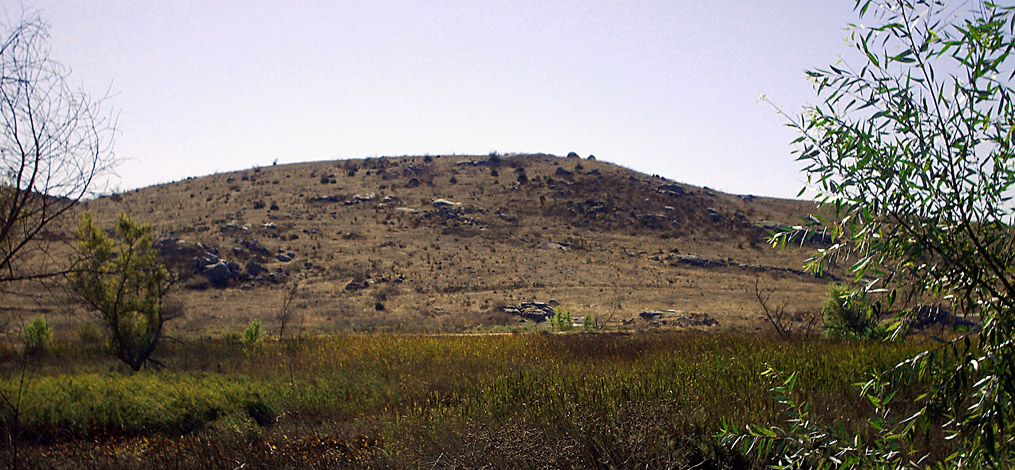
“Castillo de Guijarros” literally means castle or fortress of cobblestones in Spanish. That’s the name the Spaniards gave to a rocky point overlooking the entrance to San Diego Bay when they took possession of the area in the late 1700s. When they erected a fortification to protect the harbor from invaders in 1797 they named it after the boulders strewn about it. During ensuing decades American sailing ship captains took to using some of those cobblestones to serve as ballast for their ships on voyages around Cape Horn. So in time the site took on a new name: Ballast Point.

The site has seen archaeological excavations as well as other research by military historians and the whaling industry. This summer that research and its results will be the subject of an exhibit at the San Diego Archaeological Center, “Ft. Guijarros: Soldiers, Yankee Whalers, and Fisherfolk.” To find out more, you can email the center’s Collections Manager, Dr. Adolfo Muniz, at admuniz@sandiegoarchaeology.org .

Get Updates Automatically-Become A Follower of the San Diego History Seeker

You can get updates of San Diego History Seeker automatically in your email by clicking on the “Follow” button in the lower right corner of the blog page. You’ll then get an email asking you to confirm. Once you confirm you’ll be an active follower.

The Birth of “Branding”

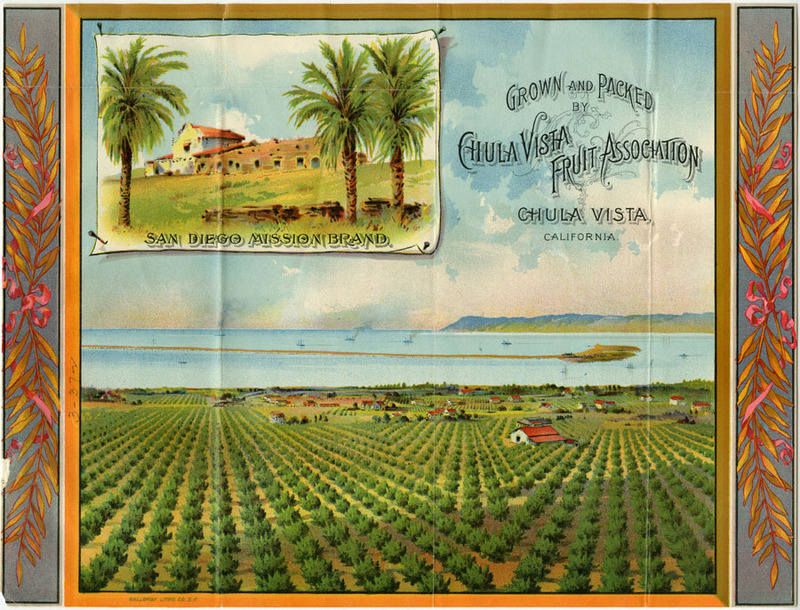
Here’s a cool image, courtesy of the California State Archives.

 SDMissionBrandLabel


Nice shot there of Chula Vista as it once was, along with the original Mission San Diego de Alcala and Point Loma in the background. The label also represents a lesson in branding history. It’s part of a collection of trademarks filed with the California Secretary of State’s office between 1861 and 1900. There are nearly 4,000 of these images on file, and they were digitized and released online by the state this past April 21, thanks to a grant from the U. S. National Archives’ National Historical Publications and Records Commission (NHPRC).

I’ll be revisiting this website, called California’s Old Series Trademarks, on future posts for sure. For now, if you’d like to check it out, visit http://www.sos.ca.gov/archives/trademarks  .


The Power of the Press?

The city of San Diego’s first newspaper was the San Diego Herald, whose initial issue appeared on May 29, 1851.

“The Herald was at first a four-page four-column paper, published every Thursday,” according to William E. Smythe’s 1908 book, History of San Diego: 1542-1908.

A newspaper just four pages in length might sound short today, but in the context of printing technology at the time, and the limited readership in a then-small town, it was state-of-the-art.

Another feature of the paper which might be a surprise to today’s readers but was standard in papers of the day was an unclaimed letters column. And it was a big one.

The very first issue of the Herald, Smythe wrote, “included a list of 320 letters which had accumulated in the San Diego post office.” It filled “five and three-fourths columns.” That’s almost a page and a half of a four-page paper.

Interestingly, Smythe noted that while two columns were devoted to advertisements for local businesses, ads for San Francisco businesses took up “eight and one-fourth columns,” or roughly two and a quarter pages, again in a four-page paper.

Of course, again, San Diego was a small town with a small business community whose residents might need to buy certain goods from San Francisco firms. But another factor was at play here. It seems that the Herald’s editor and publisher, John Judson Ames, had a lot of contacts among the movers and shakers in San Francisco. In fact, Smythe noted that Ames “spent all the time he possibly could in San Francisco.”

One of Ames’ San Francisco contacts was James Gwin, then a United States Senator from California who supported a proposal to divide the state, annex Baja California and the Sandwich Islands and “make San Diego the capital of the territory,” according to 1982 essay by Teri Thorpe in The Journal of San Diego History. The scheme also involved “the construction of a southern transcontinental railroad terminating at San Diego.”

Gwin’s and Ames’ plan never came to fruition. And an 1860 a gold strike near San Bernardino led Ames to pack up his press and move up there, where the paper became the San Bernardino Herald. San Diego would be without a newspaper for the next eight years.

Get Updates Automatically-Become A Follower of the San Diego History Seeker

You can get updates of San Diego History Seeker automatically in your email by clicking on the “Follow” button in the lower right corner of the blog page. You’ll then get an email asking you to confirm. Once you confirm you’ll be an active follower.

La Presa – 1889

The Otay Press of Chula Vista published a lengthy letter-to-the-editor in its issue of April 18, 1889. The letter writer, identified as “Hal,” was touting his home town of La Presa.

“If there is a lovelier spot on the face of nature than the region around La Presa presents today,” Hal began, “it is worth taking a great deal of trouble to see; for certainly the combinations here are enchanting.”

The beautiful scenery “owes but one feature to it,” he wrote. “That feature, however, is important. It is the Sweetwater Reservoir.”

Here, you could say, borrowing a contemporary term, Hal riffed on the reservoir:

“It is dam full of water. I mean it is full of damned water—that is to say that the great dam dams the water and therefore the water is dammed.”

He then goes back to a more traditional message.

“It makes a beautiful lake three miles long by a mile wide. The surface of Spring Valley and the surrounding hills is covered with wild oats…. clover and bespangled with flowers. For a week past the mower has been gliding through the rank vegetation; the horserake following, and thousands of hay cocks are dotting the hillsides and valleys.”

The Sweetwater Dam, which created that reservoir, had been dedicated just one year earlier from the time Hal wrote his letter, and La Presa was just beginning to develop.

“Nearly two months ago Mr. Schaeffer received an appointment of postmaster here,” the letter continued. “He immediately sent on his bonds and there the matter rests. We are patiently waiting for the establishment of our postoffice and a daily mail. In the meantime our mail is forwarded from National City with semi-occasional regularity.”

Get Updates Automatically-Become A Follower of the San Diego History Seeker

You can get updates of San Diego History Seeker automatically in your email by clicking on the “Follow” button in the lower right corner of the blog page. You’ll then get an email asking you to confirm. Once you confirm you’ll be an active follower.