Thank You Dave

I learned recently of the death, on November 12, of David Kreitzer at the age of 94. I first learned about Dave through his volunteer work in the local history and environmental communities in San Diego County. In 1984, as a volunteer member of the Rancho Bernardo Historical Society, I conducted an oral history interview with Dave. He was one of Rancho Bernardo’s earliest residents, moving there in 1965, when the area was just beginning its transformation from cattle ranch to planned community.

“The place was gorgeous,” he said in another interview years later for one of my research projects, speaking of his then-new Greens East neighborhood. “We had cattle grazing behind us. One night I went out in the backyard and caught the eyes of some coyotes in the beam of my flashlight.”

He’d come west with his wife and young children after his job in the textbook division of publishing house Harcourt Brace (now Houghton Mifflin Harcourt) was transferred from Minneapolis to San Diego. He enjoyed working in publishing, the field he would remain in until his retirement in 1991. But his original college degree was in botany, and his new community rekindled a love of open space and a concern for its preservation, motivations Kreitzer would act on as a volunteer for the rest of his life.

His civic involvement began with attending meetings of the Bernardo Home Owners Corporation (BHOC), Rancho Bernardo’s first homeowners association. By the mid-1970s he would be elected vice-president of the BHOC, and by the late 70s had helped to establish the Rancho Bernardo Town Council, which later evolved into the Rancho Bernardo Community Council.

In 1984 Kreitzer was asked to chair San Diegans for Managed Growth, an organization which had sprung up in response to a San Diego City Council-approved plan for a massive development in what is now the 4S Ranch/Black Mountain Ranch area. San Diegans for Managed Growth, which included members of the Sierra Club and the League of Women Voters, waged a campaign which put Proposition A on the ballot, calling for a city-wide vote on any zoning changes in areas considered part of the city’s urban reserve.

Prop A passed with 54 percent of the vote and helped set a new standard for “smart growth” in local development. Dave continued to pursue his vision, helping to develop two ordinances, on the county and city level respectively, to protect steep slopes, wetlands, streams, sensitive habitat lands and flood plains. Those measures passed and remain in effect today.

In the late 1980s, while serving on the County Planning Commission, he also became a member, and one of the leaders, of the San Dieguito River Valley Conservancy. This group effort led to the the creation of the San Dieguito River Park, preserving 55-miles of the San Dieguito River’s watershed from Del Mar ot Julian as permanent open space.

In 2005 the San Dieguito River Park named him Volunteer of the Year. Four years later, in 2009, when the River Park and the San Dieguito River Valley Conservancy were ready to open a graceful new bridge for pedestrians and bicyclists across Lake Hodges, they chose to name it the David Kreitzer Lake Hodges Pedestrian and Bicycle Bridge.

Into his later years, he was still literally a hands-on volunteer. I recall him in 2012 joining some other volunteers in whitewashing the walls of the farmhouse at the Sikes Adobe Historic Farmstead, one of the historic sites preserved within the River Park. For a time in the 2010s, he was volunteering once a week at another site in the river park, the Santa Ysabel General Store.

Thank you Dave, for reminding us, and helping to preserve, some of the nature and history around us.
The Snail on the Mountain

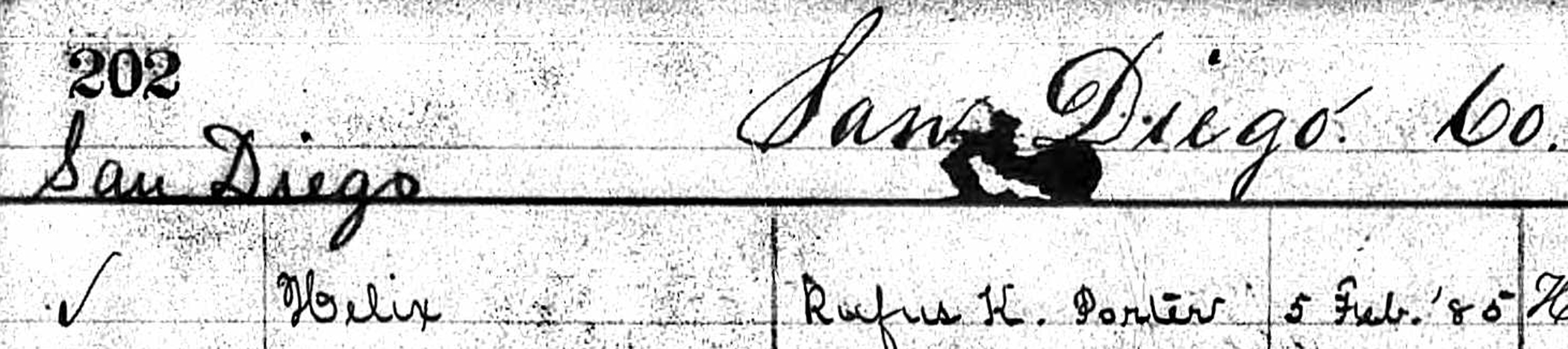
Below is a part of a record from Appointments of U.S. Postmasters, 1832-1971, covering San Diego County, from the database of the National Archives and Records Administration:

It shows that a post office named Helix was created on February 5th, 1885 with Rufus K. Porter as postmaster.

As was often the case in the county in those days, this post office was on a ranch owned by Mr. Porter, who’d acquired some acreage in 1865 in the area which we today know as Spring Valley.

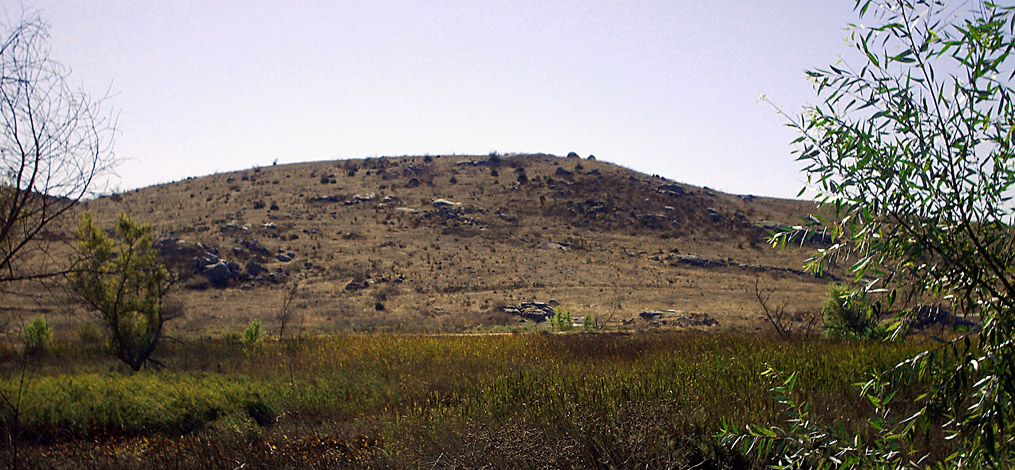
According to the account most accepted by historical researchers, the name Helix was attributed to Porter himself, inspired by a discovery on the trail leading from his ranch up a certain local mountain. As Porter’s daughter Rufina Porter Crosby stated in a memoir in the 1930s, “In traveling over the mountain one day he picked up some snail shells, and in Latin Helix means snails-thus the name.”

Helix aspersa was at that time the Latin name for the brown garden snail, today called Cornu aspersum. Porter clearly chose to call both his ranch and the mountain Helix.

In 1909 the name of the post office was changed to Spring Valley. The mountain’s name has remained Helix to this day.

In addition to the aforementioned National Archives database, sources for this post included the book San Diego County Place Names A to Z by Leland Fetzer, historic San Diego newspapers, and Featured Creatures, a database cooperatively run by the University of Florida’s Entomology and Nematology Department and the Florida Department of Agriculture and Consumer Services Division of Plant Industry.

A Lake of A Certain Name

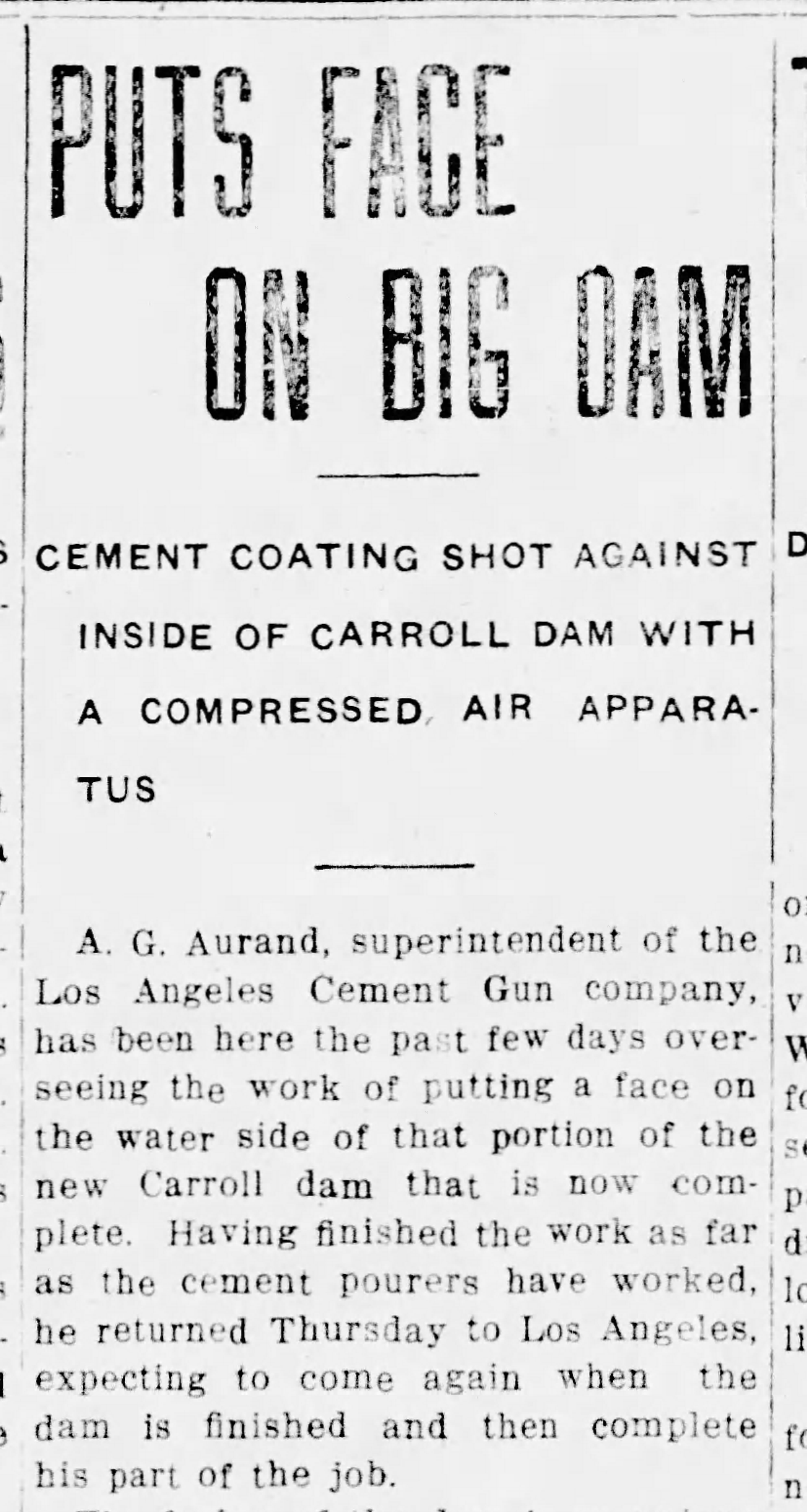
Below is a headline and portion of an article from the Escondido Weekly Times-Advocate of February 18, 1918. It tells about the application of a cement coating to “that portion of the new Carroll dam which is now complete.”

There are a number of references to the construction progress of the “Carroll Dam and Reservoir” in local papers during that time period. Even before the dam was officially completed, another name for the lake started popping up in local media. Local history evolves and takes local placenames with it. In this particular case, two local farmers who also happened to be brothers, James and Thomas Carroll, had adjoining farms in an area called Crescent Valley, which had also come to be known as Carroll Canyon. Then along came the San Dieguito Mutual Water Company, with a project to dam up part of the San Dieguito River to create a more consistent water supply for the development of the city of San Diego as well as other adjacent county communities.

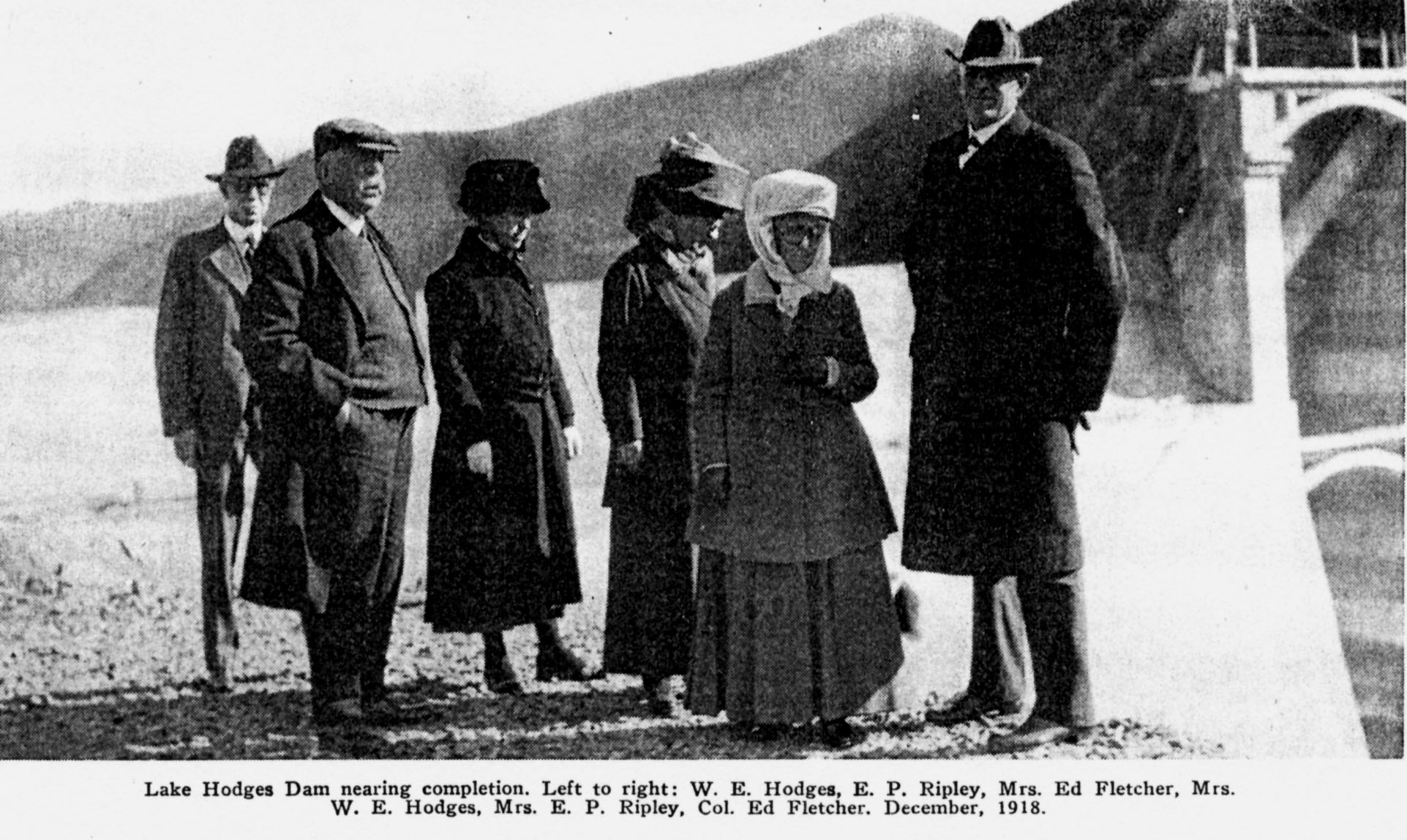
Ed Fletcher was one of the leaders of the San Dieguito Project, along with several executives of the Santa Fe Railroad, which owned considerable property in the county which the railroad wanted to see developed. One of those executives was the Santa Fe’s vice-president, a man named W.E. Hodges. At a dinner meeting not long before the dam was completed, Fletcher is said to have asked, “Why not call it Lake Hodges?” Hodges, according to one historical account, “reluctantly agreed.”

While providing a plentiful water supply for San Diego County’s development, Lake Hodges would also submerge a good part of the Crescent Valley, including the farms of the Carroll brothers.

Here’s a photo of Ed Fletcher, on the far right, and W.E. Hodges, on the far left, along their wives and one other San Dieguito official at the dam site in December, 1918:

Sources for this post include the privately published Memoir of Ed Fletcher, the book San Diego County Place Names A To Z, by Leland Fetzer, the archives of the Rancho Bernardo Historical Society, and historic San Diego newspapers.

What’s in a name? The four Stowes.

Portion of table of contents of 1918 San Diego County Brand Book showing the livestock brand registered to W. J. Stowe (misspelled Stone here). Courtesy of History Office, San Diego County Department of Parks and Recreation.

“Los Angeles man buys ranch near Bernardo,” was the headline of an article in the San Diego Union of August 3, 1918.

“W. J. Stowe of Los Angeles,” the article began, “who has bought 3,000 acres of the ranch of the Eucalyptus Culture Company, four miles southeast of Bernardo, and who has rights on 325 additional acres, has taken possession of the property and is lending his personal supervision in the making of important improvements.”

In addition to growing hay and grain, Stowe intended to keep a large herd of cattle. Livestock was big business in San Diego County at the time. Like all other livestock ranchers, Stowe had to register a brand for his livestock with the county. Below is an excerpt from the page of the county brand book for October 1, 1918 recording Stowe’s appearance:

The brand he chose represented the four Stowe family members living on the ranch and helping to run it: William J. Stowe, his wife Ada (who was listed as the official purchaser) and his sons Perry and Gardner. William’s elderly mother and mother-in-law were also in the household, but not involved in running the ranch.

The Stowe family would sell the ranch within a few years, but their “brand” remains on 4S Ranch to this day. 

Many thanks to Ellen L. Sweet and Jennifer A Grahlman, intrepid history detectives at the History Office of the San Diego County Department of Parks and Recreation. They mentioned the origin of the 4S name in their 2017 book, San Diego County Parks: Over 100 Years, The 1918 brand book is happily preserved in the History Office archives.

Other sources for this post were the websites Genealogy Bank and Ancestry.com.

Get Updates Automatically-Become A Follower of the San Diego History Seeker

You can get updates of San Diego History Seeker automatically in your email by clicking on the “Follow” button in the lower right corner of the blog page. You’ll then get an email asking you to confirm. Once you confirm you’ll be an active follower.

A County View 136 Years Ago

The photo above, labeled, “View in Poway Valley,” appears in the book, Picturesqe San Diego. Authored by Douglas Gunn and published in 1887, Picturesqe San Diego offers historical snapshots, in both text as well as photos, of San Diego County as it appeared then. The book’s section on the Poway Valley (there was no incorporated city of Poway at that point) refers to the area as a “rich agricultural valley” with a population of “about 800” (compared to an estimated 48,000 in the city of Poway today).

The Poway Valley then had, according to Gunn, “as choice farming lands as can be found in any part of Sourthern California.” In addition to hay, grain, and various varieties of grapes, “Poway peaches are especially noted for size and flavor,” the book said, adding that “Bee-keeping is profitably carried on, a choice grade of honey being produced. Fine cattle are kept, and butter-making is a paying industry.”

The 97-page book includes 72 photos like the one above, showing a very different San Diego City and County from the ones we know today.

There are print copies of Picturesque San Diego available at a few local libraries, but only in-house in the reference area. There’s a downloadable copy available online on the  Internet Archive website at https://archive.org/ .Or you can check out my upcoming Oasis lecture, “Picturesque San Diego: Images and Stories From the Past,” on Wednesday, July 12, at 10 a.m. at the Oasis Lifelong Learning Center at Grossmont in La Mesa. If you can’t make it to Grossmont, I’ll be giving the talk again on August 11 at 10 a.m. at Oasis’ new Rancho Bernardo campus, one of a number of talks on various aspects of local history I’ll be giving in RB in July and August. For further info and to register, visit https://san-diego.oasisnet.org/ and click on “Classes.” Come join me for some San Diego history!