
Subscribe to continue reading
Subscribe to get access to the rest of this post and other subscriber-only content.
Subscribe to get access to the rest of this post and other subscriber-only content.
Readers of this blog know I often find old newspaper articles can offer historical snapshots of our region. So I decided to look at what was being reported in San Diego newspapers exactly 150 years ago to the month. On page 3 of the April 22, 1874 issue of The San Diego Union, within a routine report of the previous night’s meeting of the San Diego Board of Trustees (today’s City Council), it noted board approval for the purchase of a new fire engine. The article quoted one trustee as saying he had “heretofore been opposed to appropriating any money for this purpose” as “he did not think the city was quite ready for it.” (To see the original wording from the board meeting, readers can go online to sandiego.gov/digitalarchives and select 1850-1874 Minutes and Ordinances, p.411, Image 445).
“But now,” the article continued, “the water had been brought into the streets, and several persons had put in fire plugs; others were preparing to do so.”
“Under these circumstances,” the Union article continued in reference to this particular trustee, “he was prepared to modify his opinions; the time had now come when a reasonable expenditure for fire apparatus could properly be made.”
Only a year before, in January 1873, had the San Diego Water Company, the city’s first, been incorporated. It started by digging a well at 11th and B Streets downtown. Over the next decade and a half, under contract to the city, the company would dig 11 more wells in the San Diego River and create two reservoirs to supply a growing city.
And that’s just the start of the story. Or, you could say, if you’ll excuse the pun, the start of the whole dam story.
In addition to historic San Diego newspapers and the San Diego city archives, sources for this post included the 1908 book History of San Diego: 1522 to 1908, by William E. Smythe, the 1922 book City of San Diego and San Diego County: The Birthplace of California, by Clarence Alan McGrew, and the 2023 book, To Quench a Thirst:A History of Water in the San Diego Region, by the San Diego County Water Authority.
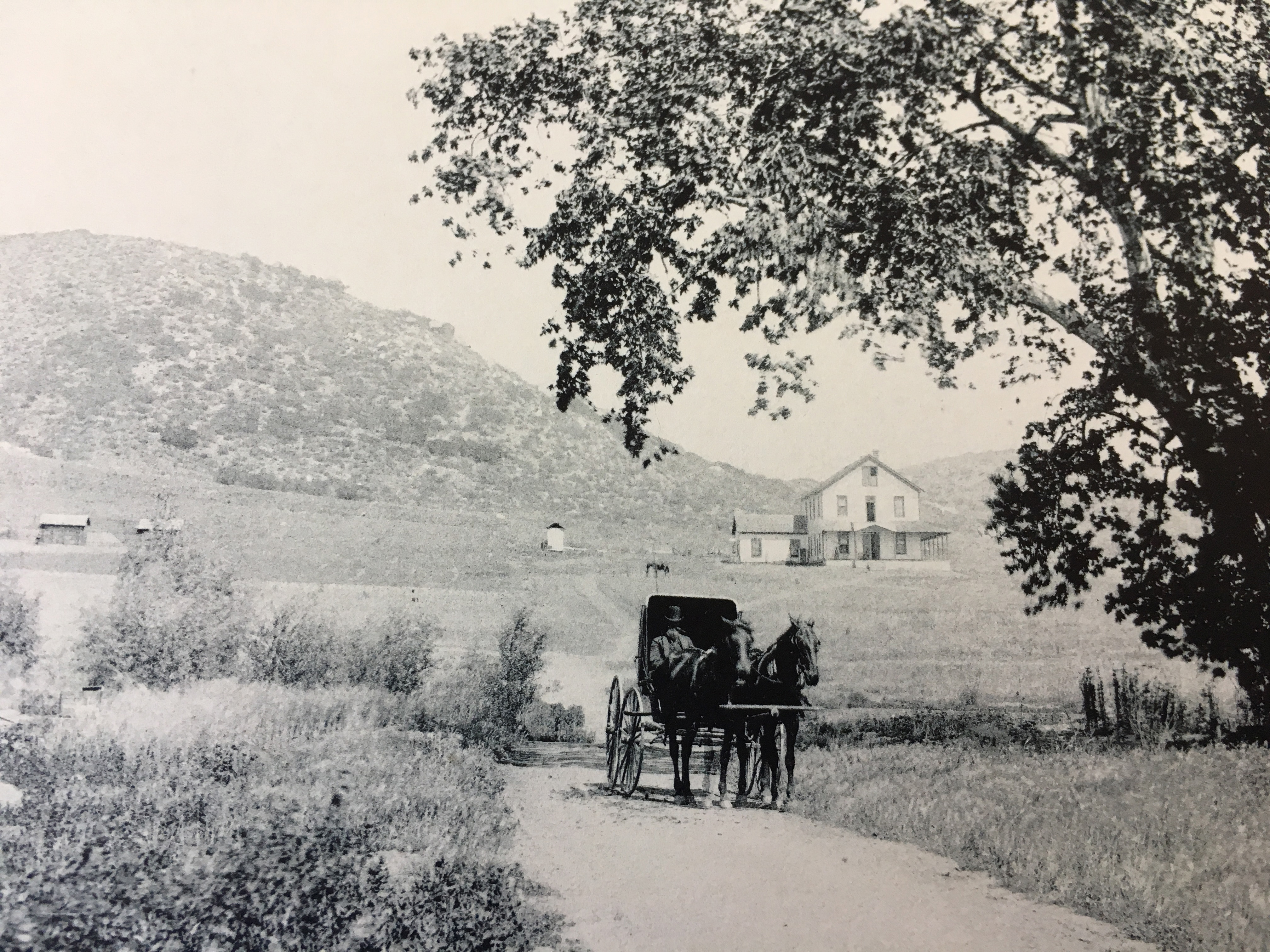
There was a time when farm livestock outnumbered human beings in San Diego County, a time when much of the county looked like the photo below of Poway Valley from 1887:
Join me on April 1 at Ranch Bernardo Oasis as I present stories and slides from my research into our county’s agricultural history and the role agriculture still plays in our lives today.
To sign up for the class, you can go online to https://san-diego.oasisnet.org/san-diego-oasis-at-rancho-bernardo/, click on “Classes” and find “Class # 2289, San Diego County’s Agricultural History.” Or you can call 858-240-2880 and tell them you want to sign up for that class number and name. See you then!
In March in San Diego County, 151 years ago, it was rodeo time, as exemplified by the notice below from the San Diego Union of March 21, 1873:
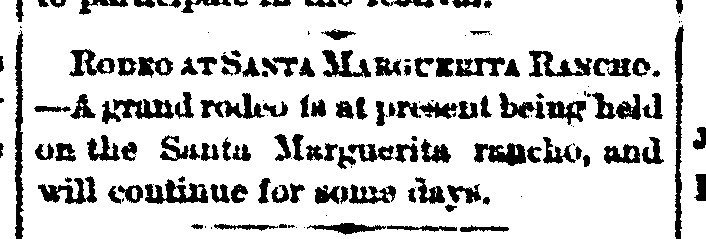
Back then, this wasn’t a public entertainment event. It was all business, part of the cattle business, to be exact. As Charles Nordhoff, a prominent journalist of the day, wrote in, California: A Book for Travellers and Settlers, which was published that same year, “Every spring, in the cattle country, rodeos are held. Rodeo comes from rodeár, the Spanish verb to gather or surround. A rodeo is, in fact, a collection of cattle or horses, made to enable the different owners to pick out their cows, count them, and, if they wish, drive them off to their own pastures.”
Nordhoff added that, “Sometimes, 20.000 head of cattle are gathered on a plain, and the work of ‘parting out,’ as it is called, and branding, lasts for several days. A carefully defined set of laws regulates this work, and law officers, called ‘Judges of the Plains,’ attend to settle disputes as to ownership, and regulate the procedure. These officers appoint the times and places of rodeos, and attend at each.”
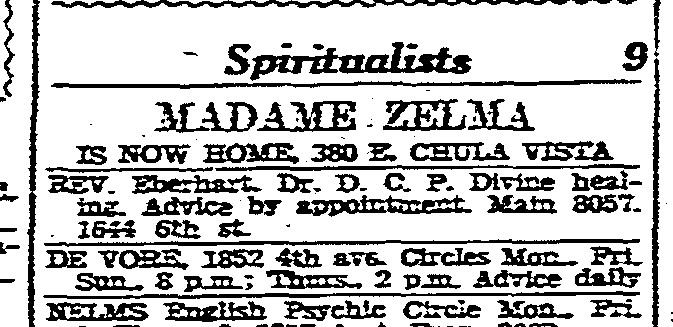
Excerpt from ad in San Diego Evening Tribune, October 10, 1934.
She was a psychic. And long before psychic hotlines, clairvoyants and mediums of various kinds were in demand, including in San Diego. How much in demand? The archives of the San Diego City Clerk’s Office include a copy of a “clairvoyance and palmistry license” issued in June 1910 to one individual, and the archive blog notes that there are “multiple similar licenses” on file.
“Madam Zelma, Truthful in her predictions, Reliable in her advice,” was the heading of a classified ad that appeared on page 23 of The San Diego Union on Sunday, November 5, 1911, informing readers that “the noted clairvoyant and medium, who acquired such a wonderful reputation for her remarkable predictions and her sensational demonstrations which startled and amazed hundreds for the past two seasons at Coronado Tent City, is now located permanently in San Diego.”
In one ad, shown below, from the Union in January of 1912 on a lecture she gave at the U.S. Grant Hotel, Zelma used a last name of Dentt. Your History Seeker team used that to find some background information on her and her husband Frank Dent (proper spelling) including their move from San Francisco to San Diego in the fall of 1910:
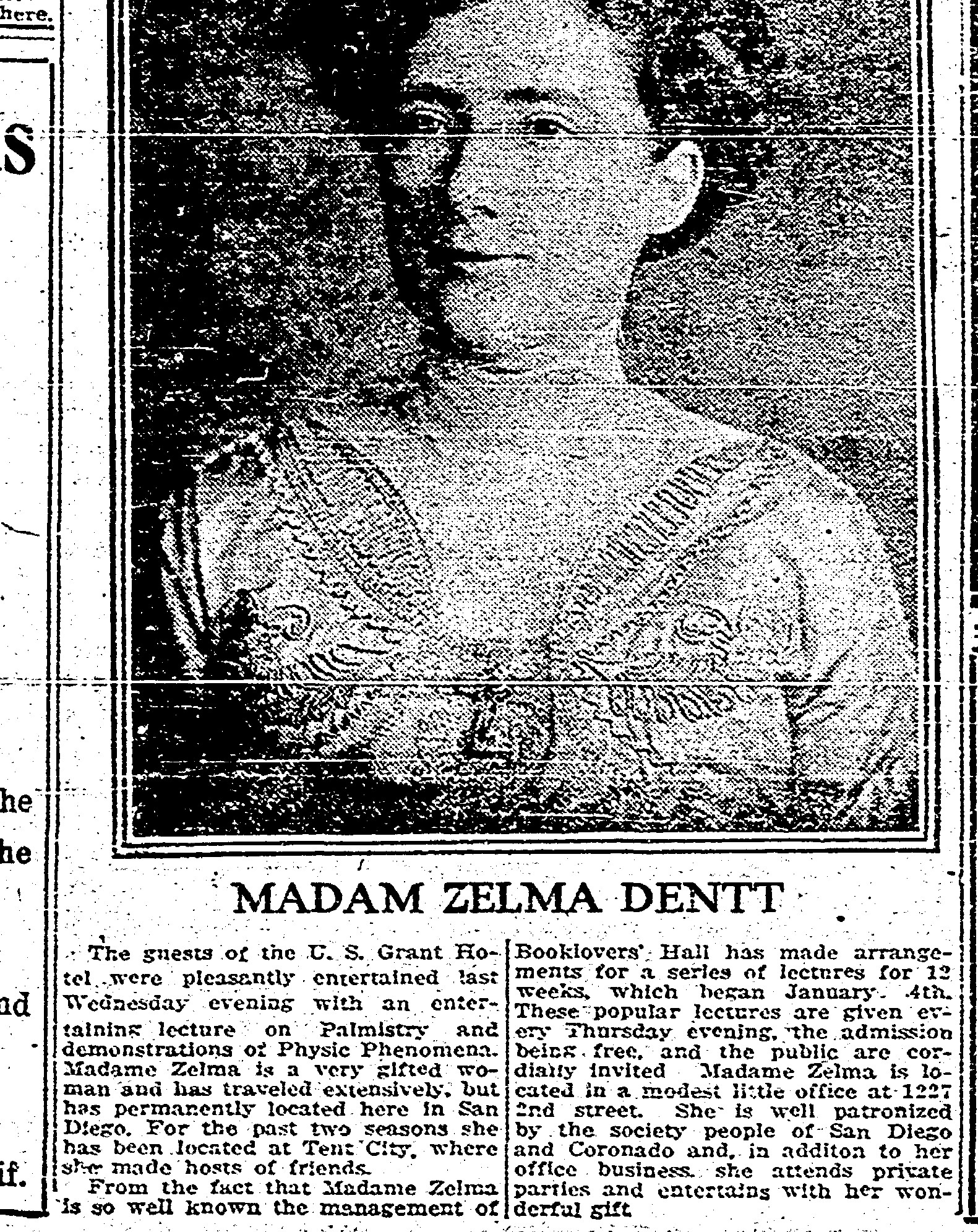
Judging by her media coverage, Zelma maintained her psychic business in San Diego from the 1910s until 1934, with ads that appeared pretty much weekly in San Diego papers during those years. The ads disappear after 1934. Interestingly, our attempts to find other info about Zelma and/or Frank in San Diego during that period, from census data to city directories to voter lists to obituaries, have come up blank. An early census we did find for the Dents, from 1910 in San Francisco, just before they moved to San Diego, gives Zelma’s age as 25. That would make her 49 years old when she ceased running pychic ads in 1934. So what became of her? Any psychics out there with any clues?

