“The Week in Pacific Beach” was a regular column in the San Diego Union in 1905, and the column on Tuesday, November 7th, included this item:
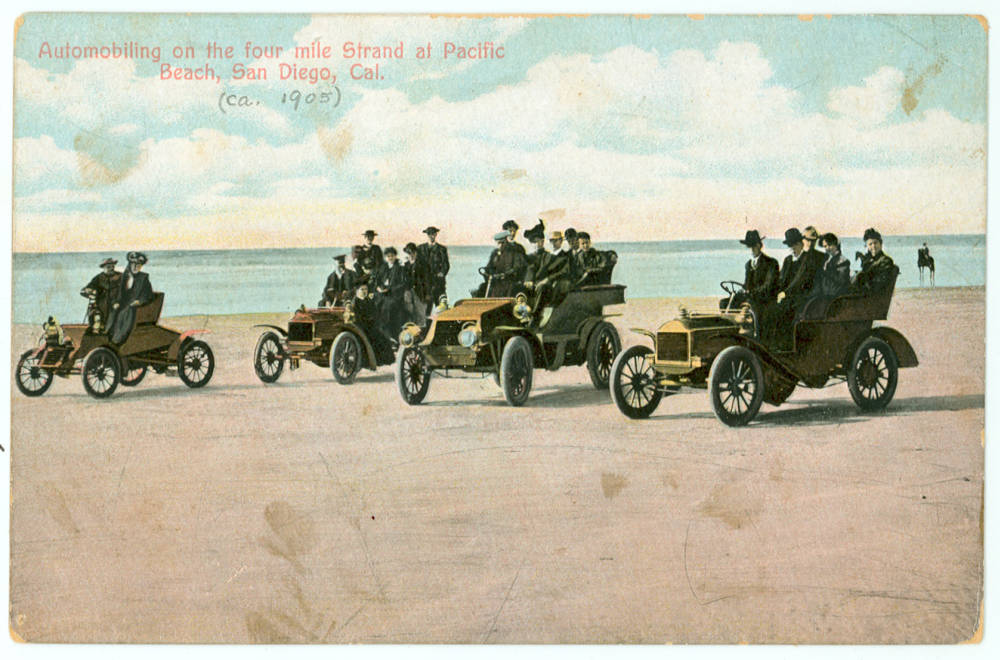
“Oliver T. Parker and Captain Jonas Parker of Lowell, Mass., are frequently seen automobiling on the strand.”
The Parkers were not alone. Take a look at this postcard from the same year:
That image is courtesy of the San Diego Public Library, which has a collection of over 5,000 postcards. The introduction to the collection on the library’s website states, “In the past postcards were the original Social Network. It was the easiest way to share images and quick thoughts.”
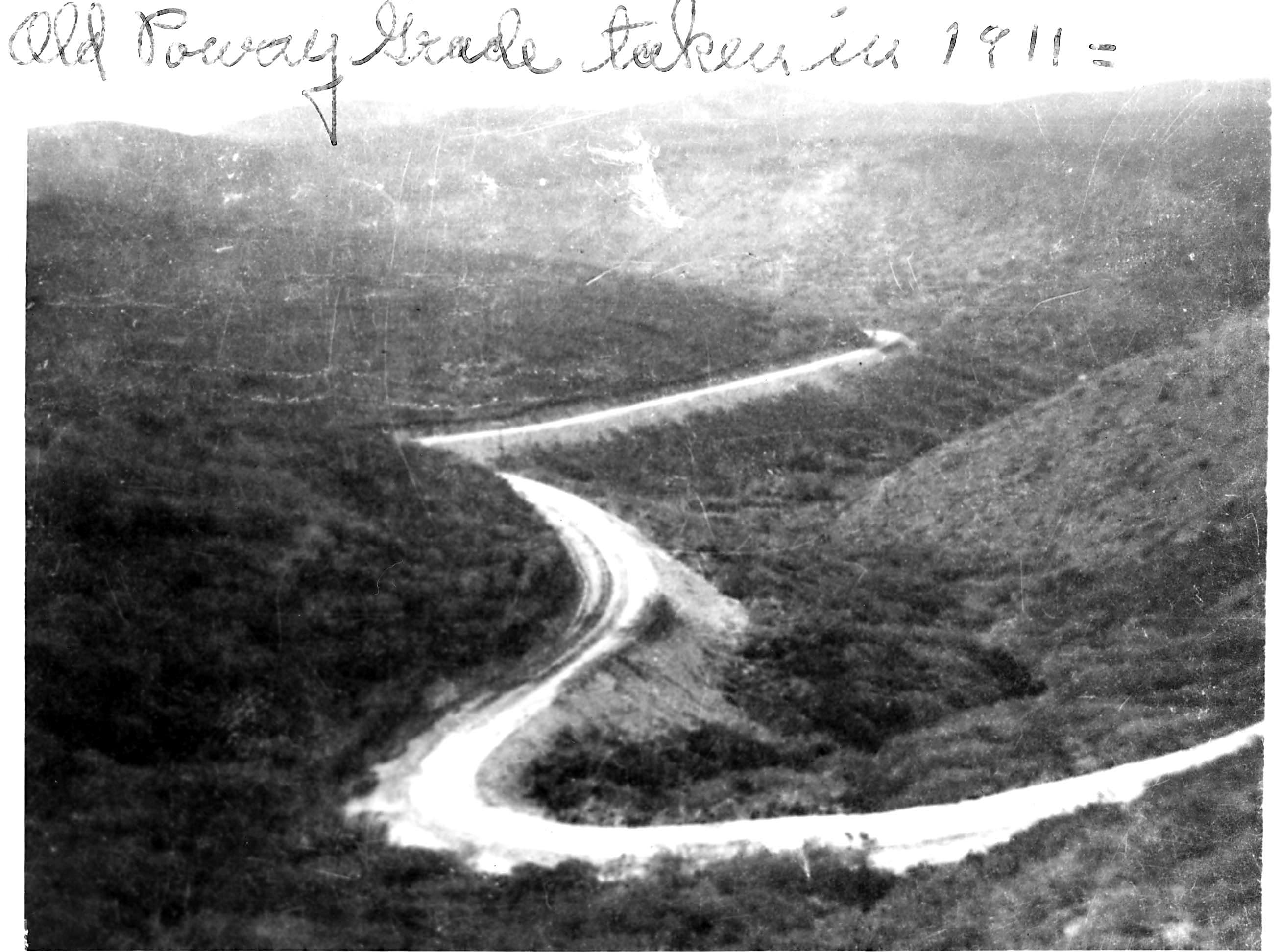
The photo below, courtesy of the Poway Historical Society. is labeled, “Old Poway Grade Taken in 1911”:
Commuters sitting in traffic snaking over the Poway Grade today might have a hard time imagining it as a dirt road where traffic jams once consisted of livestock, but that was the case a century ago.
The Poway Historical Society’s archives include the written reminiscences of Andrew Kirkham, a member of one of Poway’s pioneering farming families. One of his journals describes how, as a 14-year-old in 1898, he joined his father and brother clearing the Poway Grade’s roadbed of loose rocks.
“Whenever a flock of sheep drove down the Poway grade, there would be a lot of rocks rolled down onto the road,” Kirkham wrote. “These flocks would be driven to the northern part of the country in the springtime and return in the fall.”
The flocks numbered anywhere from 500 to 1,000 sheep according to Kirkham. Similar numbers of horses, cattle and hogs were driven over the grade as well
Gettin’ over the grade is just one of many aspects of North County history I’ll be talking about in my lecture, “San Diego North County-A Look Back,” on Tuesday, June 6 at 12:30 p.m. at the University Community Library in San Diego. The program is co-sponsored by the San Diego Public Library and San Diego Oasis. Come join us!
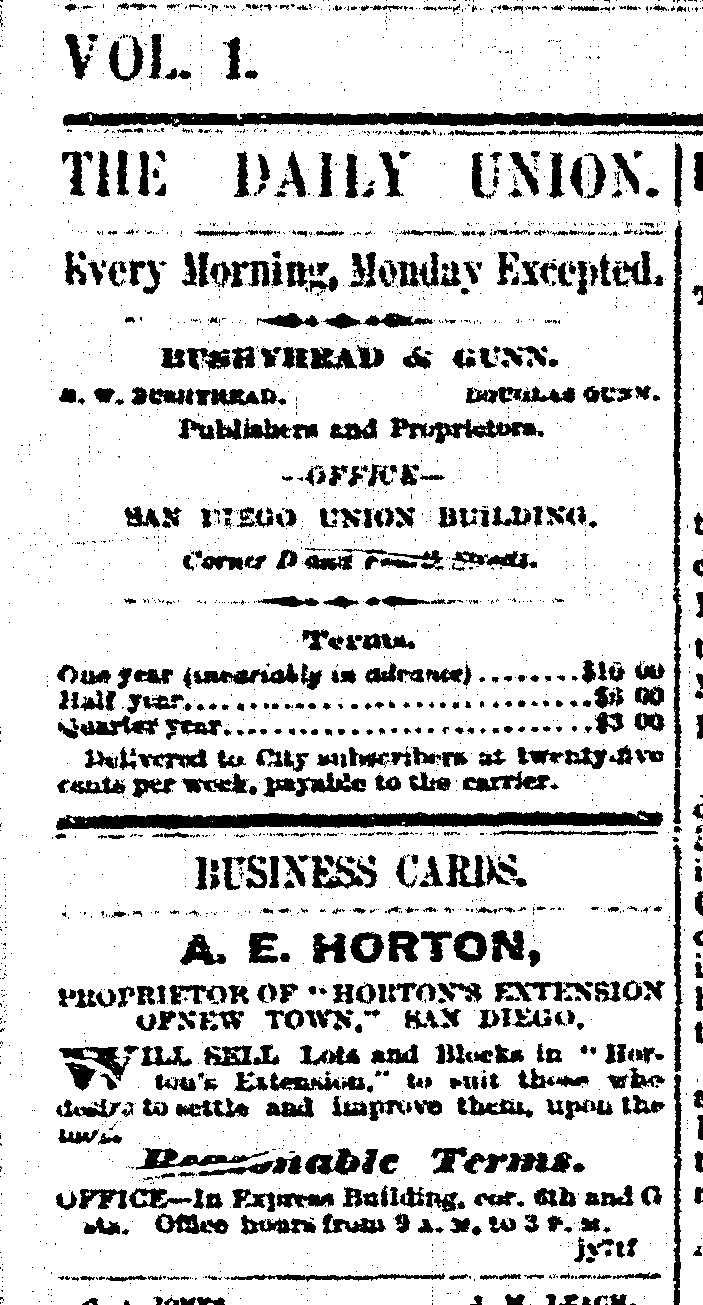
Below is a clipping of part of the front page of the San Diego Union issue of March 20, 1871.
I clipped this excerpt, which appeared at the top of column 1, as a snapshot of San Diego history. Please note the “Vol. 1” in the upper left. I included that detail because this issue was “Volume 1, Number One,” in other words, the Union’s very first issue as a daily paper. Up to then it had been only published weekly. Douglas Gunn, whose name appears on the paper’s masthead as a co-publisher-proprietor with S.W. Bushyhead, had in 1868 purchased a small interest in what was then the Weekly Union. In 1871 he assumed greater financial and editorial control and took the paper daily as of March 20.
Simultaneously with turning the paper into a daily, Gunn also moved the paper’s press from offices in what we today call Old Town San Diego to an emerging “New Town,”beginning to take shape closer to San Diego Bay.
The emergence of “New Town” is evident in the clip immediately below the paper’s masthead, displaying the “Business Card” of Alonzo Horton, who had purchased 900 acres in 1867 and begun developing it under various names including “Horton’s Extension” or “Horton’s Addition,” with the support of many in the then-small city (population less than 3,000), including Douglas Gunn and his newspaper.
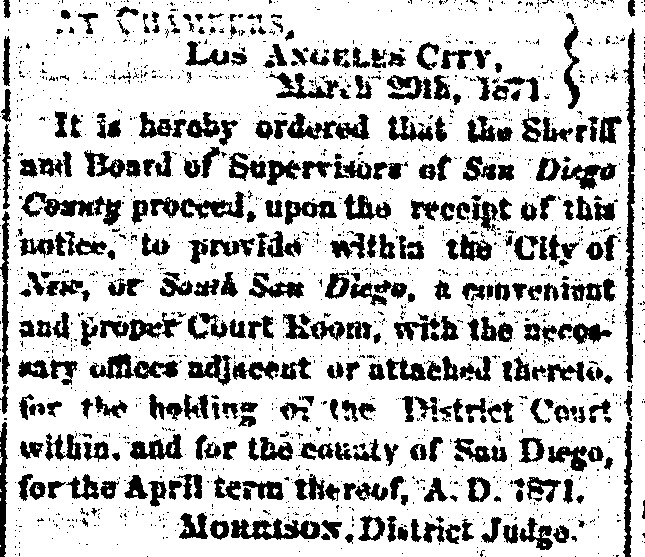
The neighborhood’s name was still evolving, as evidenced a little over a week later, when the Union posted a legal notice in its April 1 issue from a state district court judge, then sitting in Los Angeles:
Sources for this post included historic San Diego newspapers, an August 2011 Union-Tribune article by historian Richard Crawford, and the 1887 book, Picturesque San Diego,With Historical and Descriptive Notes, by Douglas Gunn.
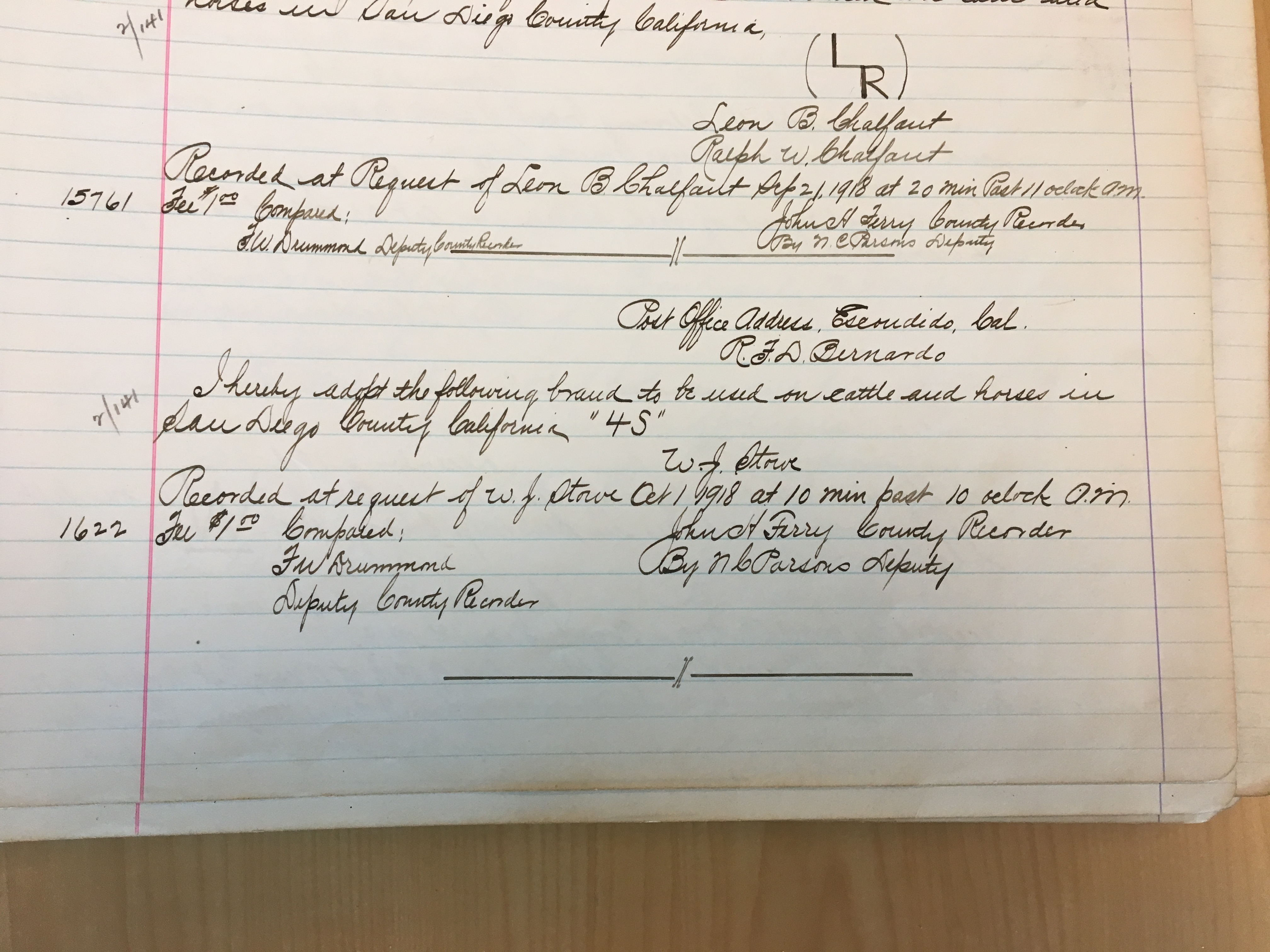
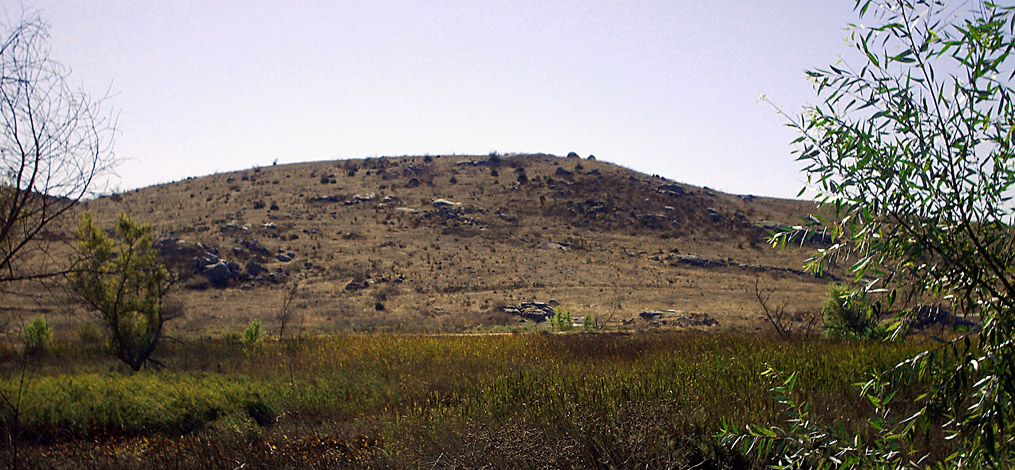
The photo at the top of this page shows Mule Hill, in the San Dieguito River Park. There’s a lot of history behind the hill and its name, which is one reason why I adopted it for the cover page of my blog. Mule Hill is also mentioned in two talks that I’ll be giving this month. On April 18th I’ll be speaking at the 4S Ranch Branch of the San Diego County Library. My topic will be: “What’s In a Name? A Lot of History.” There’s a story behind every place name, past and present, in San Diego County, and I’ll share some of those stories, from Mule Hill and Kettner Boulevard to a post office named Nellie, in my talk.
Then on Aptil 21st. I’ll be joining the folks at the Scripps Miramar Ranch Library where I’ll be talking about “Picturesque San Diego: Images and Stories from the Past.” Picturesque San Diego is a book published in 1887 by Douglas Gunn, a former San Diego Union editor and former mayor of San Diego. The book is lavishly illustrated with photos of places throughout the county taken by one of the most prominent photographers of the day. My slideshow features many of those photos along with Gunn’s text describing a much more rural and much less populated county than the one we live in today.
The only thing I love more than visiting libraries is talking about history with other folks at libraries. Check out the county and city library websites for details on location and times and join us. If you can’t make it for these, I’ll be giving other talks in the months ahead. In the meantime, don’t forget to check out my blog posts as well as my books!
Earlier this month I gave a talk at the Continuing Education Center of Rancho Bernardo on “The Nation’s Library,” the Library of Congress. One of the great features available from that library is a collection of photos from the Historic American Buildings Survey (HABS). One of the New Deal programs set up to relieve unemployment during the Great Depression, HABS put unemployed architects and draftsmen to work documenting historic buildings across the country.
In my lecture I pointed out how HABS helped to win historic recognition for a privately-owned adobe house in Old Town, Casa de Machado, that eventually became part of Old Town State Historic Park.
Here, courtesy of the Library of Congress, is another historic San Diego County property from the HABS collection, photographed in 1937, the Oak Grove Butterfield Station.
The Butterfield Overland Mail Line was a stagecoach line that carried mail and passengers between Memphis, Saint Louis and San Francisco from 1858 to 1861. Stations were maintained at roughly 30-days travel time apart along the route. This building, in Oak Grove about 13 miles northwest of Warner Hot Springs, is one of only three surviving station buildings. While it has been designated a National Historic Landmark, the adobe building is under private ownership, occupied by a store open during normal business hours.
Sources for this post included the Library of Congress, the National Park Service, and the book, Historic Stage Routes of San Diego County, by Ellen L. Sweet and Lynn Newell.