The Show Went On

Harry James

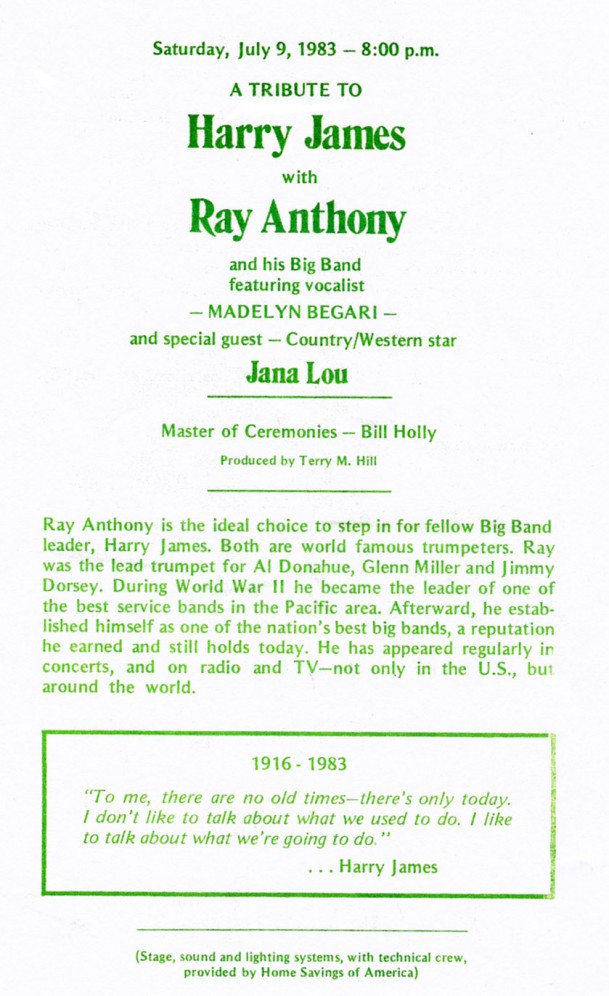
Program for Rancho Bernardo Concert On the Green, July 9, 1983. Courtesy Rancho Bernardo Historical Society archives.


Maybe it’s something about show business. I’ve read so many show-must-go-on-kinds of stories about entertainers. I don’t know why I’m almost as fascinated by stories about show business as I am about history. Notice I said almost. I sometimes rationalize it to friends and family by saying, “hey, it’s part of social and cultural history, right?”

Anyway, I ran across an instance where San Diego history and the often unique personalities of show biz people came together, in the person of trumpet great Harry James and the Rancho Bernardo Concert On the Green Series.

The Concert On the Green Series began as the brainchild of one of the leaders of AVCO Community Developers, which had taken over development of the then-new community of Rancho Bernardo in 1968. A group of dedicated community volunteers took the idea and ran with it, staging annual concerts by the San Diego Symphony and other popular musical acts every summer on the driving range of the Rancho Bernardo Inn’s golf course.

Was it a popular idea? Well, the first concert, in 1972, sold 6,275 tickets at a time when the total population of Rancho Bernardo was just over 10,000. It would continue as a popular and beloved community event until 1993.

The series was at its peak in 1983 when the announced theme was “Summer of the Big Bands,” with James’ band leading off a season that also included other great Swing Era outfits like Les Brown and His Band of Renown and Bob Crosby and the Bobcats.

Harry James was one of the giants of the Swing Band era, as both a trumpet virtuoso and a bandleader whose musical alumni included singer Frank Sinatra and drummer Buddy Rich, among others.

James was a trouper in the classic show biz sense. Driven by his own personal demons, he lived to perform, according to a biographer. In the spring of 1983, 67 years old and suffering from years of one-night stands–musical and otherwise–and hard living, he was diagnosed with cancer. Yet even after surgery and chemotherapy James was still playing gigs, including concerts in Denver on June 10 and 11 and a private party in Los Angeles on the 26th.

He was booked for dates on July 8 in Hemet and then July 9 in Rancho Bernardo. But he didn’t make it. James died in a Las Vegas hospital on Tuesday, July 5.

Ray Anthony, another swing band trumpeter and bandleader, agreed to take James place, and included a tribute to the music of the Harry James band in his repertoire that night. Bob Crosby, who lived in La Jolla and was scheduled to appear elsewhere in San Diego that week, paid tribute to James in an interview with the San Diego Union on July 6.

“He was unique,” said Crosby. “He started out in a circus band, and when you’re playing all day for a circus the way he did, you’re going to wind up with an iron lip. It’s my feeling that music should be conversational…James said things musically.”

Sources for this post included the archives of the Rancho Bernardo Historical Society, historic San Diego newspapers, and the book, Trumpet Blues: The Life of Harry James, by Peter J. Levinson.

Get Updates Automatically-Become A Follower of the San Diego History Seeker

You can get weekly updates of San Diego History Seeker automatically in your email by clicking on the “Follow” button in the lower right corner of the blog page. You’ll then get an email asking you to confirm. Once you confirm you’ll be an active follower.
 

A “Star Route” Very Much Earth-Bound

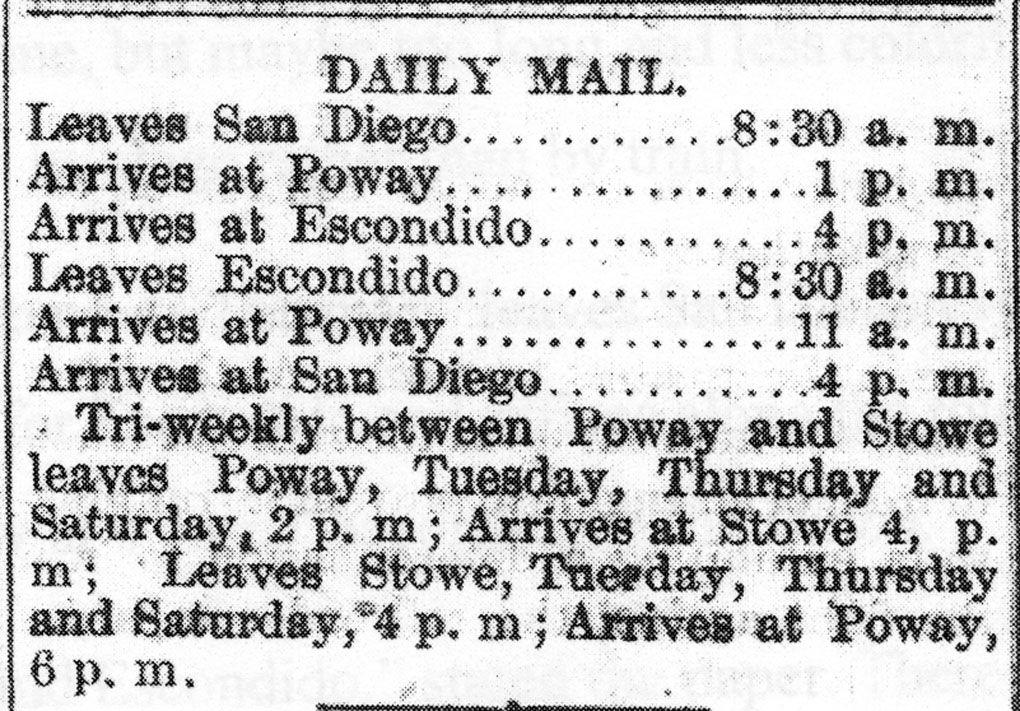
Poway mail

Poway Progress, July 14, 1894


“Star Route” might sound today like an astronomy term or the title of a science fiction film. But in the 1890s in San Diego County and elsewhere in the USA, it designated mail delivery routes not serviced by railroads, and that still covered a lot of territory.

“Not all of Uncle Sam’s business in the matter of carrying mail into and out from the San Diego Postoffice is done by the railroads; in fact the stage lines carry a great deal of it….” began an article in the June 12, 1890, San Diego Union.

“All stage routes throughout the United States and in fact all mail routes off the line of railroads are denominated ‘star routes,’” the article stated. It then went on to explain the name as derived from the * symbol (looks more like an asterisk to me, but maybe too long and less colorful a word) which marked postoffices getting their mail by stage rather than by train.

In 1890, Star Route 46-386 serviced the Escondido area. The mail “leaves San Diego every morning except Sunday morning at eight o’clock for Escondido and offices along the route. Returning the mail arrives each day except Sunday at 4 p.m.,” according to the Union.

“Over this line mail is sent for Poway, Bernardo and Escondido,” stated the paper. There was also tri-weekly service on that route from Poway to Stowe and from Escondido to Mesa Grande.

Interstate lines and smaller local companies and individuals bid for the various routes. The Union noted that the contractor then for the San Diego-Escondido route was one “J.V. Hicks and two stage coaches are on the line each day.”

Contractors could change fairly frequently, and the vehicles used as well. A notice in the weekly newspaper Poway Progress had this to say of the same route in July of 1894:

“The mail carrying is in new hands now, Mr. Cook’s time being expired. The new contractor has put on two nice three-seated and covered rigs that have the appearance of comfort for travelers. The Stowe line has also changed hands, Mr. W. F. Hewlett having the contract to make three trips weekly.”

Get Updates Automatically-Become A Follower of the San Diego History Seeker

You can get weekly updates of San Diego History Seeker automatically in your email by clicking on the “Follow” button in the lower right corner of the blog page. You’ll then get an email asking you to confirm. Once you confirm you’ll be an active follower.
 

Marston: More On His Mind Than Making Money

George Marston

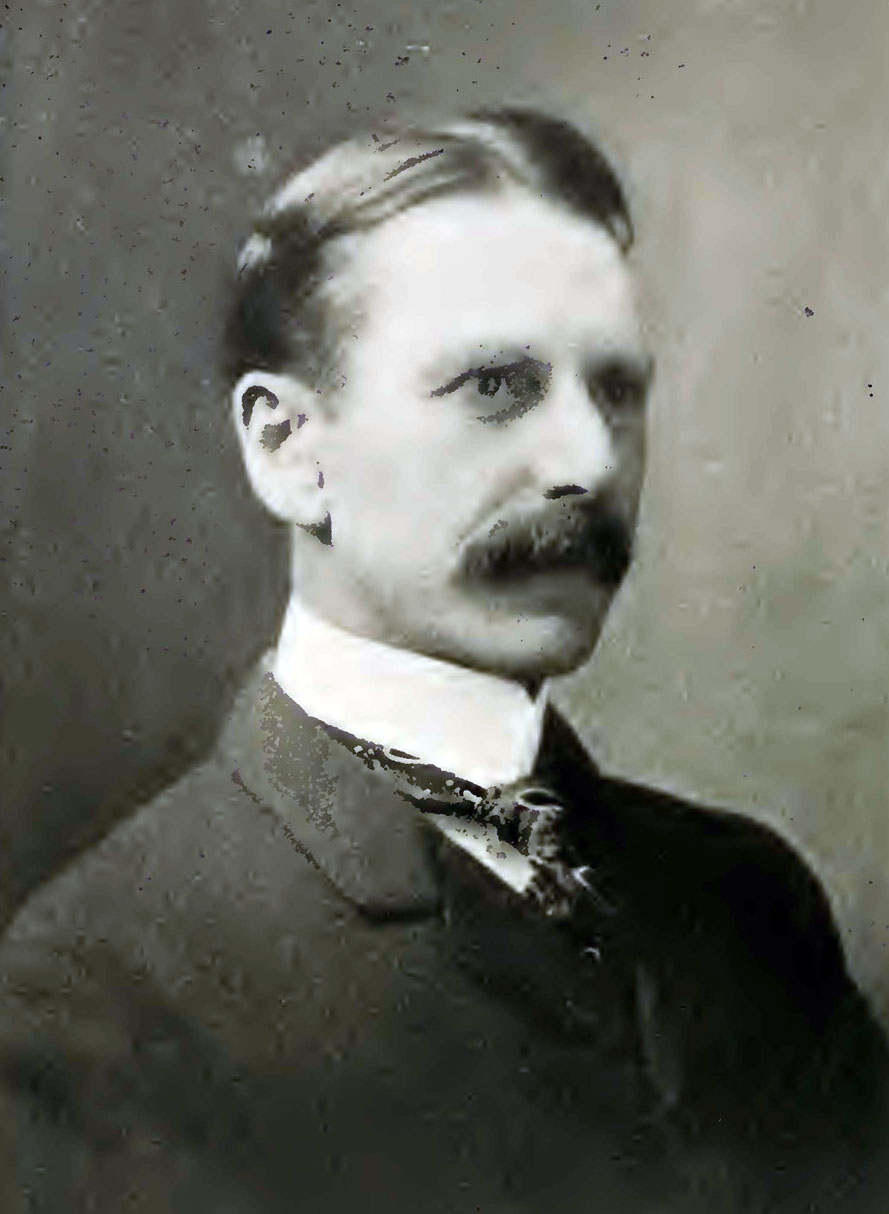
Photo of George Marston from volume II of William E. Smythe’s History of San Diego: 1542-1908, published in 1908.


A couple of weeks back I wrote a brief post about George W. Marston’s 1913 mayoral campaign. He lost in 1913 and 1917, but he is far better known as a successful department store owner and philanthropist. He was also a strong advocate of park development and city planning. He built the Serra Museum and Presidio Park at his own expense and then donated them to the city. In the early 1900s he put up his own funds to hire expert planners who crafted the first comprehensive plans for Balboa Park and for general urban development in San Diego.

He clearly had a lot more on his mind than just making money. One surprising aspect of his thinking turned up in a 1986 essay on Marston in The Journal of San Diego History written by Gregg R. Hennessey, entitled, “George White Marston and Conservative Reform in San Diego.” I refer to it to provide some historical perspective on the eve of a midterm election.

The essay noted that Marston in his adult life was politically independent. “Raised a Republican, he never hesitated to swing back and forth between Democrats and Republicans, choosing the person or the party most likely to push for reform.”

The article then quoted from a letter Marston wrote in 1932 in response to a contribution request from a local Republican party fundraiser for the November election campaign.

“I wonder how you got the idea that I was a Republican,” wrote Marston. “I did vote for Hoover four years ago and sent you a check for the campaign, but I also voted for Wilson and for Cleveland and very much prefer the political platform of the Democrats to that of the Republicans. However the Democrats are deteriorating badly these days and are controlled by the big financiers of the country as the Republican party is.”

Marston went on to write this: “In our little San Diego field you and I are both in the plutocratic, aristocratic and big financial privileged class! But there is this difference between us. I am willing to admit that we get too big a share of the good things of life and that we ought to be good enough democrats to let the people in general have a larger share…. “

Marston closed by saying, “Therefore, I am still a non-partisan, entertaining hopes that sometime a liberal, progressive party will be established in the United States. I am not a Socialist, but this year I am inclined to vote for Norman Thomas as a protest against both of the dominant parties. “

Norman Thomas was the presidential candidate of the Socialist Party in the 1932 election.

Mary Gilman Marston, George Marston’s daughter and biographer, confirmed that her father did indeed vote for Norman Thomas in 1932, and that he voted for Franklin Roosevelt and the Democrats thereafter, since, in her words, “The social aims of the New Deal were in accord with his political beliefs.”

Sources for this post included The Journal of San Diego History and historic San Diego newspapers.

Get Updates Automatically-Become A Follower of the San Diego History Seeker

You can get weekly updates of San Diego History Seeker automatically in your email by clicking on the “Follow” button in the lower right corner of the blog page. You’ll then get an email asking you to confirm. Once you confirm you’ll be an active follower.


The Shepherd of Santa Maria

Steamship arrivals to the port of San Diego were common topics in the city’s newspapers in the late nineteenth century.

“The following passengers arrived from San Francisco and way ports on the steamer Orizaba yesterday” began one typical notice on page 3 of the September 14, 1872 San Diego Union. There follows a list totaling 47 names. None of the names would jump out to anyone but genealogical or historical researchers. Two of them caught the eye of yours truly:

“J.B. Arrambide,

B. Etcheverry,”

Those two men happened to be natives of France, and their names were Basque in origin. Among the occupations Basques were known for in their native region was raising sheep.

Bernard Etcheverry had originally emigrated from France as a young man in 1856, seeking his fortune in the California gold fields. He did well enough that after a few years he was able to move on to other ventures, first in Santa Barbara, then back in his native France before coming to San Diego County in 1872. There he became a partner with Mr. Arrambide in the Santa Maria Ranch, in what is today Ramona.

It appears they returned to their shepherding roots. A notice in the San Diego Union’s edition of July 22, 1874 reads: “We notice that Messrs. Arrambide and Etcheverry of the Santa Maria Ranch have imported direct from the Government farm at Rambouillet, France, two very fine merino rams. The wool is of very long staple and exceedingly fine, and at the same time free from the oily matter usually found in those fine sheep. The rams cost over $500 each. “

Mr. Arrambide eventually went back to northern California, but Bernardo Etcheverry remained and prospered at Santa Maria.

“By 1881, Bernard Etcheverry was running 12,000 sheep on his 16,700-acre Santa Maria spread,” wrote Charles Le Menager in his 1989 book, Ramona and Round About. At the same time, Etcheverry promoted other types of agriculture, including fruit orchards, vineyards, barley and wheat fields.

“He encouraged sharecroppers to set up homes and farms on his broad ranch and was said to be a generous landlord,” Le Menager wrote.

If you’d like to find out more about the role played by Bernard Etcheverry and another French immigrant in Ramona’s history, you can find out in my book, Valleys of Dreams, for sale through this website.

Sources for this post included Charles Le Menager’s book, Ramona and Round About, historic San Diego newspapers and the archives of Ramona’s Guy B. Woodward Museum.

Get Updates Automatically-Become A Follower of the San Diego History Seeker

You can get weekly updates of San Diego History Seeker automatically in your email by clicking on the “Follow” button in the lower right corner of the blog page. You’ll then get an email asking you to confirm. Once you confirm you’ll be an active follower.


Land of Sunshine

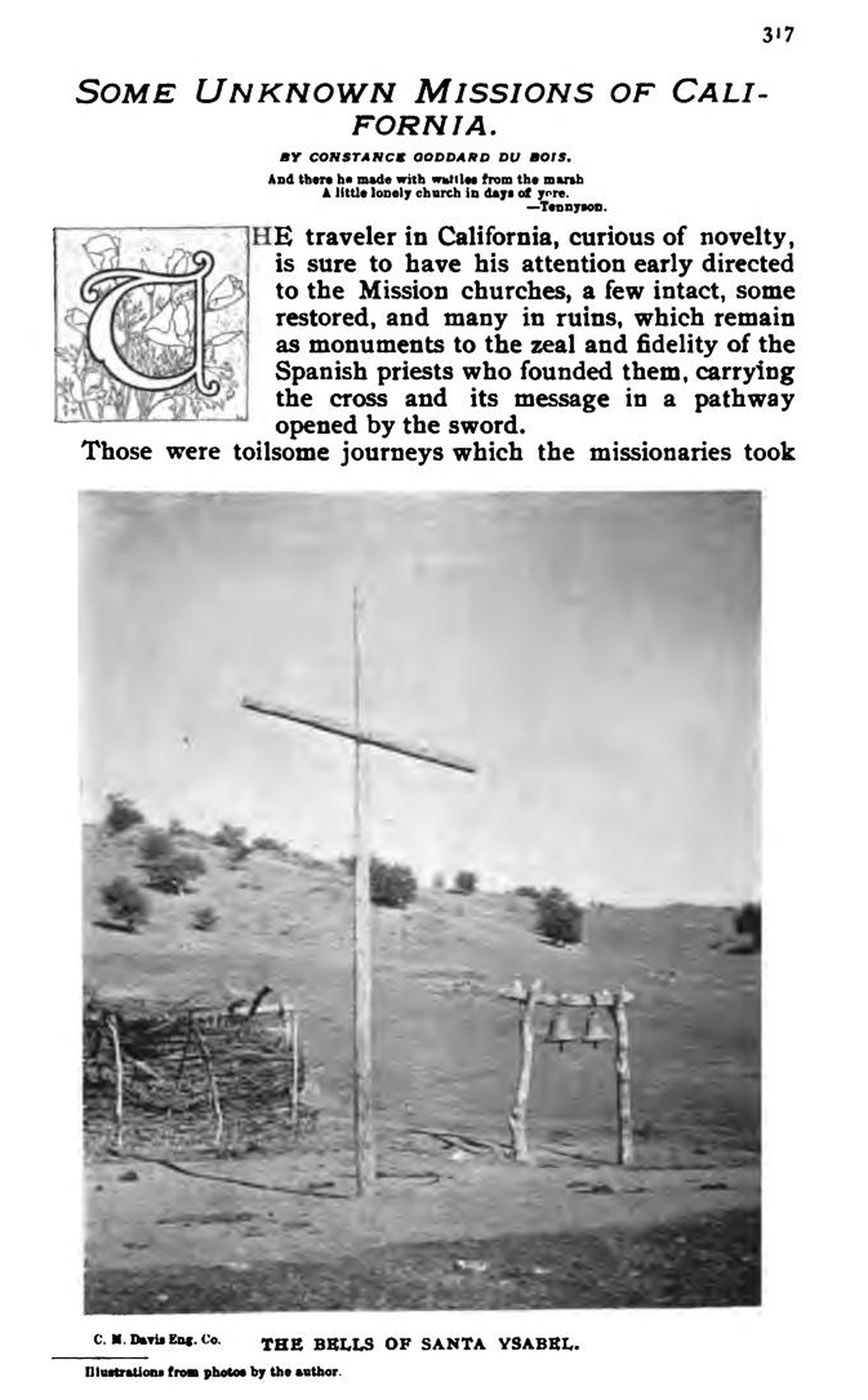
landsunshine01unkngoog_0355

“Far in the ‘back country,’ sixty miles or so from San Diego, in a region untrodden by the tourist, are the ruins of the Mission of Santa Ysabel. Leveled by time and washed by winter rains, the adobe walls of the church have sunk into indistinguishable heaps of earth which vaguely define the outlines of the ancient edifice…”

That’s an excerpt from the article beginning on the page you see above, from the November 1899 issue of Land of Sunshine, a monthly magazine published from the mid-1890s through the early 1920s.

Land of Sunshine offers some vivid descriptions of Southern California of that time, including excellent photography. I’d characterize it as a cross between, in contemporary terms, Sunset and the New Republic. This is especially true of issues during the editorship of Charles Fletcher Lummis, from 1893 to 1909.

Lummis was an interesting, and definitely eccentric character. As a young journalist in 1885, he literally walked across the nation to California, writing and sending accounts of his travels along the way to Harrison Gray Otis, publisher of the Los Angeles Times, who hired Lummis as the fledgling paper’s city editor on his arrival.

Lummis would go on to be a prolific researcher, writer and photographer of the southwestern United States. A 1985 Los Angeles Times article credited him with turning Land of Sunshine from “a Chamber of Commerce promotional sheet into a sterling literary magazine.” Contributing writers during Lummis’ tenure included Jack London, Joaquin Miller and Edwin Markham.

There were also lots of stories from Lummis himself. Among issues he spoke and wrote about were the rights of Native Americans and the need for historic preservation. He helped found two organizations, the Sequoya Club and the Landmarks Club, to take action on those issues.

I’ll definitely be looking further into issues of Land of Sunshine and the character Charles Lummis. In the meantime, the magazine has fortunately been scanned and digitized on the archives.com website, at https://archive.org/ and search for “Land of Sunshine.” There are also a number of bound volumes of the original print editions in the Genealogy Room of the Carlsbad Public Library. I heartily recommend you check it out.

In addition to archives.com, sources for this post included the Los Angeles Times, the Historical Society of Southern California, and the archive of the University of Virginia’s Institute for Advanced Technology in the Humanities.

Get Updates Automatically-Become A Follower of the San Diego History Seeker

You can get weekly updates of San Diego History Seeker automatically in your email by clicking on the “Follow” button in the lower right corner of the blog page. You’ll then get an email asking you to confirm. Once you confirm you’ll be an active follower.