HAPPY AND HISTORIC HOLIDAYS TO ALL!

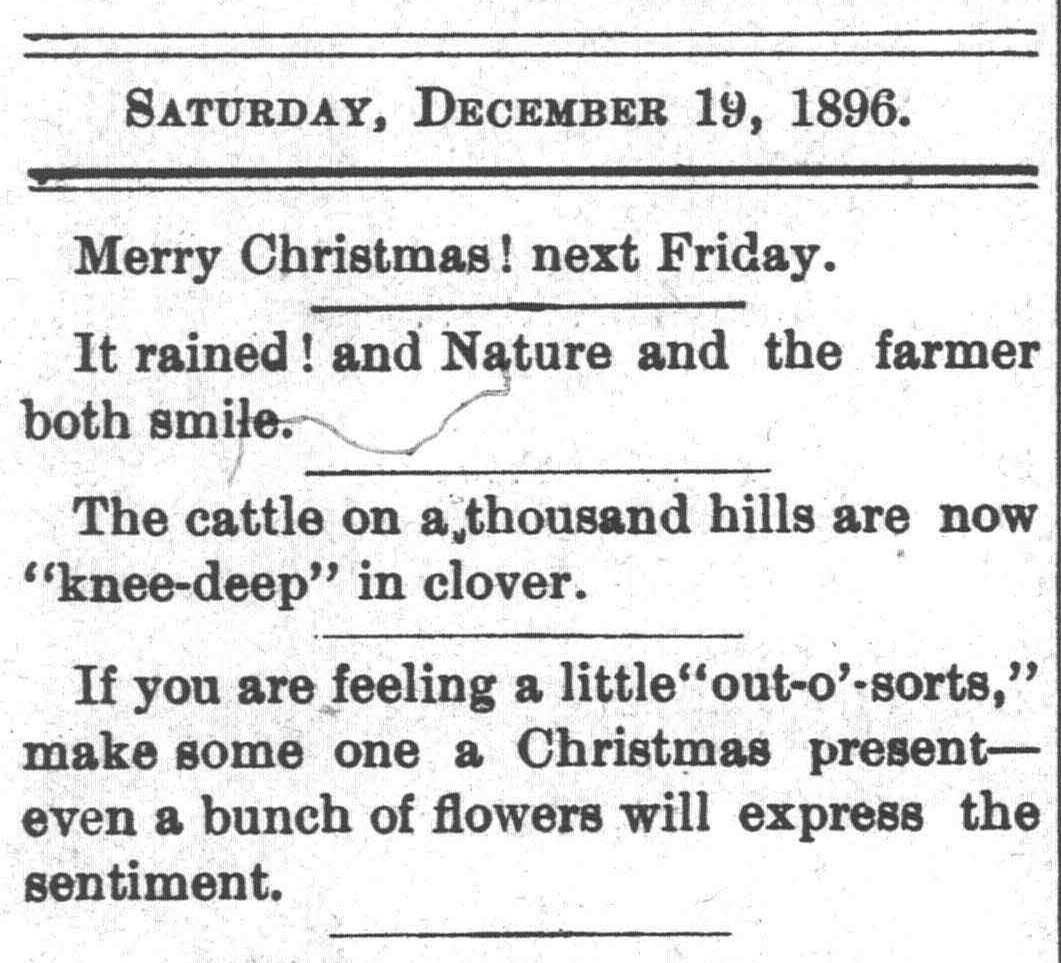
19 December 1896 page 4

Poway Progress, December 19, 1896, p. 4.

Get Updates Automatically-Become A Follower of the San Diego History Seeker

You can get weekly updates of San Diego History Seeker automatically in your email by clicking on the “Follow” button in the lower right corner of the blog page. You’ll then get an email asking you to confirm. Once you confirm you’ll be an active follower.
The Orizaba-Part II

Last week I wrote about the role that one steamship, the Orizaba, played in the history of San Diego City and County, in terms of the number of residents, noted and ordinary, who first came here on the vessel over its 22-year history carrying people between San Diego and San Francisco.

She also contributed to the development of the local economy by delivering tons of cargo, as demonstrated by this item from the January 21, 1872 San Diego Union, datelined National City:

“J. S. Gordon brought with him on the Orizaba fifty tons of freight. The hay and grain which filled the warehouses of the firm he represents, and the large stock of goods with which their capacious store was literally packed, are fast disappearing, and indicate that another trip to San Francisco will soon be necessary.”

For eleven of the 22 years that the Orizaba made San Diego her home port, she was commanded by the same man, Henry J. Johnston, and he was as well known in San Diego as his ship. In 1878 Johnston was assigned command of a newer steamer, a command he unfortunately never took up as he died on December 28, 1878 after an accidental fall at this San Francisco home.

“The flags on all the buildings in town and on the vessels in the bay were half-masted yesterday,” reported the San Diego Union of January 1, 1879, “out of respect to the memory of the late Captain Henry J. Johnston-a token of the esteem in which he was held by our whole community.”

But that wasn’t the end of the influence of the Orizaba and her long-time skipper on San Diego.

When she came into San Diego the Orizaba docked at Culverwell’s Wharf, which jutted out into the bay from what is now the intersection of Pacific Highway and F Street. As the ship made her way toward the dock, Captain Johnson used a spot on a hill to the north as a navigational aid.

After one particular voyage, Johnston became curious about that geographic point and hired a coach and driver to take him up there. Entranced by what he saw, he bought 65 acres with the hope of constructing a home there on his retirement.

Captain Johnston never lived to carry out his dream. His widow, while remaining in San Francisco, continued to own the San Diego property until May, 1887, when she deeded it to her daughter, Sarah Johnston Miller.

Miller came to San Diego and with her husband built a Victorian house which she named Villa Orizaba. She also filed plans to develop the still-rural landscape around the house as a community designated Johnston Heights in honor of her father, for whom a street in the new tract was also named.

The good ship Orizaba, over 30 years old, had at that point been taken out of service and sold for scrap. Sarah Miller acquired some parts of the ship for the construction of her home.

Villa Orizaba, under different owners over the years and considerably remodeled and relocated, remains standing in its original neighborhood, on a street named Orizaba. The former Johnston Street is now called Sunset Boulevard, and the former Johnston Heights is now better known as Mission Hills.

Sources for this article included historic San Diego newspapers, Richard Pourade’s series of books on the history of San Diego, The Journal of San Diego History, and the website of Mission Hills Heritage.

Get Updates Automatically-Become A Follower of the San Diego History Seeker

You can get weekly updates of San Diego History Seeker automatically in your email by clicking on the “Follow” button in the lower right corner of the blog page. You’ll then get an email asking you to confirm. Once you confirm you’ll be an active follower.


San Diego’s Mayflower

Orizaba


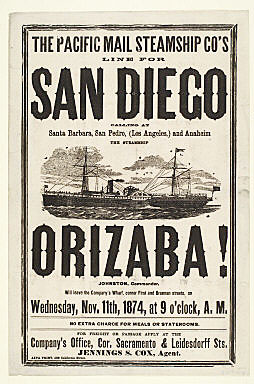
1874 Advertising poster for Pacific Mail Steamship Company service in southern California.

Credit UC Berkeley Bancroft Library.


Steamship arrivals to the port of San Diego were a common topic in the city’s newspapers in the late 19th century. I’ve also found that a number of historical personalities in San Diego history first arrived here and/or subsequently traveled on one particular steamship, the Orizaba.

My curiosity was triggered. As I started digging I discovered that a lot of people sailed to or from San Diego on the Orizaba, which plied the waters between San Diego and San Francisco, with some stops in between, from 1865 to 1887 for the Pacific Mail Steamship Company.

Keep in mind that there were fewer than a thousand people living in the city of San Diego when the Orizaba first arrived here in December, 1865. The railroad wouldn’t arrive until 1885. So overland or over the sea were the only ways to transport people and freight to or from here.

In 1865 the Orizaba was a state-of-the-art workhorse of the sea, a wooden side-wheeled steamer of 1,244 tons, 246 feet long, 35 feet wide 15 feet high from her top deck down to her keel. She made the run to San Francisco in three days and, with layovers at each end, made port in San Diego every 12 days. That comes out to roughly 528 trips over 22 years.

Arrival notices in the newspaper showed that all kinds of people travelled on the Orizaba, and there’s an easy way for today’s reader to tell who travelled first class. For example, a March 27, 1872 listing of passengers arriving from San Francisco lists 58 people by name, including rancho owner Don Juan Forster and others with honorifics like “Prof.” or “Judge.” That list is immediately followed by the phrase: “and 37 others.”

In a 1959 article for The Journal of San Diego History, Jerry Macmullen, a veteran newspaper reporter and student of both San Diego and maritime history, wrote: “In a small way, Orizaba is to San Diego what Mayflower is to New England. ‘I came here from San Francisco on the Orizaba’ or ‘My folks came here on the Orizaba’ are familiar statements to anyone talking to old-timers.”

Sources for this post included historic San Diego newspapers and The Journal of San Diego History.

Get Updates Automatically-Become A Follower of the San Diego History Seeker

You can get weekly updates of San Diego History Seeker automatically in your email by clicking on the “Follow” button in the lower right corner of the blog page. You’ll then get an email asking you to confirm. Once you confirm you’ll be an active follower.

“The Benefit of a City Education”

Readers of this blog may recall my entry on Foster, a town which existed for a few decades in a canyon which is now part of Lakeside. The town was named for its most prominent citizen, Joseph Foster, rancher, hotel owner, road builder and, in the early 20th century, a county supervisor for 23 years.

This episode touches on one little detail of Joseph Foster’s life which he shared with a lot of prominent citizens from what was then called the “back country.” That detail was to send your children to live in the city of San Diego when it was time for them to attend school.

If you peruse local newspapers of the late 19th and early 20th century, it was not at all unusual to see an entry like this one, which appeared in the “Poway” column of the Poway Progress issue for September 1, 1894:

“Joseph Foster has bought the property at 1658 Front Street, San Diego, as a temporary home for his children, whom he intends to give the benefit of a city education.”

The entry also noted that Mr. Foster’s mother-in-law, a Mrs. Swycaffer, “will take charge of the house and look after the welfare of the children. Her younger son James goes along also to attend the city schools.”

There were of course, schools out there in rural north county, often one or two-room structures where multiple grades were taught. So one could understand someone like Foster, who was in a position to do it, seeking what he thought was a better educational environment for his children.

And, as I said, this wasn’t by any means unusual, as witness this entry in the “Local Notes” column of the San Diego Evening Tribune for March 30, 1903:

“Ed Fletcher has sold Frank Salmons, the Pala merchant, a lot at the corner of 24th and D streets, where Mr. Salmons will build, it being his intention to bring his children here to be educated while he is conducting a store at the Indian reservation at Pala, having obtained a traders’ license from the government.”

Get Updates Automatically-Become A Follower of the San Diego History Seeker

You can get weekly updates of San Diego History Seeker automatically in your email by clicking on the “Follow” button in the lower right corner of the blog page. You’ll then get an email asking you to confirm. Once you confirm you’ll be an active follower.


A Place Called Apex-But Not For Long

Apex postmaster

Entry for appointment of Charles MacDougall as postmaster of Apex, California from Record of Appointment of Postmasters, 1832-Sept. 30, 1871, National Archives and Records Administration.


If I happen to mention Apex during one of my local history talks, it usually draws puzzled looks. You won’t find it on a map today, but it was a post office in northern San Diego County between 1881 and 1884.

The Apex post office was created in February 1881. Its first postmaster was Charles A. MacDougall. Like a lot of post offices in those days, it was at first located in the postmaster’s home. From coverage in contemporary newspapers, it appears that the post office was on the ranch that MacDougall jointly ran with his brother William.

The MacDougall spread was one of a number of ranches developing at that time as a result of the sale and subdivision of two large Mexican-era ranchos: Los Vallecitos de San Marcos and Rincon del Diablo.

Among the other homesteaders listed as living in the Apex area in 1881 was Gustavus French Merriam. When Merriam arrived to homestead 160 acres in 1875, he christened his property Twin Oaks Ranch after two joined 70-foot oak trees on the grounds. Over the years, that name would be applied to the whole valley encompassing his ranch.

Interesting thing about how fluid place names can be.

In 1883, the Apex post office was still around, but not in the same location. An article in the San Diego Sun of September 9, 1883, mentioning the MacDougall ranch, stated that “The Apex post office was formerly located there but has recently been moved up on the Wolfskill plains to a more central location.”

Where? The reference was to an area further south, in the heart of Rancho Rincon del Diablo, which was then owned by John Wolfskill. John Wolfskill, his brother Josiah, and another partner had purchased the 12,700 acre rancho in 1868. By the time of the 1883 Sun article John Wolfskill was a state senator and apparently doing well raising sheep, cattle, hogs and a variety of fruits.

The article went on to refer to “the new town of Apex…” Apparently, an actual separate post office building had been erected, along with “a store and blacksmith shop, while other improvements indicate a growing prosperity. The branch line of the Southern Pacific has been surveyed through the town, and it will certainly, before many years become a point of considerable importance.”

It would not, however, gain fame as the city of Apex, nor Wolfskill. A San Diego Union column on back country happenings on February 16, 1884 included this item: “The name of the Apex office is to be changed to that of Escondido.”

That name appears to have stuck.

Sources for this post included historic San Diego newspapers, the National Archives of the United States,  and the archives of the Escondido History Center and the San Marcos Historical Society.

Get Updates Automatically-Become A Follower of the San Diego History Seeker

You can get weekly updates of San Diego History Seeker automatically in your email by clicking on the “Follow” button in the lower right corner of the blog page. You’ll then get an email asking you to confirm. Once you confirm you’ll be an active follower.