“…we did not discuss politics.”

“GEORGE W. MARSTON URGED TO STAND FOR MAYOR”

So proclaimed the headline of an article in the San Diego Union of January 8, 1913.

“Spring politics took on more life yesterday when it became known in San Diego that George W. Marston, prominent merchant and pioneer of the city, is a possible candidate for mayor at the April election.”

The paper reported that a letter “was sent to Marston yesterday by twenty-seven prominent citizens of the city strongly urging him to make the mayoralty race and pledging their support to his candidacy.”

The text of the letter was printed in full by the Union, which somehow got it before even Marston did. The paper called him up to ask about it, and Marston replied that “I was told tonight downtown that the letter had been sent to me, but I have not yet received it and I can hardly give an opinion on a letter I haven’t read.”

One of the interesting things about this particular article is that Marston also volunteered that he had spent the previous evening at the home of Julius Wangenheim. Mr. Wangenheim just happened to be one of the signers of the letter urging Marston to run. But when the Union phoned Wangenheim about it, he told them, “I can’t say whether he will be a candidate for mayor or not. Although he was at my home this evening, it was a literary gathering and we did not discuss politics.”

Wangenheim hastened to add that he “sincerely hoped” Marston would make the race.

There are two other interesting things about this article. One is its position, on column one of the front page of the Union’s Second Section. The other is that the entire rest of the page is taken up by an advertisement for Marston’s Department Store, headlined in letters of comparable size to the article, “Marston’s January Sales.”

Get Updates Automatically-Become A Follower of the San Diego History Seeker

You can get weekly updates of San Diego History Seeker automatically in your email by clicking on the “Follow” button in the lower right corner of the blog page. You’ll then get an email asking you to confirm. Once you confirm you’ll be an active follower.


A Boom Story

The arrival of Santa Fe Railroad service to the city of San Diego in 1885 triggered a boom in the city and the county. Here’s one personal story of those times.

One of those arriving just before the boom got under way was a lawyer named Thomas Hayes. Hayes, then 35, came from Kansas where he’d been Brown County Attorney for a number of years. Severe health problems led his doctor to advise him to seek a cure in the sunnier climate of Southern California. After a brief time in Los Angeles, Hayes moved on to San Diego in September 1885, which he found much more to his liking.

Hayes arrived by ship. The railroad line was still being worked on and service wouldn’t begin until November of that year. When his ship arrived he accepted a ride in a horse-drawn “hack” to the Florence Hotel on Fir Street between Third and Fourth. Not long after the trip began, the young lawyer nervously asked the hack driver where they were headed.

“The Florence Hotel in those days,” Hayes recounted to historian Alan McGrew in 1922, “was then way, way out of town, or so it seemed.” After his first breakfast at the hotel, Hayes went out for a look around.

“I was indeed out in the country,” he found. “As I stood by the side of the hotel and looked about, I could see little but wild country. There was a big flock of sheep near the hotel,” said Hayes, and further on he saw “little but sagebrush and cactus.”

In a few months Hayes had regained his health (“…in a short time I had added twenty pounds to my weight and felt like a boy…”). He returned to Kansas in the spring of 1886, but not for long (“the California ‘fever’ had taken possession of me…”). He came back by train in June of 1886, and found “the town was beginning to be very active.”

Soon there commenced “the wildest boom I ever heard of in this or any other country….Almost everybody soon went into the real estate business…”

The city’s population jumped from “about 3,000 population in 1885 to 35,000 in 1888; people came from everywhere and everybody seemed to have plenty of money.”

Whether “everybody” in town had plenty of money might be hyperbole, but speculation and what we’d today call “leveraging” was stimulating business, as well as prices. When Hayes decided to jump in and buy 40 acres in “South San Diego, as it was called then, or Imperial Beach, as it is now known,” the asking price was $5,000, the terms half down, the other half due in 60 days.

He had the money for the down payment, and a letter from the governor of Kansas to a local bank president that “my name was good for any sum up to $10,000.” So Hayes bought the property and opened up a real estate office. He soon had a couple come in looking for land and told them about his original forty-acre parcel, offering it to them for $12,000.

Recounting this in the conversation years later, Hayes admitted, he only expected them to offer $6,000, and “I should have been glad at that time to get my money out of the deal.”

The couple came back and accepted his $12,000 offer. This was “exactly 30 days after I had bought the land.”

Hayes confessed to having second thoughts about the deal, feeling he had “taken more for this land than it is worth,” and feeling he “ought to look into it.”

However, “while I was thinking about the matter and how to clear it up, in came the man and his wife and told me they had just sold the land for $16,000, or $4,000 more than they had paid.”

“That’s an example of how things went,” said Thomas.

Sources for this post included the book, City of San Diego and San Diego County: Birthplace of California, by Clarence Alan McGrew, published in 1922, historic San Diego newspapers and the website of the San Diego History Center.

Get Updates Automatically-Become A Follower of the San Diego History Seeker

You can get weekly updates of San Diego History Seeker automatically in your email by clicking on the “Follow” button in the lower right corner of the blog page. You’ll then get an email asking you to confirm. Once you confirm you’ll be an active follower.

I invite you all to sign up for my OASIS lecture on The History of Immigration, this Wednesday, October 8 at 1 p.m. at the San Marcos Library, 2 Civic Center Drive. For more information visit http://www.oasisnet.org/ , go to “Find A Class,” then “San Diego County,” then “Classes,” then under “Instructor” type “Vincent Rossi.” You’ll then see a button to enroll in the class.


Down By The Ocean’s Side

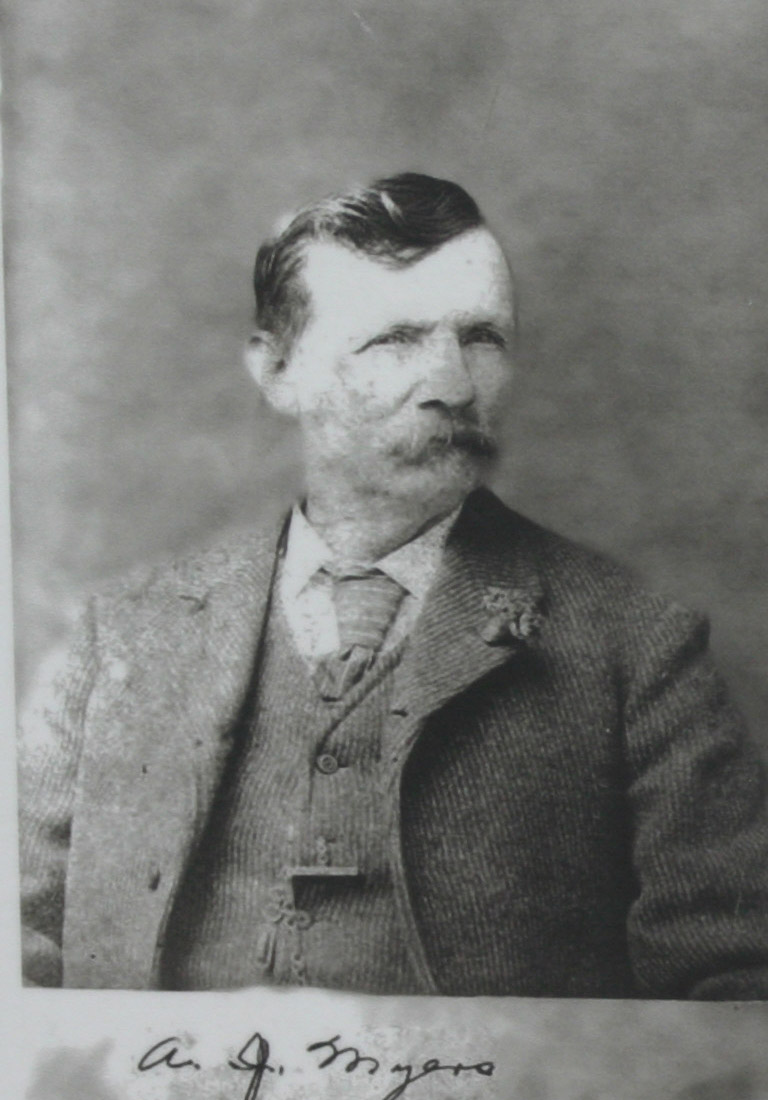
Andrew_Jackson_Myers

A. J. Myers, Oceanside pioneer. Credit: Wikipedia

A little background about the evolution of a city, gleaned from the columns of a long-defunct newspaper.

An item in the “Rays” column of the San Diego Sun (“Rays,” “Sun,” get it?) on April 21, 1883 included this item: “A. J. Meyers, of San Luis Rey, brought into market five dozen chickens yesterday. He says the business is a very profitable one.”

Andrew Jackson Meyers was a storekeeper who’d applied for a homestead grant in the San Luis Rey Valley, near the old mission. Poultry wasn’t the only business he found profitable. Subsequent “Rays” columns report this “merchant from San Luis Rey” dealing in real estate. Along with some business partners including Cave Couts and J. Chauncey Hayes, Meyers set about developing a new town. In the process, they developed a new name, suitable for their location by the sea.

Meyers sought to make the new name legal by applying for regular mail deliveries to the new community. In the meantime, he and his partners were already using it, and the local media of the day picked up on it.

“Oceanside, the new seaside resort of Southern California, at San Luis Rey depot, will be subdivided next week, and town lots placed on the market,” announced the Sun on April 28, 1883. “A first-class hotel, livery stable and general merchandise store will be established at once.”

On May 28, 1883, the U. S. Postal Department granted Meyers’ application, designating him the first postmaster of Oceanside, California.

The rest, as they say, is history.

Sources for this post included historic San Diego newspapers, the website for the city of Oceanside, and the books City of San Diego and San Diego County: The Birthplace of California, by Clarence Alan McGrew, and San Diego County Place Names A To Z, by Leland Fetzer.

Get Updates Automatically-Become A Follower of the San Diego History Seeker

You can get weekly updates of San Diego History Seeker automatically in your email by clicking on the “Follow” button in the lower right corner of the blog page. You’ll then get an email asking you to confirm. Once you confirm you’ll be an active follower.

History Happenings-Upcoming Events in the Local History Community

Join the Escondido History Center for their 4th annual Adobe Home Tour, Sunday, October 5 from 11 a.m. to 4 p.m. This year’s tour includes a ranch house (Bandy Canyon Ranch) and suggested finale at Hacienda de Vega restaurant, which was originally one of the first mid-century adobe homes in the area. Tickets $25 in advance, $30 day of tour. For further info visit http://www.adobehometour.com/ .

Escondido Public Library will host Escondido’s Surprising Connection to Balboa Park’s 1915 Panama-California Exposition, presented by Dr. Michael Kelly on Tuesday, October 21, 2014, at 6:00 p.m. in the Turrentine Room of the library, 239 South Kalmia Street, Escondido, California 92025. Kelly, President of the Committee of One Hundred and editor of Balboa Park and the 1915 Exposition, will also reveal the surprisingly significant and historic role the City of Escondido played in the planning of the 1915 Exposition.

Sponsored by Escondido Public Library’s Pioneer Room Friends, a support group dedicated to preserving and promoting Escondido Public Library’s local history and genealogy archive. Talk is part of the Friends’ annual meeting and will appeal to all local history enthusiasts. Library programs, events, and services are free and open to the public. For info contact Librarian and Archivist, Helene Idels at 760-839-4315 or visit http://library.escondido.org/ .


Hosmer and Fannie McKoon: 19th Century Power Couple

Hosmer P McKoon Land of Sunshine page

Excerpt from tribute to Hosmer McKoon on his death, published in June 1894 issue of the magazine Land of Sunshine.


For the week of September 8, I wrote a post called “Raisins and Real Estate” which talked about efforts in the late 19th century to promote San Diego County. It described the county’s exhibit at the California Midwinter Exposition in San Francisco in 1894 which included displays of the county’s produce and distribution of free samples of raisins as an added incentive.

One of the movers behind San Diego’s exhibit was Hosmer P. McKoon. The San Diego Chamber of Commerce was a prime sponsor of San Diego’s exhibit and McKoon was chamber president. He was also elected president of the “County Commissioners Club,” an organization of representatives of the various exhibiting counties.

Hosmer McKoon appears to have been a real go-getter, which is why he was chosen to lead various civic groups like the chamber and to represent the county at various conferences on development-related subjects in the late 1880s and early 1890s.

McKoon was a practicing attorney, having earned a law degree in his home state of New York before moving to San Francisco in 1876, where his clients included the Southern Pacific Railroad. He must have done pretty well because when he moved to San Diego County in 1885 he was able to purchase 9,500 acres in the El Cajon Valley. He named his spread Fanita Ranch, in honor of his wife Fannie. She, also a college graduate and native of New York State, married Hosmer in 1873. Two sons, Hosmer, Jr., and Henry, were born to them while they were living in San Francisco, and came south with them in 1885.

Like many movers and shakers in the county back then, Hosmer was serious about real estate. He regularly ran large ads offering parts of his ranch for sale. “I have sold within the last 30 days four tracts of ten acres each,” he wrote in an ad October 13, 1885 issue of the San Diego Union, “upon which four houses have been built and are now occupied by the purchasers. I will sell four other tracts of the choicest bottom lands in El Cajon Valley at $50 per acre to purchasers who will improve the same this season.”

At the same time, he also farmed. An article in the Union of September 5, 1889 on the first major exhibit of the newly-formed El Cajon Horticultural Society included this entry: “Hosmer P. McKoon exhibits some fine products of his famous Fanita Rancho. Among them are Boston Field….Black Wax, Mohawk and Marble beans, some splendid early Rose and Peerless potatoes of thirteen weeks’ growth, without irrigation; also some Southern Queen (sweet) potatoes. Two samples of the soil of Mr. McKoon’s ranch attracted attention for its great fertility.”

Hosmer led an active life, but a sadly short one. He died of Bright’s disease at the age of 49 in 1894. His widow Fannie recovered from her own illness and grief, raising her two sons and also taking over the business interests that her husband left behind, including property in the city of San Diego as well as Fanita Rancho.

She also was active in the local movement for women’s suffrage. In 1896, at an Equal Suffrage event, asked the question “Why should mothers want to vote?” Fanny gave this eloquent response to a Poway newspaper: “Mothers need the power of the ballot to protect their children after they have grown out of her arms and beyond the reach of their hands. For ages ‘mothers influence’ has battled with ‘effects.’ With the power of the ballot in her hand she can reach ‘causes’…”

During the last years of her life she lived in the city of San Diego, where she died in 1917 at the age of 66.

Get Updates Automatically-Become A Follower of the San Diego History Seeker

You can get weekly updates of San Diego History Seeker automatically in your email by clicking on the “Follow” button in the lower right corner of the blog page. You’ll then get an email asking you to confirm. Once you confirm you’ll be an active follower.

History Happenings-Upcoming Events in the Local History Community

Author Carol Fitzpatrick will speak on “Meriwether Lewis- Debunking the Myths of His Suicide,” at the next meeting of the Temecula Valley Historical Society, Monday, September 22, 6 p.m. at the Little Temecula History Center. Free and open to the public. For details call Rebecca Farnbach at 951-699-5148.

Rancho BEERnardo Festival at the Sikes Adobe Historic Farmstead, Saturday, September 27 from 3-6 p.m. Enjoy tastings choices from some of San Diego’s best craft breweries, live music food, and tours of the historic farmstead. 15 tastings for $30. Proceeds benefit local charities supported by the Rancho Bernardo Sunrise Rotary plus the Sikes Adobe Historic Farmstead. For further info visit http://ranchobeernardofestival.com/ .

Join the Escondido History Center for their 4th annual Adobe Home Tour, Sunday, October 5 from 11 a.m. to 4 p.m. This year’s tour includes a ranch house (Bandy Canyon Ranch) and suggested finale at Hacienda de Vega restaurant, which was originally one of the first mid-century adobe homes in the area. Tickets $25 in advance, $30 day of tour. For further info visit http://www.adobehometour.com/ .

“STRANDED ON THE DESERT”

That was the headline on an article in the Poway Progress of November 30, 1895. That’s how the article began as well.

“Stranded on the desert, within twenty miles of Banning, is where J. Chilson of Fallbrook, has found his son-in-law, Bud Russell, and family,” stated the article, which attributed the story to a Fallbrook newspaper.

Russell and his family were part of a wagon train that left Oklahoma (then Oklahoma Territory) a few months previously, headed for California, the article said. They ran into some trouble, not specifically described other than to say their journey “has proved a most disastrous one to the whole party.”

“Just how nearly destitute they are is now known,” the article continued, “but on Saturday Mr. and Mrs. E. C. Shipley and J. Chilson left Fallbrook with two teams [of horses], to assist their relatives and bring them to Fallbrook.” The members of the stranded party were said to be “in good health, though their horses are broken down.”

The Shipleys, Chilsons and Russells were all part of the same extended family, descended from Oliver Cook and his wife Clarissa. They were also somewhat used to traveling together, if their family history is any indication.

After over 20 years as a successful farmer in Kansas, Oliver Cook, then in his late sixties, decided to pull up stakes and move to California in 1885. With Kansas in a recession and train fares reduced due to railroad price wars, Cook convinced most of his extended family to come with him. Arriving on the same train that day at the Fallbrook depot were Oliver and his wife Clarissa, daughter Clarissa and husband Elmore Shipley and their two sons, and daughter Mary Elizabeth and husband Joseph Chilson and their three children. Oh yes, and one of the Chilson’s children, daughter Mary Alice, came with her husband, Allen “Bud” Russell, and two sons.

The Russell branch of the family wasn’t quite finished with traveling, migrating to what is now Oklahoma in 1892. Although that didn’t work out too well, the Russells would re-establish themselves successfully in Fallbrook.

You can find out more about this very enterprising—and mobile—clan in my book, Valleys of Dreams, available for sale through this website.

Sources for this post included the archives of the Fallbrook Historical Society and the research of Susan M. Hillier Roe, third great-granddaughter of Oliver Cook.

Get Updates Automatically-Become A Follower of the San Diego History Seeker

You can get weekly updates of San Diego History Seeker automatically in your email by clicking on the “Follow” button in the lower right corner of the blog page. You’ll then get an email asking you to confirm. Once you confirm you’ll be an active follower.

History Happenings-Upcoming Events in the Local History Community

Art Animates Life and San Marcos Historical Society present a live train ride thriller, “Passage Into Fear,” September 19-21 at Heritage Park. A historical stage thriller in the tradition of Hitchcock and Christie, the play is set during World War I in recognition of the war’s 100th anniversary. Proceeds support the San Marco Historical Society’s educational programs at Heritage Park. Tickets $9 for adults, $5 for 15 and under. For tickets or further info call 760-716-0107 or visit www.smhistory.org .

Join members of the Santee Historical Society for their annual Barn Bar BQ and General Meeting Saturday, September 20 at 11 am at the society’s headquarters, the historic Edgemoor Barn, 9200 Magnolia Avenue. Speaker will be yours truly, the San Diego History Seeker, speaking on the lives of pioneer residents Hosmer and Fannie McKoon. $2.50 a plate for members, $5 a plate for non-members (you can join on the spot). RSVP by calling 619-449-2024.

Author Carol Fitzpatrick will speak on “Meriwether Lewis- Debunking the Myths of His Suicide,” at the next meeting of the Temecula Valley Historical Society, Monday, September 22, 6 p.m. at the Little Temecula History Center. Free and open to the public. For details call Rebecca Farnbach at 951-699-5148.