A Most Noteworthy Event “In The Interior”

It was apparently quite a party for its day.

“Nuevo’s Town Hall” was the headline on an item in the San Diego Union on Saturday, February 24, 1894.

The subject was a dedication celebration for a new town hall two days previously, on Washington’s Birthday.

“It is reported to have been the most noteworthy event that has transpired in the interior for years,” proclaimed the Union article. “There were fully a thousand persons present, including representatives from this city and from every locality within a radius of a half-day’s drive of Nuevo, and all were entertained in a manner that will cause the pretty little town of Nuevo to be remembered.”

To those of you out there who may not quite be able to place the location of the “pretty little town of Nuevo,” here’s another clue from the article: “The hall was donated to the town by Augustus Barnett, a wealthy rancher of the neighborhood, and is to be under the care of a board of trustees selected by the citizens.

Still stumped? Well, you may not recognize the name because the name was changed not long after the building was dedicated. The hall, in fact, survives to this day as the Ramona Town Hall. The hall celebrated its 100th anniversary in 1994 and still functions as a community gathering place, still run by a board of local trustees. It’s also been proclaimed a county, state and national historic landmark, and is well worth a visit. Find out more at the website: http://ramonatownhall.com/ .

Get Updates Automatically-Become A Follower of the San Diego History Seeker

You can get updates of San Diego History Seeker automatically in your email by clicking on the “Follow” button in the lower right corner of the blog page. You’ll then get an email asking you to confirm. Once you confirm you’ll be an active follower.
Changes from the Sky to the Ground

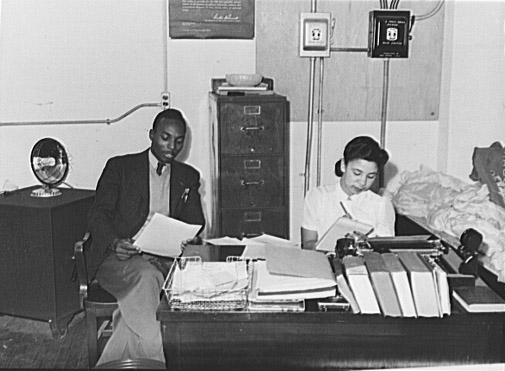
Below is a photo from the National Archives of the United States, part of a collection of World War Two-era photos depicting various aspects of life in San Diego during the war:

Pacific Parachute Company office, April 1942 - Copy


It was a time that profoundly changed San Diego City and County. The city’s population grew almost 200 percent just between 1940 and 1943.

This photo is an example of one particular change during that era. The original caption reads, “Office of the Pacific Parachute Company, 1942.”

Several other photos of that particular company identify the man in the photo as Howard “Skippy” Smith, “Manager.”

When the company opened its doors at 627 Eighth Avenue in downtown San Diego in March 1942, it was proclaimed as the first defense plant in the city, and arguably the first in the nation, to be managed by an African-American.

Smith had been a skydiving star in Hollywood airshows before becoming an inspector in the parachute industry. His time in Hollywood also got him the support of Eddie Anderson, famous then as the sidekick “Rochester” to comedian Jack Benny on the stage and the radio.

Anderson invested in the plant and was there as a celebrity guest at the opening, along with delegations representing the mayor’s office, the governor’s office, union officials and contingents of male and female paratroopers and ground troops.

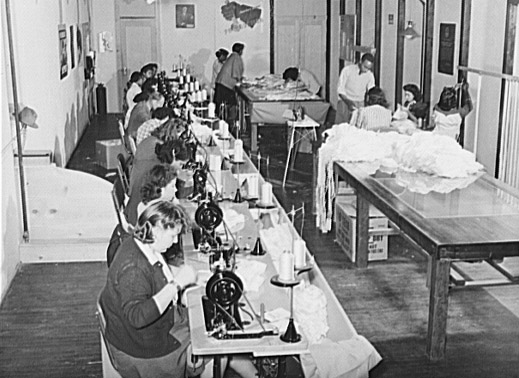
The white and black soldiers present that day were in racially segregated units, as was the rule in those days. But the company’s workforce was integrated, as demonstrated by another photo of the main workroom:

Workroom, Pacific Parachute Co


Get Updates Automatically-Become A Follower of the San Diego History Seeker

You can get weekly updates of San Diego History Seeker automatically in your email by clicking on the “Follow” button in the lower right corner of the blog page. You’ll then get an email asking you to confirm. Once you confirm you’ll be an active follower

WPA: The Work They Did Shapes Our World Today

A headline in the San Diego Union on Sunday, September 20, 1936 proclaimed:

“$400,000 Zoo Improvement Program Near Completion,”

The program, including construction of an aviary, a reptile house and an amphitheater for educational and community programs, extensive landscaping, and new sewer and drainage systems, “will be completed this fall, Mrs. Belle Benchley, curator, announced yesterday,” the article stated.

Curator Benchley pointed out the “The entire program was a WPA project.”

The reptile house and some other WPA-built facilities at the zoo continue to serve their animal occupants and zoo visitors today. They are worth visiting in and of themselves, of course, and also worth remembering as part of the enormous contribution to the nation’s public facilities and infrastructure made by the WPA, the CCC and other New Deal programs instituted during the Great Depression of the 1930s.

Some other examples of San Diego structures that began as part of WPA projects are the Old Globe Theater in Balboa Park and the Open Air Theater on the SDSU campus. Not to mention schools, sewage treatment plants, murals and soil reclamation projects all over the county. This heritage is being rediscovered and preserved through the Living New Deal Project, which tracks past and still existent public works projects built during that era across the United States.

I heartily recommend a visit to the project’s website: https://livingnewdeal.org/ .

Reminder:Schedule Change

Due to mounting work demands, I’ve gone to an every-other-week schedule. So look for the next new post on February 15. Feel free, in the meantime, to enjoy past posts or check out my books, offered for sale under the “Books” tab.

Get Updates Automatically-Become A Follower of the San Diego History Seeker

You can get weekly updates of San Diego History Seeker automatically in your email by clicking on the “Follow” button in the lower right corner of the blog page. You’ll then get an email asking you to confirm. Once you confirm you’ll be an active follower

Back Country Back Stories

The 1860 United States Census offers a glimpse into San Diego County life at a time when California was just twelve years removed from having been a part of Mexico. Below is part of a page from that census showing the household of one Henry Clayton.

Henry Clayton census

The census indicates that Henry is 45 years old and his occupation is listed as “Ranchero/Stock Raiser.” It also shows that he owned real estate valued at $12,000. That was big money in 1860, and his $3,000 in personal property was a pretty big chunk of change at that time as well.

The last column on the right shows Clayton’s birthplace as England. So, it might look like another case of an English boy who made good in California. But there are some complicated back stories behind these statements and statistics.

English immigrant Henry Clayton originally came to California as a surveyor with the Mexican-United States Boundary Commission. The commission was set up under the treaty that ended the U.S.-Mexican War in 1848 to establish the new boundary line between the two countries.

Clayton subsequently continued to work as a surveyor after the commission’s work was done. He served as surveyor of both San Diego City and County, as well as county assessor, for periods during the 1850s and 1860s.

His work as surveyor undoubtedly put him in contact with the Californio owners of ranchos originally granted by the Mexican government. And Henry Clayton wound up marrying one of them. The name listed immediately below Henry’s on the census form, written in period shorthand as “Maria Ant” with a tiny a in the corner, was in fact Maria Antonia Alvarado Snook Clayton.

Maria Antonia Alvarado was the daughter of a prominent San Diego family when she married Don Jose Snook, another transplanted Englishmen, in 1837. At his death in 1848, Don Jose was the owner of Rancho San Bernardo, covering 17,000 acres in north San Diego County.

In his will Don Jose left his widow Maria a life estate in the rancho, and she actively pursued her right to use the property in the first years after her husband’s death. Among other things, according to a 1997 essay by Ruth Collings in The Journal of San Diego History, Maria “added a fleur-de-lis to [her late husband’s original cattle] brand and registered it as her own. Lured by the high prices for beef in San Francisco, she sent cattle north for several years.”

In 1853 Maria married Henry Clayton, and her role in owning and running Rancho San Bernardo was apparently and unjustly eclipsed–in the mind of the census taker anyway–by that of her new husband.

But Maria remains more well-known in county history than the six other people listed as part of the Clayton household. Five of them are ranch employees, all natives of Mexico, ranging in age from 25 down to 14. The fourteen year-old, Antonio Bonia, is listed as a “monthly laborer,” as are two others, aged 25 and 16. Juan Navarro, 19, works as a “vaquero.” Another, listed only as “Alvarado,” is a shepherd. An 8-year old girl named Maria Alvarado appears to be a relative of one of the employees.

Sources for this post include the 1860 United States Census, the essay, “Joseph Snook: English Mariner, California Don,” from the Fall 1997 issue of The Journal of San Diego History and the 1908 book History of San Diego, by William E. Smythe.

NOTE: Schedule Change

Due to mounting work demands, starting today I’m going to an every-other-week schedule. So look for the next new post on February 1. Feel free, in the meantime, to enjoy past posts or check out my books, offered for sale under the “My Books” tab.

Get Updates Automatically-Become A Follower of the San Diego History Seeker

You can get weekly updates of San Diego History Seeker automatically in your email by clicking on the “Follow” button in the lower right corner of the blog page. You’ll then get an email asking you to confirm. Once you confirm you’ll be an active follower

A Man Called Rainbow

Mr. Rainbow

Poway Progress, July 21, 1894, p. 4.

It was a good week in the county for rain, and also for rainbows. With the sun intermittently coming out between the showers in my neighborhood, I observed four or five in one day. This, naturally, led me to think of the small valley near Fallbrook called Rainbow (yes, readers, this is how my brain works). And I remembered my surprise at discovering that this valley didn’t get its name from anyone ever seeing a rainbow over it or anything like that, but was rather named for a real live person: J. P. M. Rainbow.

James Peebles Marshall Rainbow, usually referred to as J. P. M. Rainbow, came to San Diego County from his native Pennsylvania in 1875. He settled in the Fallbrook area with his wife Augusta and began growing fruit.

He apparently did pretty well as a farmer.

“Mr. Rainbow had the honor of shipping the first carload of fruit that was ever shipped from this county,” stated an article in the Poway Progress newspaper in July, 1894. The shipment “consisted of muscat grapes grown upon his twenty-acre ranch near Fallbrook.”

While working at his own ranch, the article noted that Rainbow “has found time to assist in locating a colony of twenty other families in its neighborhood, and today their holdings are largely planted in deciduous fruits.”

Rainbow also found time to serve in county government. He was elected to the county board of supervisors for two terms, from 1882 to 1884 and again from 1891 to 1895.

When J. P. M. Rainbow died in 1907 at the age of 71, the San Diego Union saluted him as “for many years a well-known and respected resident,” and concluded its obituary by stating “The town and post office of Rainbow, near Fallbrook, was named in his honor.”

The Rainbow post office closed in 1914, but the name remains.

Sources for this post included historic San Diego and Poway newspapers, the book San Diego County Place Names by Leland Fetzer, and the database Records of Appointments of Postmasters, 1832-1971 at the National Archives.

Get Updates Automatically-Become A Follower of the San Diego History Seeker

You can get weekly updates of San Diego History Seeker automatically in your email by clicking on the “Follow” button in the lower right corner of the blog page. You’ll then get an email asking you to confirm. Once you confirm you’ll be an active follower