Runaways-And You Thought Freeway Driving Was Dangerous?

The Poway Progress column on happenings in Encinitas in the January 16, 1894 issue included this item: “Mr. Johnson, who brings meat here, was hurt in a runaway last week.”

A week later the same newspaper’s “County Compend” column included this: “The best rig of J. Chauncey Hayes of Oceanside was demolished in a runaway.”

“Runaway” then meant a runaway horse or team of horses. The use of that single term suggests how often such incidents happened in an era when a horse-drawn vehicle, or “rig,” was the principle means of transportation and commerce. The fate of Mr. Hayes’ “best rig” indicates that, in today’s parlance, his family car was totaled.

A May 1895 runaway on the stage line serving Alpine lasted five miles and resulted in some damage to the stagecoach, according to a brief newspaper account. There was no mention of any driver or passengers so presumably the stage was empty at the time.

A far different and more dangerous incident took place in the city of San Diego in 1882 in the midst of a funeral cortege heading from the church to the cemetery. The drivers of a carriage transporting the pallbearers discovered one of the reins was broken. When one driver suddenly jumped down off the carriage it spooked the horses and they took off.

The other driver leaped off, followed by each of the pallbearers “as the team without guide or line left the procession and ran wild over the adjoining, uneven rocky ground,” according to the account in the San Diego Sun. The driver of another wagon, Luis Machado, got down from his wagon, harnessed one of his horses, and took off in pursuit of the runaways. He managed to catch up to them and subdue them.

The drivers and the pallbearers, uninjured, still managed to make the funeral, the Sun reported.

In a July 1896 incident a Poway Valley resident, Miss Louise Cravath, matched Mr. Machado in courage and horsemanship, if not success. Driving a buggy led by a two-horse team on a trip from Poway to Escondido, she stopped at a neighboring family’s place to take some produce to market for them.

“While she was out of the buggy the team was startled by some noise and started off without their driver,” reported the Poway Progress. Cravath, “ being an expert with horses, made chase for and overtook them, and would have stopped them at once, but by some means she fell, or was thrown so that the buggy wheels passed over her with, fortunately, but little injury…”

The gutsy Louise wasn’t finished. “Our heroine,” stated the Progress, “at once secured and mounted a horse, determined not to be beaten in that fashion, and started off after the runaways.” Unfortunately the horse, apparently belonging to her neighbors and so not familiar with Cravath, reared and threw her off its back.

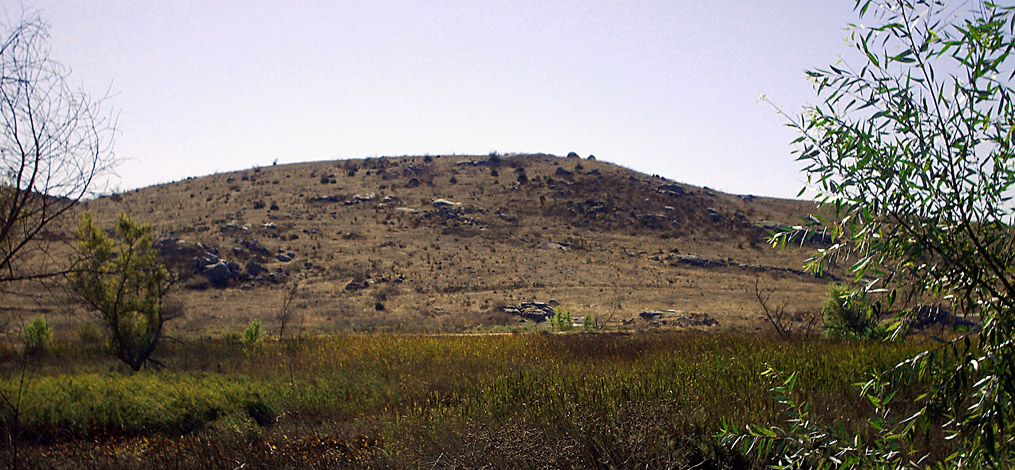
The runaways ran up a knoll covered with rocks and boulders “where the team and buggy became separated after considerable damage to the latter,”the article stated, adding, “We are glad to state that the young lady escaped with but little injury.”

Those runaways turned out okay for the animals and humans, if not the vehicles. However, more serious incidents took place as well, leading to fatalities for people as well as livestock.

Upcoming History Events

Jim Bregante talks about life in Little Italy and the San Diego waterfront from the 1930s to the present on Wednesday, February 19 at 10 a.m. at the Rancho Bernardo Historical Society Museum. The program is the latest in the Rancho Bernardo Historical Society’s Speakers Series. For further information go to http://www.RBHistoricalSociety.org.

_________

Celebrate Valentine’s Day with tea at the Sikes Adobe Historic Farmstead. Seatings for tea, sweets and sandwiches are planned for three Sundays in February, the 9th, 16th, and 23rd.  A $10 ticket includes tea and snacks plus a tour of this historic 19th century farmhouse. For further details go to www.sdrp.org .
Escondido: They Had A Plan

Old newspapers are a great source of history, and not just in the headlines or regular news columns. This was one of numerous items listed under “Real Estate Transactions” on page 3 of the San Diego Union, March 10, 1886: “Escondido Company to Escondido Land and Town Company, all that tract of land known as the ‘Rincon del Diablo,’ containing 12,633 77-100 acres; $104,042.56.”

“Many tracts of from ten to forty acres can be sold as soon as the surveyors shall have completed their work,” read a brief news item, datelined Escondido, immediately following the listing.

The Escondido Land and Town Company (ELTC) was organized in the early 1880s by a group of businessmen led by Jacob Gruendyke and five brothers, A. Richard, William W., John R., George V. and Charles F. Thomas. The company purchased the vast rural acreage of the former Mexican land grant Rancho Rincon del Diablo with the goal of building a town. The ELTC had a plan.

They hired a surveyor to plot out townsite lots. Simultaneously they began constructing a fine hotel to house prospective land buyers. The three-story, 100-room Escondido Hotel was up within the year.

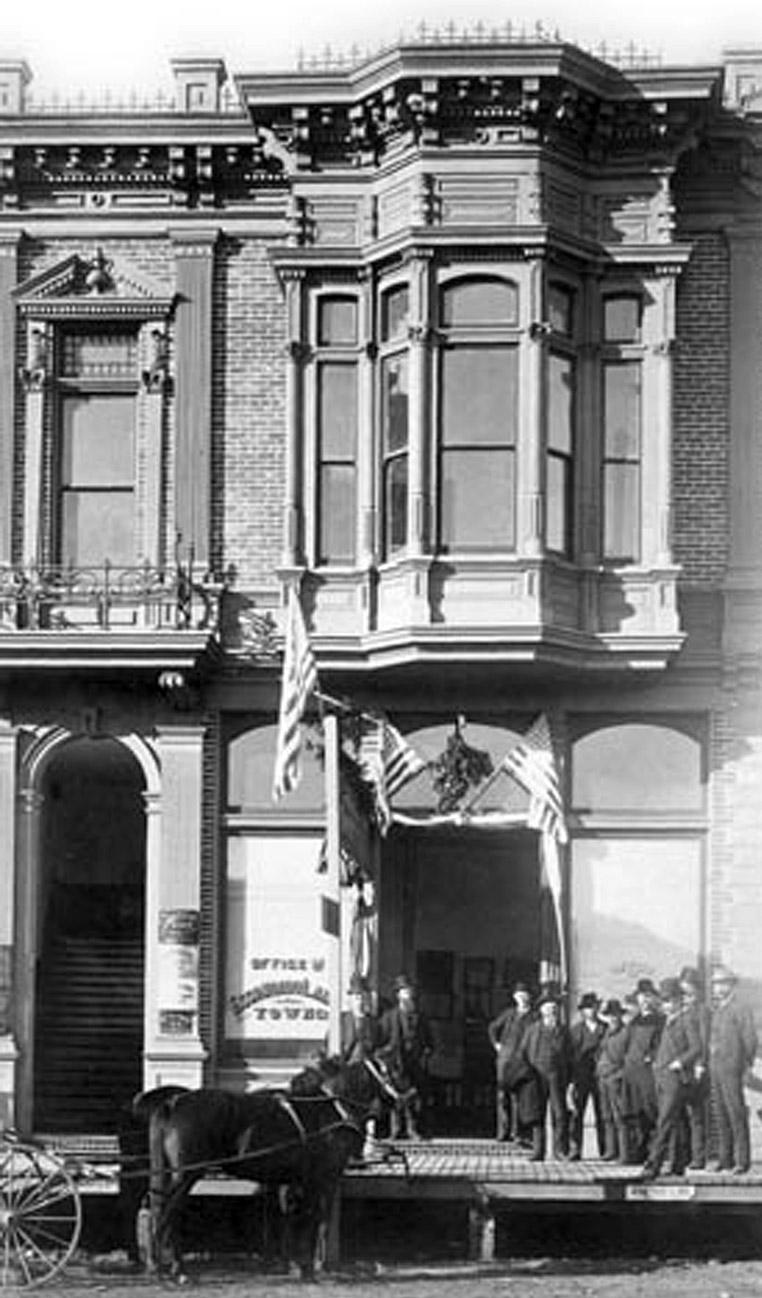
The company built a headquarters, shown here courtesy of the Escondido Public Library’s Pioneer Room:

Escondido Land and Town Co

They also built some model homes and even a “model ranch,” a working farm to demonstrate the advantages of Escondido’s climate and soil.

They created a newspaper, the Escondido Times. The Escondido Times inaugural issue, published May 1, 1886, was undoubtedly printed in the city of San Diego since the paper predated the city of Escondido’s existence. Since there was likewise no readership yet in Escondido, the ELTC paid for the distribution of the Escondido Times across the United States. By late 1886 the paper was being published locally, but ELTC was still paying for the national distribution of 1,000 copies per issue per year. For at least the next three years, the company also paid for two full columns of advertising in each issue.

Looking at copies of the Escondido Times from that period on microfilm in the Pioneer Room today, one finds that ELTC ad campaign readily apparent. Every issue carries front page ads with prominent photos of the Escondido Hotel, palm trees, and fields of lush crops, accompanied by articles on the wonderful climate and fertile soil of what ELTC called “the sunkist vale.”

The company also invested in getting the Santa Fe Railroad to build a line from Oceanside to Escondido. Service began in January 1888. The railroad made the new town an important shipping point connecting local farm products to markets in Los Angeles and across the country. It was also crucial for the promotion of the town as a destination for travelers, settlers and investors.

When the Santa Fe erected a depot on the west end of Grand Avenue, the Escondido Hotel, which stood on a knoll on the east end of the street, inaugurated a free shuttle service to and from the depot by horse-drawn, surrey-topped bus. Specially organized “Booster Excursion” tours brought crowds of tourists and prospective settlers.

The company’s plan worked. Escondido was incorporated as a city on October 1, 1888.

Upcoming History Events

Celebrate Valentine’s Day with tea at the Sikes Adobe Historic Farmstead. Seatings for tea, sweets and sandwiches are planned for three Sundays in February, the 9th, 16th, and 23rd.  A $10 ticket includes tea and snacks plus a tour of this historic 19th century farmhouse. For further details go to www.sdrp.org .
Vista’s Rose Parade Moment: A Five-Foot Avocado

How important was avocado growing in Vista?

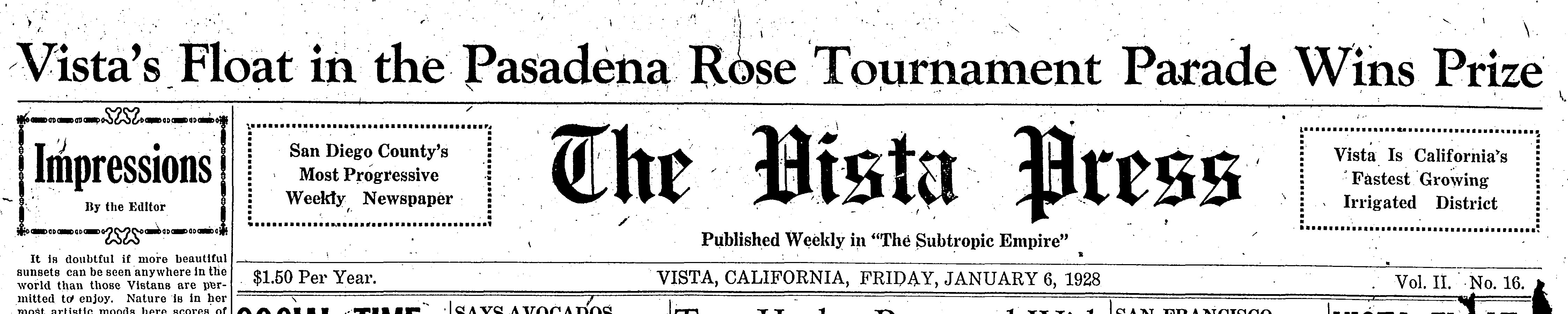
Take a look at this banner headline on the front page of The Vista Press for the week of January 6, 1928:

Vista Press banner headline Avocado float

“Vista did herself proud at the Pasadena Tournament of Roses last Monday with her beautiful and novel avocado float,” the article began. The float was sponsored by the Vista Chamber of Commerce and assembled by a committee composed of chamber members along with members of the local horticultural society. The article saluted the backers and the assemblers for their “enthusiasm and teamwork” in creating the float.

The float, 10 feet long by 27 feet wide, was, in the words of the article, “intended to represent the rolling lands of the Vista district, the whole surrounded by an immense avocado…”

The base was a field of foliage, including strawberry vines interspersed with white and pink carnations, poinsettias, pepper boughs and holly. There were some small avocado trees representing an orchard, and “at each corner of the float a larger avocado tree bearing fruits was placed,” read the account.

Dominating this scene was a giant avocado, “which was 42 inches in diameter and 60 inches in height.” The big fruit was made out of thousands of avocado leaves, “pinned on in such a manner that the large imitation of a fruit was very realistic and attracted undivided attention while it was passing the countless thousands who lined the route of the great parade.” One man was even said to have thought the big fruit was made of “wax or plaster of paris…”

The float was entered in Class A-2 in the parade competition and “was awarded a special prize, a silver cup, which is now being suitably engraved and will be forwarded soon to Vista. “

The article concluded by stating that “Thousands of people were impressed with the novelty of the float and immediately began asking about Vista, and where to find this great land of the avocado and other subtropical fruits—‘The Subtropic Empire.’”

It’s not evident how much the nickname “Subtropic Empire” caught on, but the title of “Avocado Capital of the World” was prominently associated with Vista for a number of years, according to Harrison and Ruth Doyle’s book, A History of Vista. Until the late 1940s, Vista was home to the largest avocado packing plant in the United States. But as the Doyles and other chroniclers of San Diego County’s agricultural history have pointed out, the title of “Avocado Capital of the World” was traded among a number of north county communities over time. That, however, is a story in itself.

To read the entire 1928 Vista Press article, visit the Vista Historical Society website, http://www.vistahistoricalsociety.com/ . The home page contains a digitized archive of the newspaper. Click on the year 1928 and find the January 6 issue.

Upcoming History Events

“The Archaeology of Childbirth” is the subject of a lecture this Saturday, February 8 from 11 a.m. to noon at the San Diego Archaeological Center. Cara Ratner, M.A., Education Program Director at the center, will discuss the biology and evolution of human beings in relation to childbirth and the cultural and archaeological aspects surrounding it.  Free to center members, $5 per person for non-members. For further details, visit http://www.sandiegoarchaeology.org/ and click on the “Events” tab.

____________________________

Celebrate Valentine’s Day with tea at the Sikes Adobe Historic Farmstead. Seatings for tea, sweets and sandwiches are planned for three Sundays in February, the 9th, 16th, and 23rd.  A $10 ticket includes tea and snacks plus a tour of this historic 19th century farmhouse. For further details go to www.sdrp.org .
“We have had a rain.”

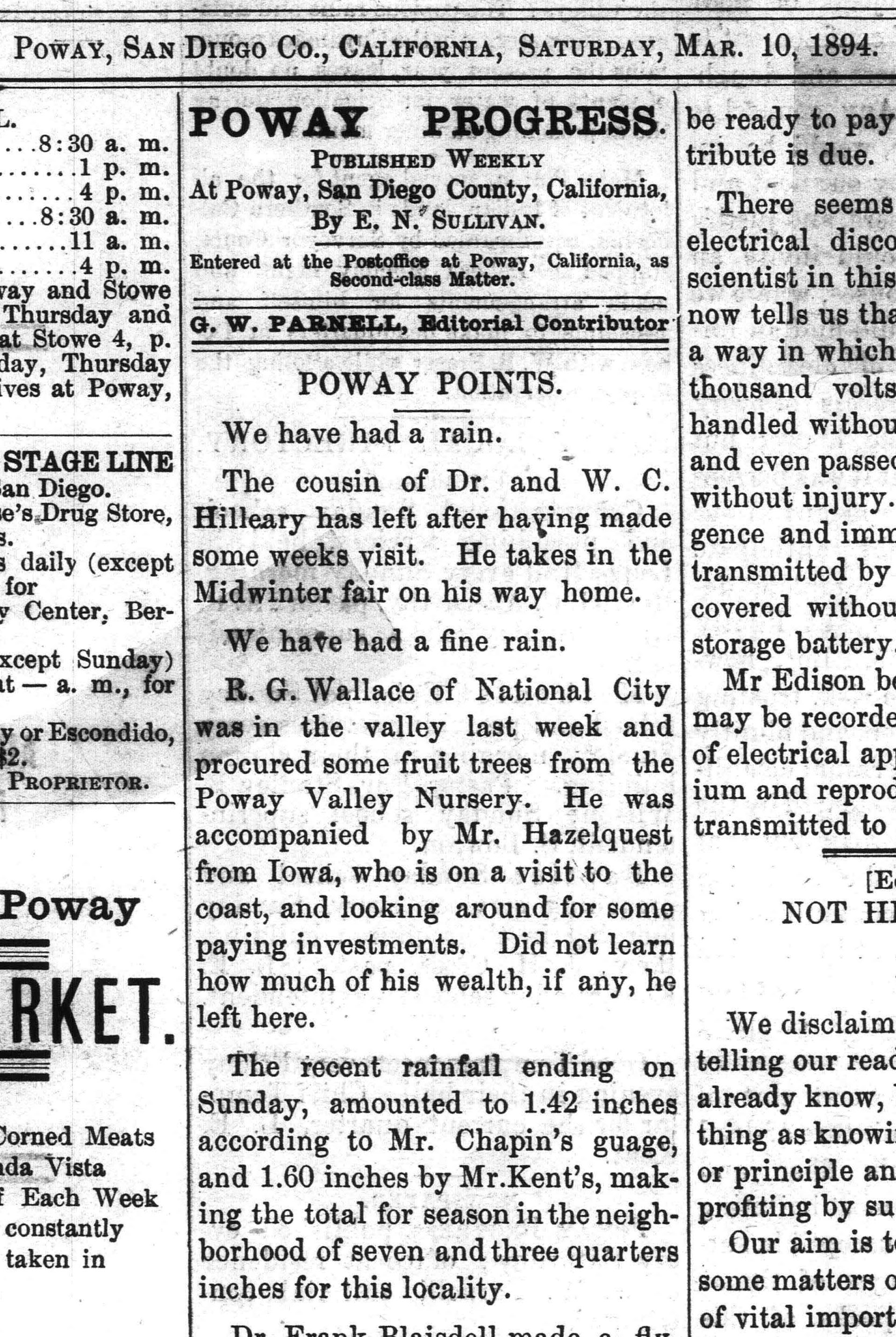
No, that’s not a recent headline. Unfortunately. But as our region and the entire state confront serious drought conditions today, that sentence from an 1894 newspaper article demonstrates that rain or lack of same has been a historic issue for San Diego County.

Below is a partial reproduction of the front page of the March 10, 1894 issue of the Poway Progress, a weekly that was published out of the Poway Valley from 1894 to 1897.

Poway Progress, page 1, March 10, 1894

“Poway Points,” a column that usually appeared on the front page, ranged from hard news to local gossip and points in between. The paper also ran similar columns on other communities with headings like “San Diego Siftings” and “Lakeside Letters.”

The March 10, 1894 issue’s “Poway Points” starts with the sentence, “We have had a rain.” The writer then shifts topics in the next paragraph to some out-of-town visitors staying with a local family, the Hillearys.

But the editor isn’t through talking about the weather. That paragraph is followed by this simple declarative sentence:

“We have had a fine rain.”

And he still wasn’t through. He follows another paragraph about a visitor from National City buying fruit trees from a local nursery with this:

“The recent rainfall ending on Sunday, amounted to 1.42 inches according to Mr. Chapin’s gauge, and 1.60 inches by Mr. Kent’s, making the total for the season in the neighborhood of seven and three quarters inches for this locality.”

The Chapins and the Kents were pioneer settlers in the Poway Valley, involved in agriculture. Their strong interest in the rainfall, shared obviously by the editor and publisher of the Poway Progress, reflected the predominantly agricultural character of the valley at the time.

From the time that cattle ranching gave way to farming in the mid-1800s until 1954, Poway remained a sparsely populated rural community dependent on individual wells and rainfall.  While the valley’s population swelled to 800 in 1887, by 1891 it had shrunk back to 250, according to newspaper accounts at the time.

Drought played a big role. A local building boom went bust during the same period, followed by the onset of economic depression in the county and across the country. However, better economic times didn’t translate into population growth. The population of the Poway Valley in the 1930 census stood at just 367.

In her 1993 book “Paguay,” historian Louhelen Elizabeth Hassan sums up Poway’s history from 1900 to 1954 in this way: “While the population expanded and contracted in rhythm to the rainfall cycles, the community remained essentially unchanged for another half century when the introduction of Colorado River water altered it forever.”

Upcoming History Event

Come hear the cannon roar and learn about the bloodiest battle of the Mexican-American War: the battle of San Pasqual. The San Pasqual Battlefield Volunteer Association stages Living History Days the first Sunday of every month-except for July, August and September. Join them Sunday, February 2 at San Pasqual Battlefield State Historic Park. Black powder demonstration and cannon fire at 11:30 a.m. and 1:30 p.m. Admission free. For more info visit: www.spbva.org .

Picturesque San Diego

Picturesque San Diego is a book which offers a fascinating visual and narrative view of San Diego city and county in a bygone era.

The book was published in 1887 by Douglas Gunn, who was editor and publisher of The San Diego Union from 1873 to 1886, and served as mayor of the city of San Diego from 1889 to 1891. A strong promoter of, and investor in, the development of San Diego, Gunn decided in 1887 to create a book describing the city and county in both text and quality photographs.

He hired a prominent Los Angeles-based photographer, Herve Friend, and from March to July they traveled around San Diego County, covering an estimated 1.500 miles according to Gunn in his introductory note. The book was published in October 1887. It’s 98 pages with 72 photographs.

San Diego County in 1887 was a place where the livestock literally outnumbered the humans. Gunn demonstrates that quite emphatically. In a section on county agricultural products, he gives the following breakdown of the livestock population for the whole county:  “Horses, 8,755; Mules, 2,552; Horned Cattle, 33,548; Sheep, 202,548; Hogs, 22,815.” Add them all up and you get a total livestock population of 270,218.

By contrast, the human population for San Diego County at that time stood at about 30,000.

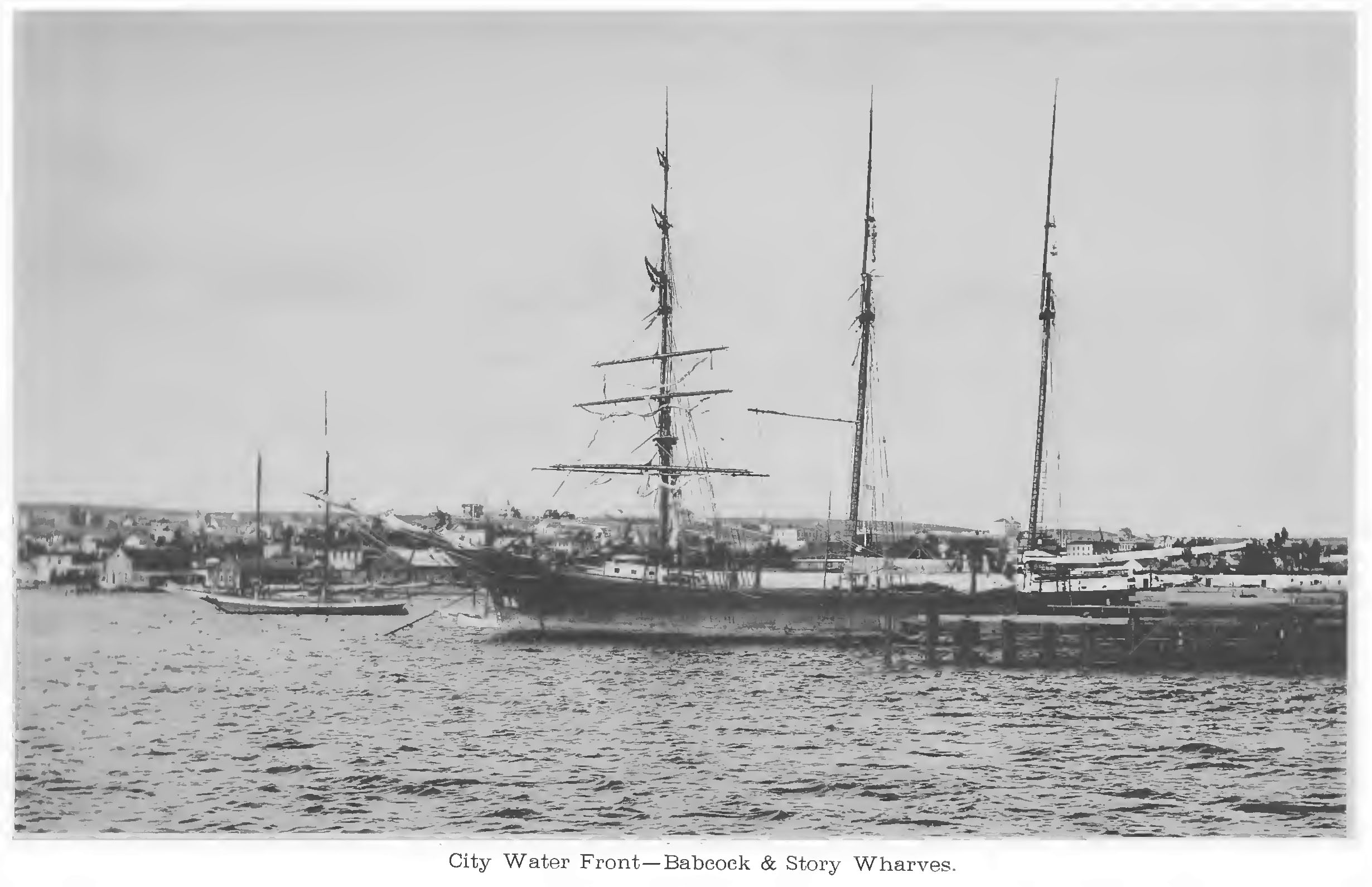
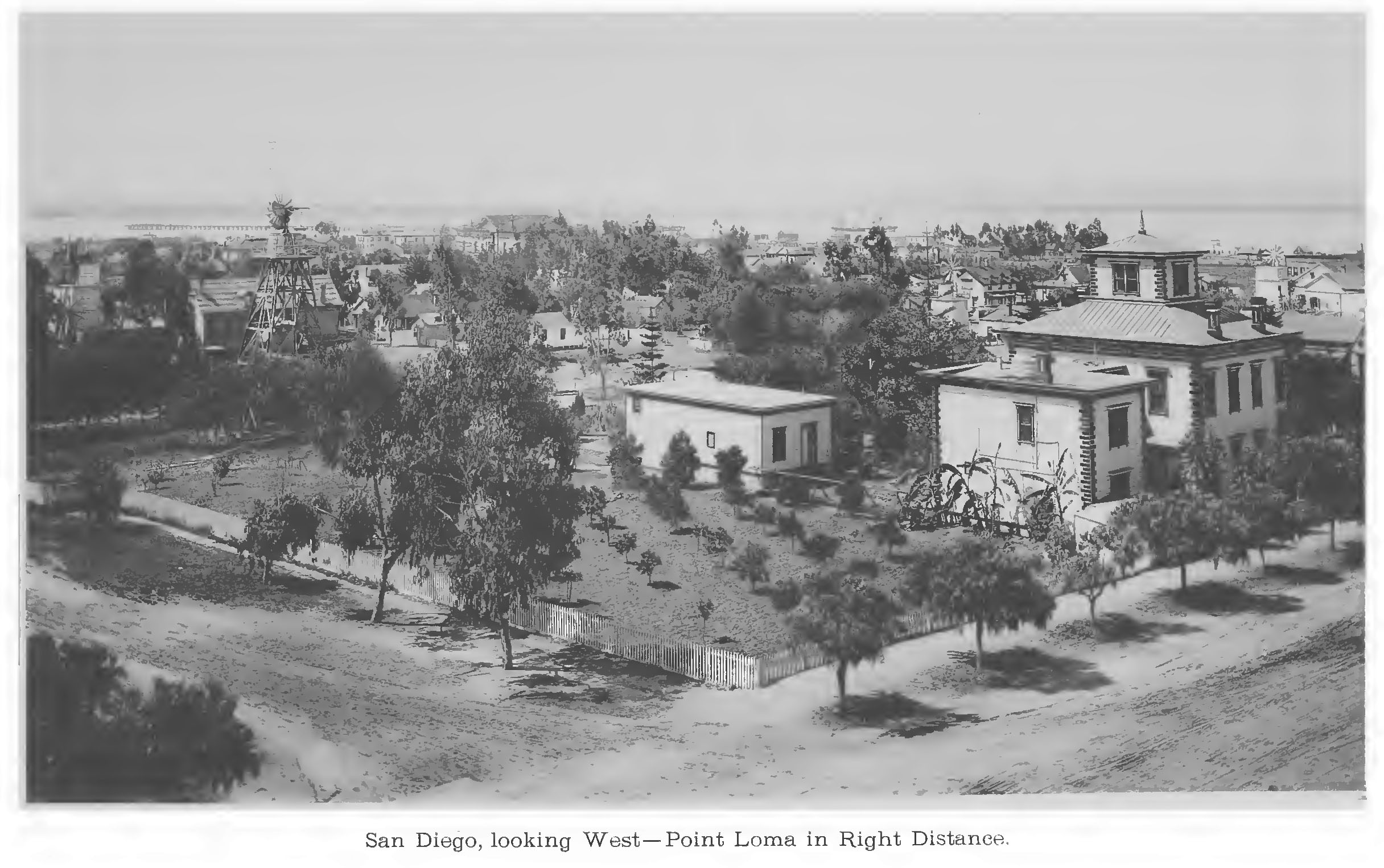
Yes, it was a very different San Diego County from the one we know today. That point is underscored by some representative photos from the book. Here are two of the city of San Diego:

PSD47

The caption reads, “San Diego looking West-Point Loma in Right Distance”

PSD53

Caption: “City Water Front-Babcock and Story Wharves”

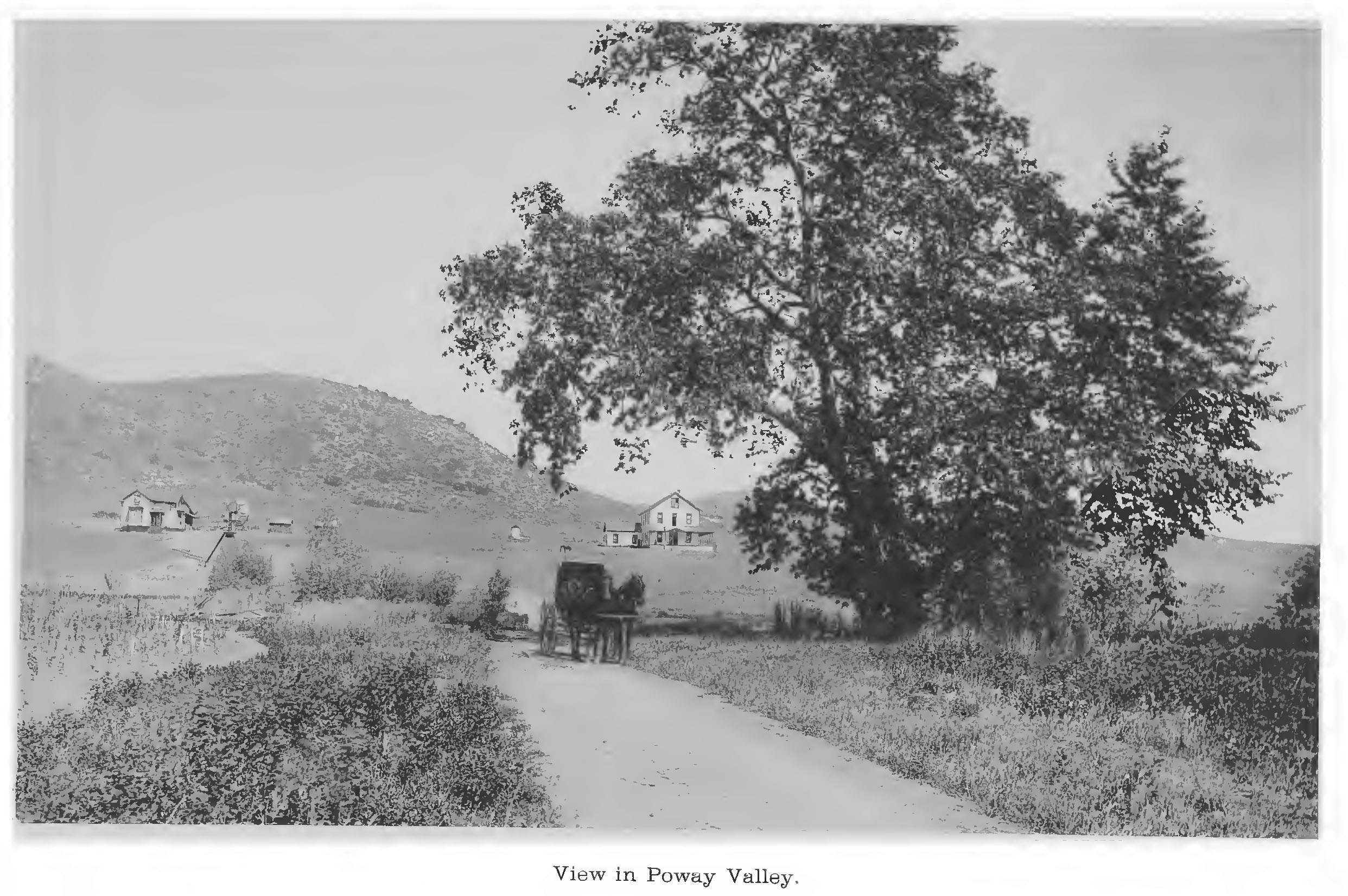
Here’s one from North County:

PSD161

Caption: “View in Poway Valley”

Yeah, that’s Poway in 1887. In the book Gunn describes Poway as  a “rich agricultural valley” with a population of “about 800” and “one of the most flourishing settlements in the county.” Yet within a few years the onset of drought would drive out many residents, reducing the population down to 250. Gunn wasn’t around for that change, or for other circumstances that would belie some of his more boosterish claims. He invested a lot, emotionally and financially, in the city and the region, and that was arguably his undoing. We’ll return to Picturesque San Diego in future blog entries.  It offers a lot of facts, impressions, and contradictions, especially in hindsight.

If you’d like to see the book for yourself, go to  https://archive.org  , and search for it by title.