Snook, Forster and Warner: The Three Anglo Rancheros

When I give a talk on the history of Rancho Bernardo, I always get chuckles when I describe the case of Don Jose Snook.

Snook was an Englishman by birth, born in Weymouth, Dorsetshire on the southern coast of England in 1798 into a family of agricultural laborers. Seeking a better life, he went to sea, and by 1830 he was a captain, commanding ships for merchants trading goods between ports in California, Mexico and Peru. California was then Alta California, a province of Mexico.

After winning its independence from Spain in 1821, Mexico was anxious to colonize its northernmost territories, fearing, as the Spaniards had, the encroachment of foreign powers including the United States.

So the Mexican government offered massive tracts of land to anyone agreeing to settle on and work the lands.

During his times ashore in California, Captain Snook fell in love with the place and wished to acquire some land. In order to do so under the then Mexican government, Snook had to become a Catholic and a Mexican citizen. So in April 1833 he petitioned for a letter of naturalization. It was granted two years later, and in November 1835 he was baptized.

The baptism took place at Mission Santa Clara in northern California. The baptismal record, in the mission archives in Santa Barbara, gives his birth name and also the baptismal name he chose, Jose Francisco de Sales. There is a reference to his being of English descent, and of Protestant religion. From thenceforward, he would become Jose Francisco de Sales Snook. Sounding out that name for an audience, with a slight pause before “Snook,” always elicits the chuckles.

Snook’s baptism occurred in northern California because he apparently liked it better up there. Jose acquired a grant for a rancho north of San Francisco in 1836, hoping to settle down there with Maria Antonia Alvarado, the daughter of a prominent San Diego family, whom he wished to marry.

Don Jose and Maria did indeed marry in 1837. However, Maria didn’t want to live in an area that was then the northern frontier of Alta California, and her young husband soon sold the rancho there.

Sometime in 1841 Don Jose petitioned Mexican authorities to grant him the then-vacant Rancho San Bernardo. Territorial governor Juan Bautista Alvarado, who happened to be a cousin of Maria’s father, approved the grant in February 1842.

Don Jose Snook was far from the only person from an Anglo background to go through such a metamorphosis in Mexican California. Some of the numerous examples include John Forster, another Englishman who became Don Juan Forster and owned several ranches in the San Diego area. And how about Jonathan Trumbull Warner, a Connecticut Yankee who became Juan Jose Warner, proprietor of the ranch and springs that still bear his name?

Early examples of multiculturalism? Or the melting pot? Or a merger of both? Hey, that’s history for you.

__________

Sources for this post included the essay, “Joseph Snook: English Mariner, California Don,” by Ruth Collings, from the Fall 1997 issue of The Journal of San Diego History, the Santa Barbara Mission Archive-Library, and two books, Some Old Ranchos and Adobes by Philip S. Rush and History of San Diego County Ranchos by Robert W. Brackett.

History Happenings-Upcoming Events in the Local History Community

Escondido History Center and Escondido Citizens Ecology Committee co-sponsor Tuesday evening walking tours of historic city sites twice a month from April through August. For details visit: http://www.escondidohistory.org/2014_walking_tour_brochure.pdf .
 

A Look At An Earlier Tax Deadline

Since April is the month for filing income taxes, the History Seeker looks back to an earlier and historically significant filing deadline.

The first federal income tax had been passed by Congress during the Civil War, then repealed in 1872. Congress passed another one in 1894 only to have it struck down as unconstitutional by the U. S. Supreme Court.

The sixteenth amendment to the U.S. Constitution, passed by Congress in 1909 and ratified by the requisite number of state legislatures by early 1913, established the federal power to tax incomes. An income tax was included in tariff legislation passed by Congress in October 1913 and signed by President Woodrow Wilson the same month, with a tax filing deadline set for March 1, 1914.

In the months between the law’s passage and the filing deadline, the San Diego Union ran a daily “Income Tax” column publishing readers’ questions and providing answers on how to comply with the new law. Several columns provide a picture of how San Diegans dealt with tax preparation at that point.

The column of February 22 reported on “a puzzled real estate dealer…who applied to the financial department of the Union yesterday” to determine how much of his gross income was taxable.

In going over the details, the Union discovered that “the gentleman, although of sufficiently keen insight into business and handling real estate to secure an income during 1913 which made him subject to the income tax, kept no books, but carried the bookkeeping end of his business ‘in his hat.’”

The amazed columnist asked readers, “How long think you would a bank, which sells money, a store selling groceries, a doctor selling his professional services, or an attorney doing likewise, conduct their several businesses at a profit if they kept no books?”

The rest of that column elaborates on the need to keep careful records. It also reminded taxpayers that their forms “should be posted prior to March 1 in order to insure receipt of same at the collector’s office by 4 o’clock on the afternoon of March 1.”

The column for March 1 began: “March 1 falling on a Sunday, belated returns may be made Monday. Persons whose returns have not been made will be within the law if same are filed by 4 o’clock Monday afternoon.”

The Union went on to note that the deputy internal revenue collector at the San Diego office had remained at his desk on Saturday, February 28 “until after 4 o’clock,” even though “the closing hour on Saturday is noon.”

The deputy had received more returns on that last Saturday “than on any one day since filing returns began,” stated the Union. Those returns were from San Diego residents.

“Fully 75 per cent of the returns filed at first were by eastern people spending the winter in San Diego,” the column reported. Those returns had all been taken care of, and the collection office was being “cleaned up by delayed filings of returns from San Diegans.”

From the number of returns posted to that point, it appeared “practically a certain thing” that many San Diegans would be paying penalties for late filing.

File all that under The More Things Change, Etc.

History Happenings-Upcoming Events in the Local History Community

Rancho Bernardo Historical Society’s Speakers Series will present a free program featuring Jack Larimer, Director of the Vista Historical Society and Museum, on Wednesday, April 16, at 10 a.m. For details visit http://www.rbhistoricalsociety.org/ .


Escondido History Center and Escondido Citizens Ecology Committee co-sponsor Tuesday evening walking tours of historic city sites twice a month from April through August. For details visit: http://www.escondidohistory.org/2014_walking_tour_brochure.pdf .


“Armed With Opera-Glass and Note-Book”

The notes contained in this book were taken from March to May, 1889, and from March to July, 1894, at Twin Oaks in southern California.

From preface to A-Birding On A Bronco, by Florence A. Merriam

A-Birding On A Bronco is a remarkable book by a remarkable person. Florence Augusta Merriam Bailey (as she would be known professionally after her 1899 marriage to Vernon Bailey) was a pioneer in the fields of ornithology and nature writing. Her first book, Birds Through An Opera Glass, published in 1889, is considered the first modern field guide for birdwatchers.

At a time when most bird study was still based on studying specimens killed and brought into a laboratory, Bailey preferred to study them in the wild, on foot or horseback.

“I had no gun, but was armed with opera-glass and note-book,” she says on page one of A-Birding On A Bronco, her third book, published in 1896.

The Twin Oaks Valley, today part of San Marcos, then held the homestead of Florence’s uncle, Major Gustavus Merriam. Originally from upstate New York, Gustavus was the first European-American to settle in the area, in 1875. He’d named his ranch Twin Oaks after two joined 70-foot oak trees on the grounds. By the time that Florence and her father Clinton Merriam, who still lived in New York, came to visit in 1889, the name Twin Oaks had come to be applied to the whole valley.

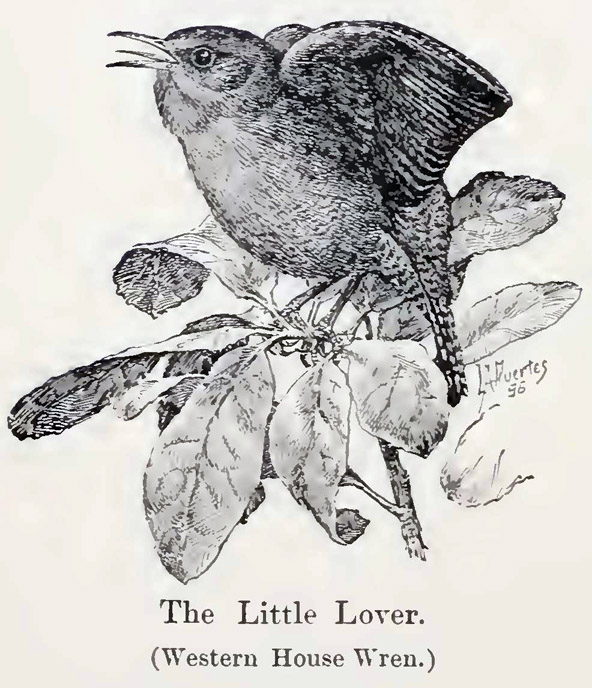
Here’s one of the book’s illustrations, which were done by Louis Agassiz Fuertes, one of the best ornithological illustrators of the day:

The Little Lover

Here’s a photo of Augusta Merriam Bailey from a 1904 issue of The Condor, an ornithological journal:

FlorenceMerriam1904[1]

Bailey offers detailed observations of valley birds hunting, nesting, singing. She writes with the sensibility of a scientist, but with a humanistic and poetic sensibility as well.

“From the ranch-house,” she begins in one early passage, “encircled by live-oaks, the valley widened out, and was covered with orchards and vineyards….It was a veritable paradise for the indolent field student. With so much insect-producing verdure, birds were everywhere at all times.”

Bailey waxes almost lyrical: “Flocks of migrating warblers were always to be found here: flycatchers shot out at passing insects; chewinks scratched among the dead leaves and flew up to sing on the branches; insistent vireos cried tu—whip’ tu-whip’ tu-whip’ tu-wee’-ah, coming out in sight for a moment only to go hunting back into the impenetrable chaparral…”

And there are impressionistic, almost sensuous descriptions of the valley at sunrise and sunset. Here’s one example:

In the East we are accustomed to speak of ‘the peace of evening,’ but in southern California in spring there is a peculiar interval of warmth and rest, a langorous pause in the growth of the morning, between the disappearance of the night fog and the coming of the cool trade wind, when the southern sun shines full into the little valleys, and the peace of the morning is so deep and serene that the labor of the day seems done. Nature appears to be slumbering. She is aroused slowly and gently by the soft breaths that come in from the Pacific.

And that’s just the first half of the paragraph. A sunset description is just as good. See for yourself. The book is in the public domain at www.archive.org .


Upcoming History Events

Every second Tuesday of the month the San Diego History Center invites local community and cultural groups to celebrate their history with exhibits in the center’s atrium. This Tuesday, April 8 from 10 a.m. to 5 p.m., north county communities will be represented. For further info visit http://www.sandiegohistory.org/calendar/detail/57836 .


The Rancho Bernardo Historical Society’s Speakers Series will present a free program featuring Jack Larimer, Director of the Vista Historical Society and Museum, on Wednesday, April 16, at 10 a.m. For details visit http://www.rbhistoricalsociety.org/ .


“A Garden of Small Farms and Dairies”


“Overlooking Mission Valley,” or “View of Mission Valley” were common selling points found in realty ads in San Diego papers from the 1880s to the 1950s. “Good bottom land” was a similar selling point, especially in the late 19th and early 20th centuries.

“This valley is situated three miles from the business center of San Diego,” begins a description in An Illustrated History of San Diego, published in 1890. “It is traversed by the San Diego river, and it may be reached either by way of Old Town, which lies at the mouth of the valley, or by the road up to the mesa and new grade, which enters some two miles farther up.”

The old mission that had given the valley its name was at that point a neglected ruin near its eastern border. But the valley itself was lush with natural life. “This valley was well chosen by the Franciscan Fathers, “ stated the book, “for it contains some of the most productive land in present San Diego County. On the higher benches grow fruits, vegetables and cereals, while the lower, more sandy portions are well adapted for the cultivation of alfalfa and other grasses. Good water, which may be found even during the dry season, at three to ten feet depth, abundantly underlies the whole surface.”

The valley remained predominantly rural and agricultural through the first half of the 20th century. Here’s a photograph from the 1922 book, City of San Diego and San Diego County: The Birthplace of California, by Clarence McGrew:


 Mission Valley

This was the valley that Arthur Ribble called “a garden of small farms and dairies” in his 1990 book, Yesterday in San Diego. Ribbel was a columnist for San Diego newspapers from the 1930s to the 1970s with a lifelong love for San Diego and for Western history. His book, published shortly before his death, included a chapter called “Bygone Mission Valley,” in which he recalls “a tranquil and beautiful checkerboard of well-manicured truck farms” producing crops ranging from alfalfa, corn, cabbage and beans to hogs and dairy products. “Many oldsters recall hunting rabbits, quail and dove on the floor of the valley,” wrote Ribbel.

The building of motels on the western end of the valley in the early 1950s was a portent of change that accelerated in the middle of the decade with the erection of a new minor league baseball stadium and, in 1958, city approval for the construction of a new shopping center by the May Company. The transformation from Mission Valley to Fashion Valley had begun in earnest.

Women’s Suffrage-San Diego County Led the Way

“The ushers in the First Methodist church could not find seats enough last night to accommodate all who went there to hear Susan B. Anthony and Rev. Anna Shaw speak on woman suffrage.”

So began an article in the June 20, 1895 San Diego Union on a lecture by Anthony and Shaw, then president and vice president respectively of the National Woman’s Suffrage Association. The two, pioneers of the women’s movement, had come at the invitation of suffragist leaders in California. At that point in time only Wyoming and Colorado had extended the right to vote to women.

Anthony was 75 then, but the Union reporter found “her 75 years seemed to prove but slight if any hindrance to her efforts in expressing her views on the question of suffrage for women, a vocation in which she has been engaged for half a century.”

Susan B Anthony  

Undated photo of Susan B. Anthony, pioneer of the women’s suffrage movement. Photo courtesy Library of Congress. 

The evening’s program began with an invocation by the Rev. Amanda Deyo, who was followed by Flora M. Kimball, meeting chair and president of the San Diego Woman’s Suffrage Society, who introduced the speakers.

Deyo and Kimball were part of a group building support for women’s rights throughout San Diego  County.

The account of a meeting of the San Diego group, chaired by Kimball, in the May 16, 1896 Union noted that “Rev. Amanda Deyo and Mrs. Judge Sloan (sic) gave interesting accounts of their tour through the county establishing suffrage societies,” reporting establishment of 13 societies “with a total membership of 191.”

San Diego city and other community papers of the day carried reports of activities by suffrage clubs in Poway, Lakeside, Jamul and El Cajon, among other communities.

Club meetings were social events, presenting food and entertainment as well as civic lectures, as this account about the Poway club from the September 19, 1896 Poway Progress shows: “There was amusement for young and old, songs, readings and recitations comic and serious, embracing an essay by Judge Chapin on the women voting question, an article read by Mrs. W.C. Hilleary extolling woman in her self sacrificing labors in times of distress, and a capital performance by C. C.  Watson in his exhibition of a “living sphinx” from the desert of Arizona…”

That same issue of the paper editorialized that “If every county in the state is as strong for woman suffrage as San Diego,” a proposed state constitutional amendment on the ballot for November of that year “is sure to be adopted by a large plurality—a big majority, in fact.”

The paper was right about support in San Diego County, where Amendment 6 passed, 4,129 to 2,717. Unfortunately, it lost statewide. But the movement would carry on and win in both San Diego County and all of California with the passage of Amendment No. 4 in 1911, and ultimately triumph nationwide with the ratification of the Nineteenth Amendment to the U. S. Constitution in 1919.