Fourth of July, 1914

The July 4, 1914 issue of the San Diego Evening Tribune called the Independence Day parade “the greatest in San Diego history.”

It had a special meaning for one particular parade marcher, according to the article by Tribune reporter George White.

“Fifty years ago today in the battle of Helena, Arkansas, Captain Jack Winscott, of the Thirty-third Missouri Infantry, was shot down with wounds in his jaw, one arm and a leg. He survived and marched today in the parade, carrying the flag for which he fought in the Civil War.”
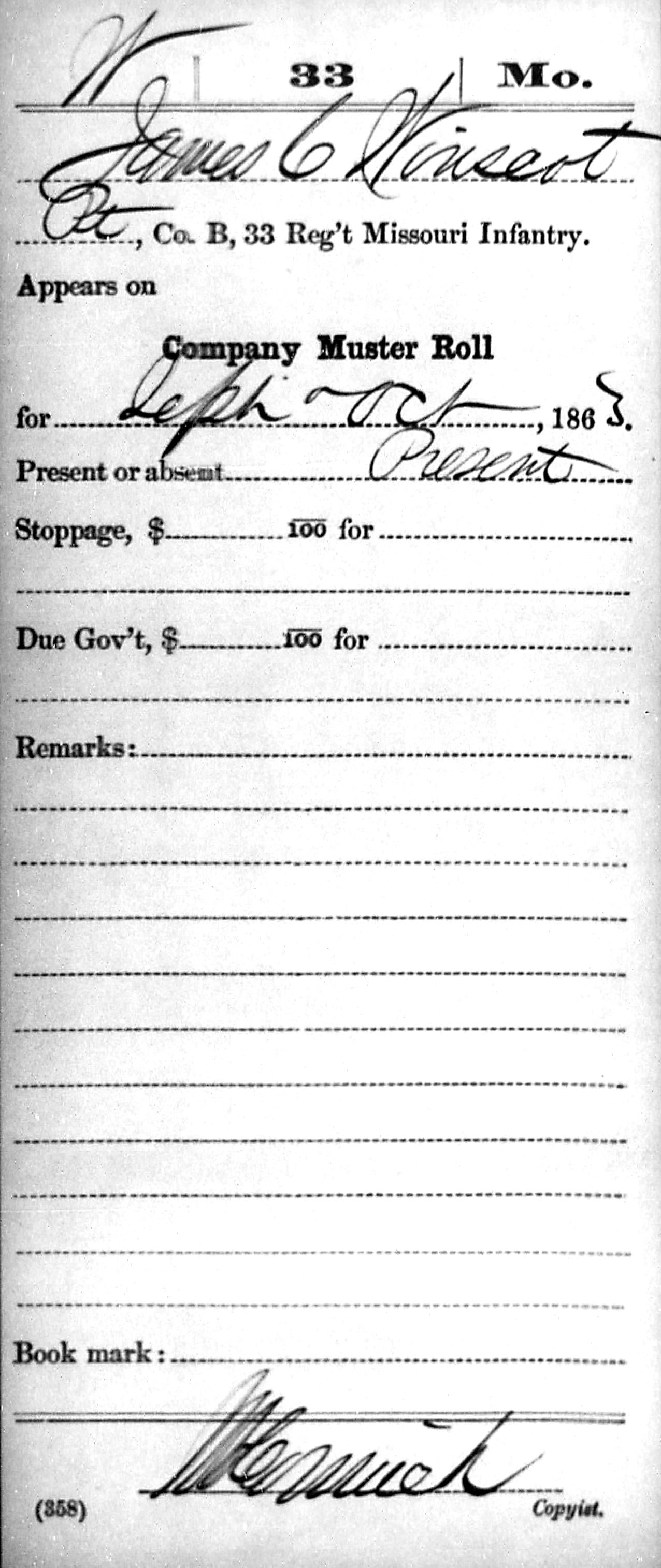
James C Winscott civil war muster roll card

The article went on to point out that Winscott, then 76, “has lived in San Diego twelve years,” and served as “color bearer for the G.A.R. post.”

G. A. R. stood for Grand Army of the Republic, a fraternal organization for union veterans of the Civil War.

That wouldn’t be the first or the last time that James Clayton Winscott would appear publicly to commemorate his service and that of his civil war comrades. A notice in the May 1912 Tribune on planned Memorial Day addresses by G. A. R members at city and county public schools included this entry: “Logan Heights—Arthur E. Vest, Jerome Hopkins, James Winscott.”

Winscott was also among Union veterans onstage for a commemoration of Abraham Lincoln’s birthday at the Strand Theater in February 1918.
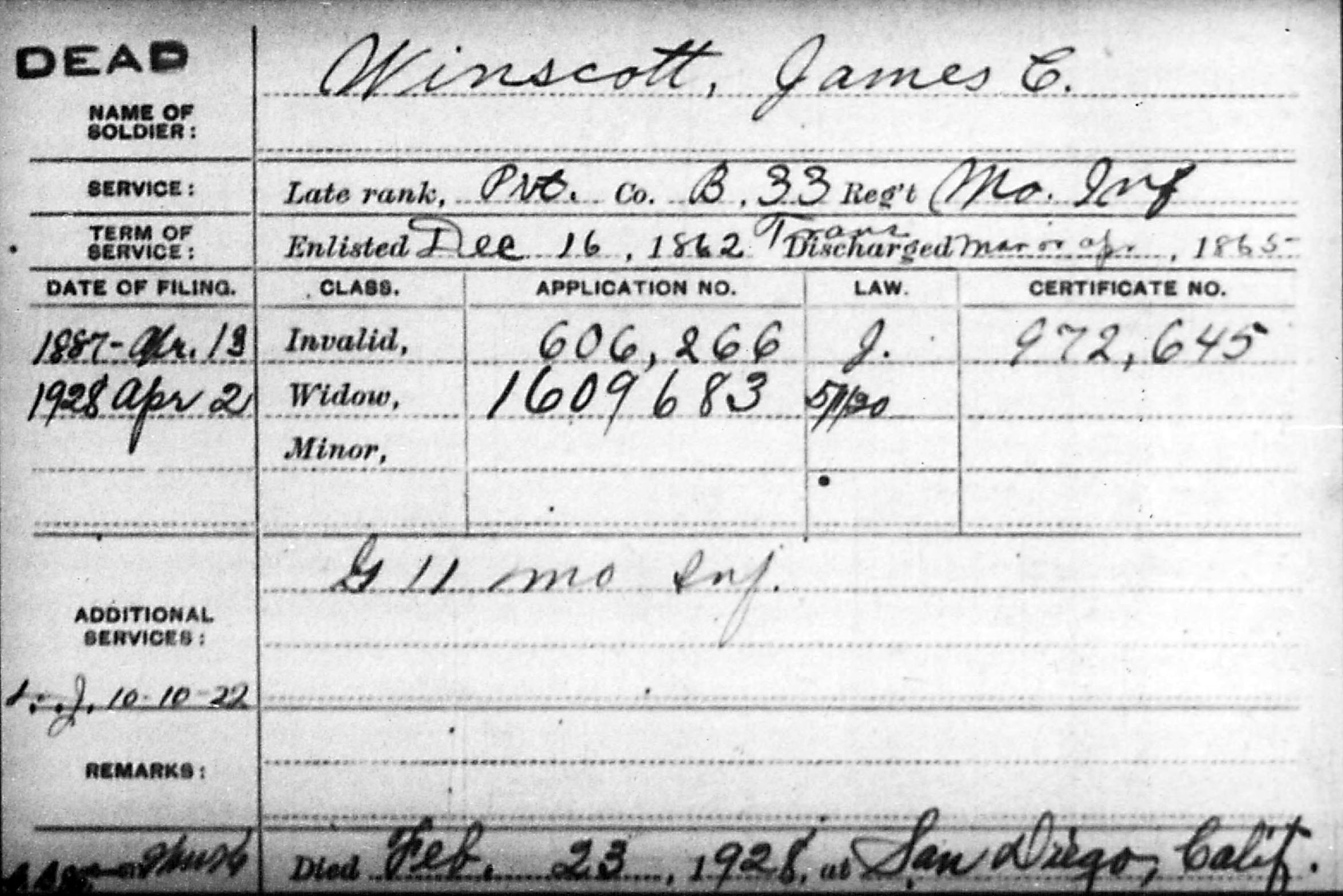
Winscott, James C pension card 33rd

A copy of an index card from the National Archives showing Winscott’s pension history.

That card seems to show that he actually never rose above private. But the fact that he received a pension in 1887 affirms that he was injured while in service, because only injured veterans could qualify for pensions at that time.

Embellishment of his rank might perhaps reflect a somewhat itinerant family background. While he was born in Missouri, his family lived in Iowa and Illinois in his youth. After his war service, young James went on to live in Texas for a time.

We do know that after coming to San Diego in the early 1900s Winscott periodically had to be admitted for treatment at the local branch of what were then called National Homes for Disabled Volunteer Soldiers.

San Diego newspaper accounts show Winscott working at carpentry and other odd jobs at least into his mid-seventies. He died in San Diego on February 24, 1928 at the age of 82.

___________________________________________

Get Updates Automatically-Become A Follower of the San Diego History Seeker

You can get weekly updates of San Diego History Seeker automatically in your email by clicking on the “Follow” button in the lower right corner of the blog page. You’ll then get an email asking you to confirm. Once you confirm you’ll be an active follower.

 

The Transformation of Andres Pico

General  Andres Pico, 1846

Andres Pico, circa 1846

Time can bring many changes. Especially when the time includes wars between neighboring nations.

Andres Pico is probably best known in San Diego history as the commander of the Californios against American troops at the Battle of San Pasqual, the bloodiest battle of the Mexican-American War. The battle is still re-enacted here every year and some controversy still swirls over who really won it and which army had the better leader, although most accounts give the edge to Pico.

The battle may still be disputed but the war of course was won by the USA, bringing California under the American flag in 1848. And how many know what became of Andres Pico after that?

In 1849 Pico was among those selected as a delegate to the California Constitutional Convention. Two years later, in 1851, he won election to the state assembly.

His old adversaries clearly recognized his military prowess, because in 1858 he was appointed a Brigadier General in the California State Militia. But Pico proved as adept at politics as he did on the battlefield.

By 1860 he was serving in the state senate from the San Fernando area of Los Angeles. A rundown of state senate business in the Los Angeles Star on February 4, 1860, included this item: “On motion of Mr. Peachy, Don Andres Pico was added to the Committee on Hospitals.”

In April of 1860, the same newspaper, reporting on a bill to re-organize the city’s government pushed through the state assembly with little opportunity for local input, wrote that “Our citizens are much indebted to their Senator, the Hon. Andres Pico, for his watchful care of their interests and his desire to consult their wishes, manifested by forwarding a copy of the bill to this city, and delaying its passage in the Senate until he could hear from his constituency.”

Pico was elected as a Democrat, and was considered a “Buchanan Democrat” as the national party split over the issue of slavery. But two months after Fort Sumter, when he was asked by federal officials to clearly define his stance in the war, Pico declared that he respected “the Constitution and the Union entire, to maintain which I would cheerfully offer as a soldier, my sword, and as a citizen, my fortune.”

When the federal government moved to recruit a battalion of “Native Cavalry” from California for the Union Army, Pico was offered the command. Ill health forced him to turn it down, but he became an important recruiter and fundraiser for the unit which ultimately helped to prevent Confederate incursions into New Mexico and Arizona.

When Andres Pico died in 1876 his funeral was described in the Los Angeles Herald as “one of the most imposing ever seen in this city,” with “fifty carriages and at least a hundred sincere mourners on foot” following his casket, and pall bearers that included the governor of California and the mayor of Los Angeles.

_____________________

Sources for this post included historic Los Angeles newspapers, the website of the San Fernando Valley Historical Society,  the essay, “California Soldiers in the Civil War,” by Leo Kibby, from the California Historical Society Quarterly, and the book, The Decline of the Californios, by Leonard Pitt.


Get Updates Automatically-Become A Follower of the San Diego History Seeker

You can get weekly updates of San Diego History Seeker automatically in your email by clicking on the “Follow” button in the lower right corner of the blog page. You’ll then get an email asking you to confirm. Once you confirm you’ll be an active follower.


“The Back Country”

It seems that in San Diego newspapers of the late 19th and early 20th centuries, everything north of Old Town was considered “the back country.”

Here’s some proof from the February 7, 1914 San Diego Union. It reported a planned mass meeting later that month of representatives to create a county farm bureau.

In response to a new law creating a cooperative extension service under the Department of Agriculture, counties who organized farm bureaus would get local advisors, working with agricultural colleges (like the then new UC Davis), to provide advice on up-to-date farming methods.

“Ranchers and fruit growers of Lemon Grove organized last night as a branch of the County Farm Bureau, which will co-operate with the promised farm advisor in the development of the back country,” began the article.

A week later, the Union was reporting that the idea for a farm bureau was “leaping like wildfire from center to center all through the county…”

Individual communities were to elect officers to section clubs which were to gather February 20 at the Spreckels Theater to form a countywide organization. Since the project’s initiation, reported the Union, “club after club, numbering ten or more members and each having a president, secretary and treasurer, has been formed by the ranchers of the back country.”

Then it listed all those new clubs in the “back country:”

“Oceanside, Lemon Grove, Fallbrook, Vista, Escondido, El Cajon, Ramona, Julian, Spring Valley and Alpine have all been organized and last night Nestor and Jamacha were added to the number. Organization meetings have been planned for tonight at Chula Vista and Dehesa, and for Wednesday at Lakeside, through the Chamber of Commerce here. The San Ysidro people have organized by themselves. Each of these will elect representatives to the county farm bureau meeting before Friday.”

On February 19 the Union reported that “in order to accommodate the throng of farmers coming in from the back country to attend” the meeting “a special train will be run on the San Diego and Southeastern Railroad.”

On February 20 over 1,500 farmers, many with their families, showed up for morning and afternoon sessions to elect bureau officers and hear speakers such as two deans from the University of California’s Agriculture Program, Thomas Hunt and H.E. Van Norman (the latter also a president of the National Dairy Association), and B. H. Crocheron, state leader of the new agricultural extension program.

“This is beyond comparison the biggest piece of agricultural business that has ever been put through in San Diego County,” reported the Union on February 21. “It means that the farmers scattered over miles of territory have at last united under one banner, that the farming industry has taken unto itself a backbone, and that from now on the progress of one will in a large measure mean the progress of all.”

_________

Get Updates Automatically-Become A Follower of the San Diego History Seeker

You can get weekly updates of San Diego History Seeker automatically in your email by clicking on the “Follow” button in the lower right corner of the blog page. You’ll then get an email asking you to confirm. Once you confirm you’ll be an active follower.


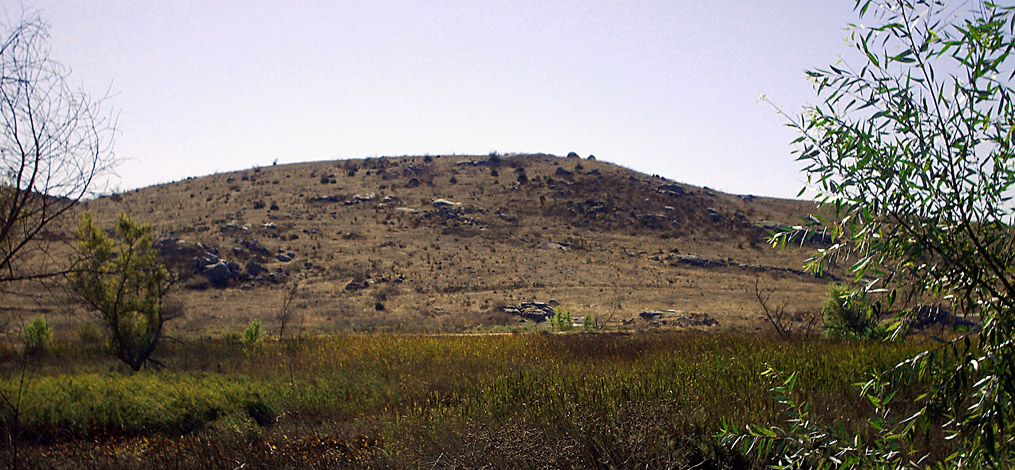
Rocks and Flocks on the Poway Grade

“A large band of sheep passed over Poway grade last week, and in consequence the road bed is liberally ballasted with loose stone, to the discomfort of wheelmen and other travelers.”

Poway Progress, August 3, 1895 (Note:”wheelmen” refers to bicyclists.)

Yes, there was a time when traffic jams on the Poway Grade consisted of livestock rather than cars.

In an earlier entry I wrote about Andy Kirkham, a hard working farmer who was also an amateur historian and chronicler of his community, Poway Valley from the late 19th to the mid-20th centuries. He kept journals throughout his life which he later compiled into manuscripts donated to the archives of the Poway Historical and Memorial Society.

One of those journals described the time in 1898 when 14-year-old Andy joined his father and brother clearing the Poway Grade’s road bed of loose rocks in the wake of a large flock of sheep.

“Whenever a flock of sheep drove down the Poway grade, there would be a lot of rocks rolled down onto the road,” wrote Kirkham. “These flocks would be driven to the northern part of the county in the springtime and return in the fall.”

“It was a full day’s work for father and two of us kids to rake the rocks off the road bed for which the county road department paid three dollars.”

The flocks consisted of anywhere from 500 to 1,000 head, according to Kirkham. And it wasn’t just sheep. There were horse and cattle drives of similar size as well, and Sylvester Mendenhall, who ranched on Palomar Mountain, “would drive hogs on foot to the slaughter yard at Old Town,” wrote Andy.

Kirkham also participated in some of those drives. He described an annual cattle drive from the Poway Valley “to the slaughter yard on the mud flats between old San Diego and the San Diego Bay.” A butcher would come from the city, “spending three or four days, going from one ranch to the other picking out the animals he wanted delivered” down to the yard.

“This was one of the biggest events of the year,” wrote Andy. “Everyone, old and young, men and women, helped to round up the herd.”

It took two days to get all the cattle in one corral. Then, starting out just before dawn, the ranchers would begin driving the cows toward the city.

“It would be afternoon before we’d reach the top of the Poway Grade,” wrote Andy. “From there on, all had to herd them down the road. We had fresh horses from this point and by sundown we had them in the slaughter yard. By the time we had a couple hours rest, we were on our way home.”

______________

Get Updates Automatically-Become A Follower of the San Diego History Seeker

You can get weekly updates of San Diego History Seeker automatically in your email by clicking on the “Follow” button in the lower right corner of the blog page. You’ll then get an email asking you to confirm. Once you confirm you’ll be an active follower.


The Blitz Boom

The biggest construction job in San Diego’s history–the Kearny Mesa housing project for defense workers and their families–was contracted for yesterday when the federal works administration awarded a $9,070,000 contract for 3,000 residential units.

San Diego Union, December 13, 1940

They called it the “Blitz Boom,” a term coined by the Saturday Evening Post to describe the surge in defense production in San Diego in 1940. War was raging in Europe. While the United States wasn’t officially involved, Washington had declared a “limited national emergency” in September 1939, calling for “strengthening our national defense within the limits of peacetime authorizations.” At the same time, U.S. defense companies were getting big orders for material from nations fighting the Axis powers, like Great Britain.

How much business were they getting? The September 24, 1940 San Diego Union reported that the total backlog of orders for Ryan Aeronautical and Consolidated Aircraft exceeded the total assessed real estate value for the whole county of San Diego ($231.5 million vs. $221.4 million)!

The production boom of course meant a jobs boom, triggering an enormous migration from across the country to the city of San Diego. Plans for the housing project on Kearney Mesa, whose builders promised “3000 houses in 300 days,” was one of the results. Today we know this community as Linda Vista.

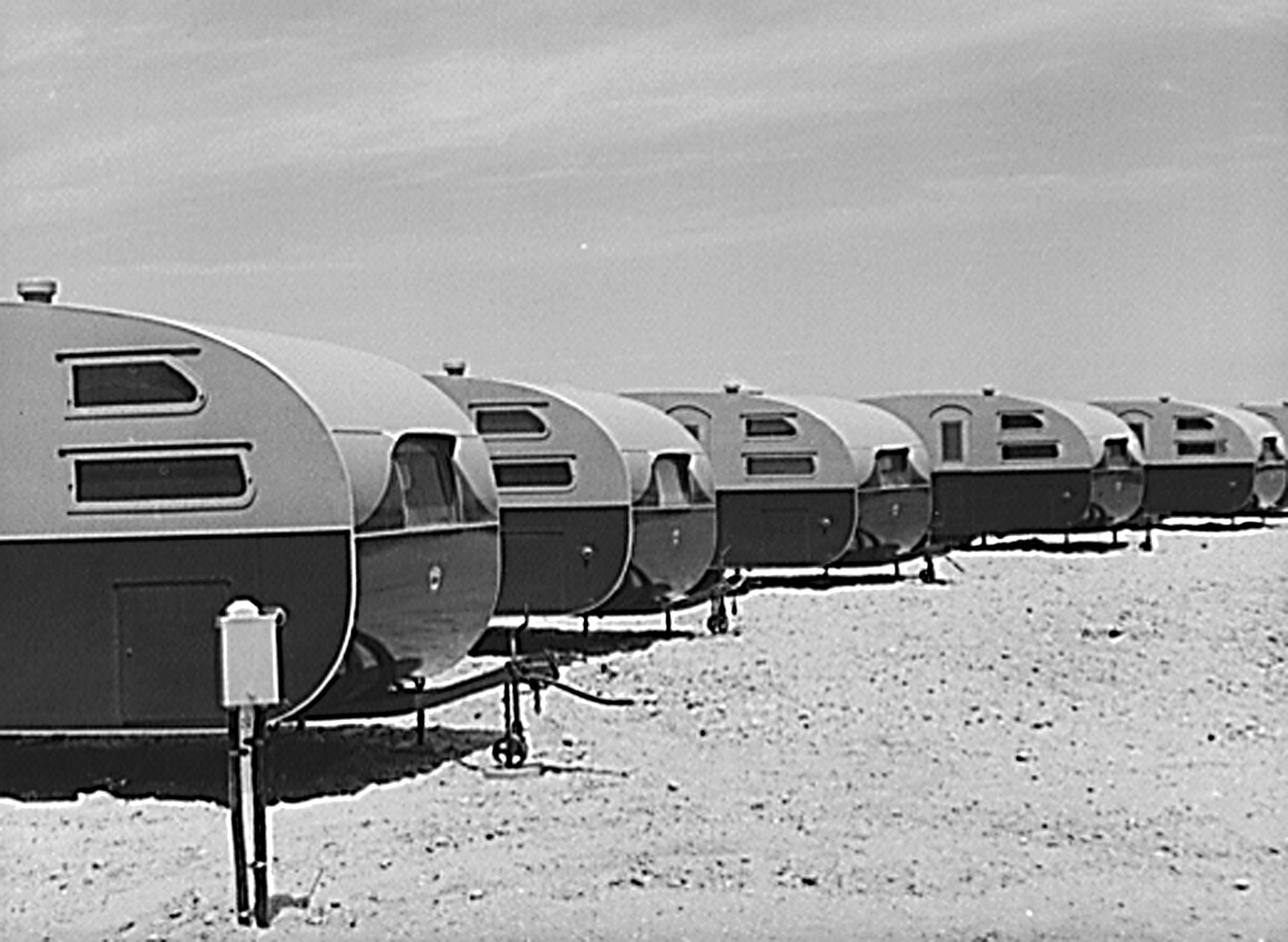
The city didn’t have enough housing even for the people it needed to build the housing. So “defense dormitories” and trailer parks sprouted up in places like the formally rural Mission Valley.

Here’s a photo of a trailer camp for the Linda Vista project workers:

Trailers, FSA defense workers camp, May 1941

FSA photo.

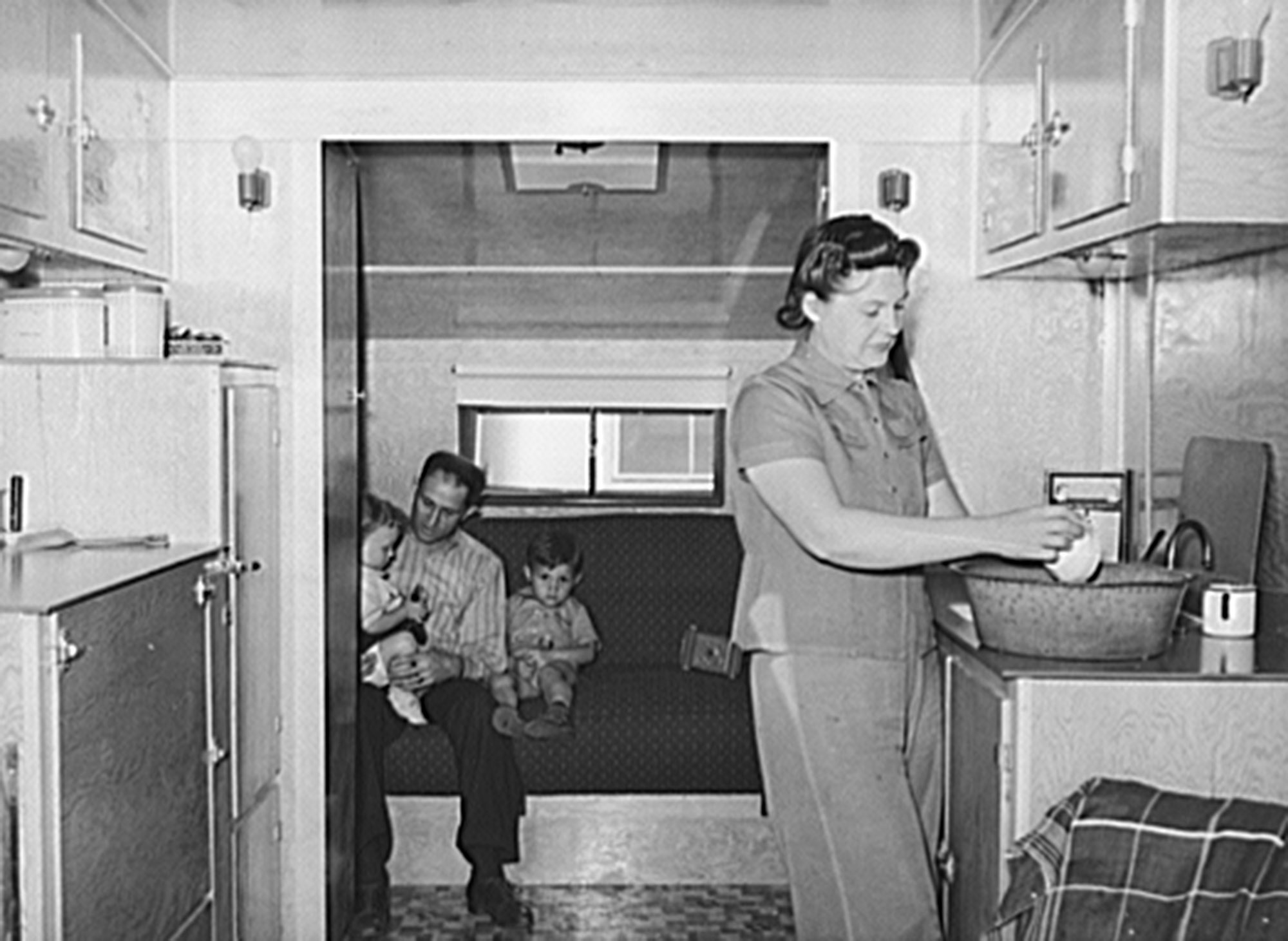
And here’s a photo of the interior of a trailer, with a construction worker and his family:

Family at home at FSA defense workers camp

FSA photo.

By May, 1941, it was reported that there were 1,500 people moving into San Diego each day. And this was seven months before Pearl Harbor.

It was the beginning of a profound change for San Diego City and County.

Sources for this post included historic San Diego newspapers, the Journal of San Diego History and the photo archive of the Library of Congress.

Get Updates Automatically-Become A Follower of the San Diego History Seeker

You can get weekly updates of San Diego History Seeker automatically in your email by clicking on the “Follow” button in the lower right corner of the blog page. You’ll then get an email asking you to confirm. Once you confirm you’ll be an active follower.