The Season of Renewal, A Century Ago

Accounts of Easter in San Diego papers in the late 19th and early 20th centuries sound similar to our celebrations today. One can find some variations perhaps owing to the more rural nature and sensibilities of the populace then, such as this account from the April 15, 1895 San Diego Union:

“The old custom of Easter egg-rolling was observed at La Jolla yesterday, a large number of persons participating in the pastime. The search for rabbits’ nests was also a feature of the days observance of Easter, both being thoroughly enjoyed.”

An item in the April 6, 1896 Union described the streets of Coronado on Easter Sunday morning as “alive with church goers” with “exquisite flowers” decorating the churches. “Many out-of-town visitors were on the beach during the day, enjoying the sea, the hotel grounds and court and listening to the orchestra concert.”

A 1915 event for members of a children’s music class, appearing in the Union, described “Easter songs and Easter singing games. Numerous surprises greeted the little folks throughout the afternoon. Dainty marshmallow chickens and highly colored real Easter eggs delighted the children. Mesdames S. J. Wines, S. S. Hage, Ed. Gamle, C. M. Richardson, W. Clarence Randal and Ruth Brattan were among the patron guests.”

Side by side with notices about Easter worship and cultural celebrations were notices about Passover.

“Tifereth Israel will hold services in their synagogue at the corner of Eighth and I streets, H. Meyer officiating,” concluded an April 3, 1909 Union article on the significance of the feast. “The Reforned congregation will hold services at the Temple Beth Israel, corner Beach and Second streets, Rev. Ellinger officiating. An elaborate program of music has been planned.”

Get Updates Automatically-Become A Follower of the San Diego History Seeker

You can get weekly updates of San Diego History Seeker automatically in your email by clicking on the “Follow” button in the lower right corner of the blog page. You’ll then get an email asking you to confirm. Once you confirm you’ll be an active follower.
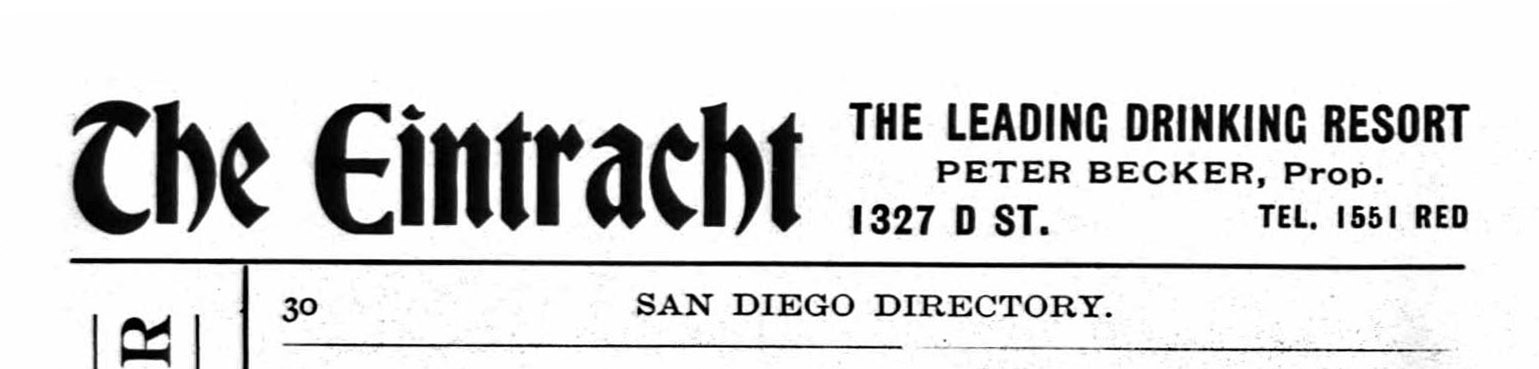
What’s a “Drinking Resort?”

Eintracht ad

Ad from 1901 San Diego City Directory

It was a saloon. But its owner, Peter Becker, sometimes referred to it as a “resort,” or “drinking resort,” in newspaper ads. It turns out, in looking at newspapers of the late 19th and early 20th centuries, that the word “resort” would sometimes be used for saloons and restaurants, perhaps to convey the image of a place where patrons could relax, drink and eat in peace and comfort.

That certainly appears to have been Becker’s marketing strategy. Becker was a German immigrant who came to San Diego in the late 1880s. The word “eintracht” in German means “peace, harmony, or unity.”

An early ad for the place, in the San Diego Evening Tribune on February 20, 1896, , was pretty basic: “Fine Wines, Liquors and Segars. Hot Lunch forenoon. Steam and lager beer on draught. Mixed drinks a specialty.” That was it.

But the ads ran daily, and soon became bigger. A typical one in the Evening Tribune of June 9, 1897 proclaimed:

“PRIMA BEER

Always cool and fresh and just the right temperature for drinking can always be found at the EINTRACHT,

959 Fifth Street, Two doors from the corner of D.

Headquarters for the San Diego Prima bottled and keg beer.

PETER BECKER, Proprietor.”

The business must have justified his ad budget, because in July of 1898, he announced in the San Diego Union that he was moving “the well-known and popular ‘EINTRACHT’ saloon” to “more spacious and convenient rooms…at 1327 D, between Fourth and Fifth Streets.”

Becker could be clever and topically opportunistic in his ads as well. An ad from the fall of 1898 in the Evening Tribune appears from the headline to be an election notice. “NOTICE OF PRIMARIES,” it says in bold caps, “For the election of delegates to the various conventions to nominate CANDIDATES for COUNTY OFFICES will be announced soon. In the meantime all CANDIDATES irrespective of party will be enabled to better keep their proper temperature by cooling off with PRIMA BEER at the ‘Eintracht’……”

Sometimes the ads got smaller again, but they were still clever. Like this one from April 1903:

The Mississippi Rising

So is the quality of liquors at Peter Becker’s Eintracht, D near Fifth Street.”

Becker ran the Eintracht through 1912, then moved on to run other establishments. It obviously paid to advertise.

Get Updates Automatically-Become A Follower of the San Diego History Seeker

You can get weekly updates of San Diego History Seeker automatically in your email by clicking on the “Follow” button in the lower right corner of the blog page. You’ll then get an email asking you to confirm. Once you confirm you’ll be an active follower.
Olivenhain: The Bitter and the Sweet

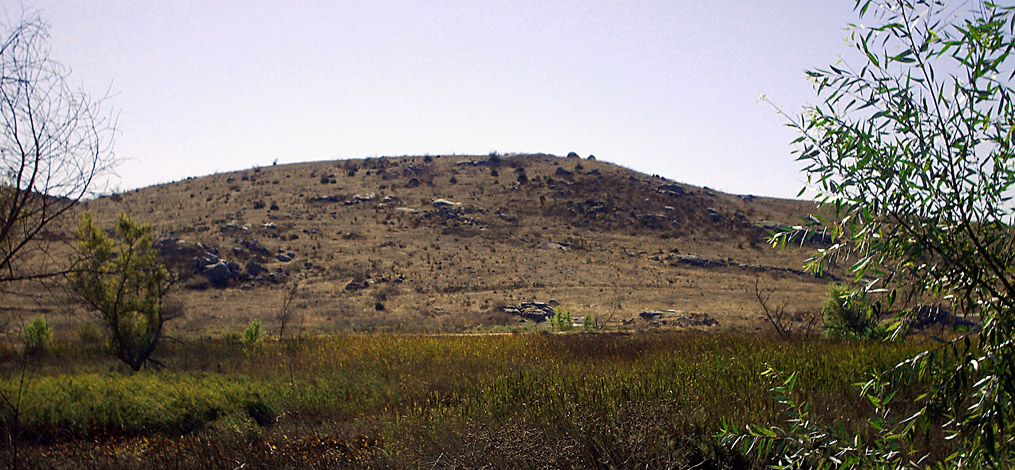
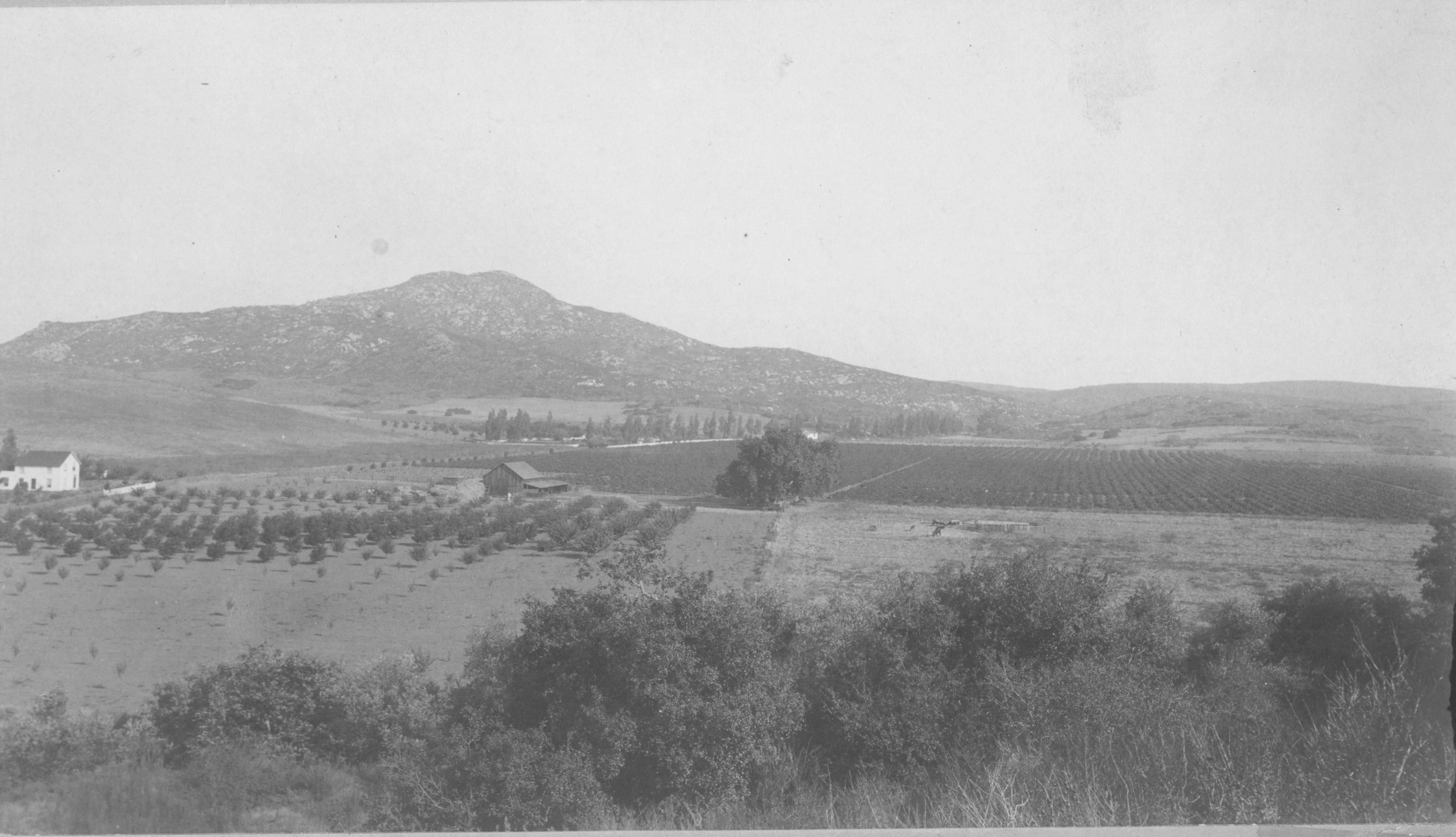
How does a place in north San Diego County, occupying former Mexican rancho land, wind up with the German name for “olive grove?”

In 1880 Warren and Frank Kimball, already big landowners in National City, Chula Vista and Jamul, found themselves owning the 4,400 acre Rancho Las Encinitas.

They advertised the rancho for sale, and in 1884 they found a buyer in Theodore Pinther, a German immigrant then living in Denver who had an idea to develop a German-speaking colony in his new country. By June of 1884 twenty people had signed up as fee-paying members of the Colony of Olivenhain.

The rancho land was purchased on October 3, 1884. On October 31, the colonists, by then totaling 67 men, women and children, boarded a train in Denver and headed west.

It turned out that conditions on the rancho were not quite what the colonists had been led to expect. Promotional brochures had promised the immigrants a rich, well-watered soil that was already yielding an abundance of olives. The reality was quite different.

The colonists began digging wells, but, time and time again, they came up dry. “The colonists finally realized the awful truth,” states a website on the colony’s history, “the land lacked sufficient water!”

There were other revelations too, such as overcharges on land prices, secret sales commissions paid to Pinther by the Kimball brothers, and other provisions of a contract originally written in English and only provided in German translation at the demand of increasingly irate colonists.

Pinther and another leader were literally forced to leave the community and the colonists demanded a new contract from the Kimball brothers. A team of arbitrators, including banker Jacob Gruendike, were brought in, and a new deal was negotiated.

Many of the colonists left. But the small group who stayed began to work the land and make the best of it. A report in the San Diego Union on May 23, 1889 called Olivenhain “beautiful and prosperous. Many of the first settlers, through the fraud and misrepresentations of their agents, suffered much loss and disappointment, and some of them had to look elsewhere. But those who remained are thriving….”

Among their most successful crops in that period were sugar beets, which inspired a San Diego Union article in September 1890 with a pun for a title, “Beats Other Beets.”

The article was reporting on an analysis of county beet crops for sugar content. The analysis was conducted by by J. D. Spreckels, who knew something about sugar.

“The latest analysis shows that Olivenhain, Leucadia, La Mesa, and Otay produce beets richer in sugar and with a greater coefficient of purity than is required, a gratifying fact that will have its bearing on Spreckel Bros.’ decision as to what portions of the State shall have the ten sugaries they contemplate erecting.”

Sources for this post included historic San Diego newspapers, the website of the Olivenhain Town Council, http://www.olivenhain.org/ , Leland Fetzer’s 2005 book, San Diego County Place Names A to Z, and the 1890 book, Illustrated History of Southern California, by the Lewis Publishing Company.

Get Updates Automatically-Become A Follower of the San Diego History Seeker

You can get weekly updates of San Diego History Seeker automatically in your email by clicking on the “Follow” button in the lower right corner of the blog page. You’ll then get an email asking you to confirm. Once you confirm you’ll be an active follower.
A Good Citizen

“Mr. Cambron has been very busy the past week putting his orchard and vineyard in apple pie order. With working his ranch and taking care of the roads we think friend Tom must have his hands full.”

From the “Poway Points” column in the Poway Progress newspaper, March 23, 1895.

Thomas Jerome Cambron was a busy man indeed. He’d been farming and raising livestock in the Poway Valley since arriving from Illinois around 1873. By the 1890s he was farming some 300 acres and apparently doing pretty well.

“T. J. Cambron last year had some 1,200 pounds of dried peaches, and he anticipates having about the same quantity this year,” proclaimed the Poway Progress on July 21, 1894. “His principal crop of peaches comprises the early and late Crawfords, and they are among the best raised.”

A week later that same paper reported Cambron taking 2,300 pounds of hay over the Poway Grade into San Diego, where he sold it “a the rate of $16.50 a ton.”

Early in 1895, Cambron was appointed a roadmaster. The San Diego County government appointed local citizens to do road maintenance in unincorporated communities. Remember, at that time the Poway Valley and its immediate environs were still considered “the back country.” Locals were hired and paid a nominal wage to grade and clear the then-unpaved roads.

There are a number of accounts in Poway and San Diego papers from the mid-1890s to around 1904 that describe Cambron working to repair various roads, sometimes in the company of one or two others, at other times with what is described as “a force of men.”

“T. J. Cambron and A Danielson have repaired the worst break in the road to Stowe, an improvement which is appreciated by the mail carrier on that route,” read an account in the Progress of August 3, 1895.

He also managed to find the time to participate in the civic life of his community.

“T. J. Cambron and Adams Chapin have been named as deputy county clerks in this township,” announced the “Poway Notes” column in the San Diego Union of January 29, 1903.Cambron’s name also appears in jury lists and as a polling official in Poway during elections.

He wasn’t as well known as some other San Diego pioneers, but he certainly did his civic duty, while also tending a farm and raising two children with his wife Martha.

Here’s to Good Citizen T. J. Cambron!

Sources for this post included historic Poway and San Diego newspapers, the 1880 and 1900 U. S. Censuses, and the archives of the Poway Historical and Memorial Society.

Get Updates Automatically-Become A Follower of the San Diego History Seeker

You can get weekly updates of San Diego History Seeker automatically in your email by clicking on the “Follow” button in the lower right corner of the blog page. You’ll then get an email asking you to confirm. Once you confirm you’ll be an active follower.

When “Grist for the Mill” Wasn’t Just An Expression

“The New Mill at Pala,” was the subject of an extensive article in the San Diego Sun on December 28, 1881.

“This mill, erected last March by the proprietors, Messrs. M. M. and W. A. Sickler, at considerable expense, is two stories high and a basement; is fifty-five miles from San Diego, and within reach of Poway, Bernardo, Bear valley, San Pasqual, Julian, San Luis Rey, Fallbrook and Temecula, all of which are the best wheat-producing sections in this county.”

Gristmills, or flour mills, were places where farmers brought their crops of wheat, corn or barley to be ground into flour. They were an essential part of the agricultural economy in San Diego County at that time. The Sickler Brothers Mill was the first in the county.

“The advantages of a mill of this kind to the community is very great,” stated the Sun article, “ the farmers being able to procure flour at fully one-third less than formerly….” Up to then San Bernardino was the closest milling location for local farmers. Otherwise, customers seeking flour had to rely on imports “from San Francisco at high charges for freight.”

The Sickler brothers knew their business. Two large grinding stones, built in France, were shipped from Missouri—where the Sickler family had formally lived and operated a mill—to Oceanside and then hauled to Pala by wagon.

The brothers built a flume to divert water from the San Luis Rey River, carrying it down a twenty foot drop to the mill. There the force of the water drove a cast iron wheel, just under 6 feet in diameter, its surface studded with large buckets or paddles.

The milling process was time-consuming. Since it was the only mill in the area and the only way to bring crops there was by horse-drawn wagon, it often took several days to get to and from the mill, and once there “people had to wait from several days to several weeks to get their crop processed,” according to a 2005 report published by the San Diego County Department of Parks and Recreation.

The mill became a community gathering place, with farmers and their families camping out for two weeks or more, “sharing stories and recipes, and trading goods,” the report stated. The Sicklers even set up a makeshift school for farm children.

The mill operated successfully for about a decade. Then as railroad service in the county became more developed, it became easier and cheaper for farmers to transport their crops for processing in Los Angeles and elsewhere.

Today the mill site is part of the Wilderness Gardens Preserve, maintained by the Parks and Recreation Department and open to the public. The tall wooden mill structure is gone, but its stone foundation remains, along with the cast iron water wheel which sits alongside it. For further information, visit http://www.sandiegocounty.gov/parks/openspace/wildernessgardens.html .

Sources for this post included historic San Diego newspapers and the archives of the San Diego County Parks and Recreation Department, with special thanks for the work of Lynne Newell Christenson, former San Diego County Historian, Ellen Sweet, Volunteer Researcher at the Parks Department’s History Office, and Department District Manager Jake Enriquez.

Get Updates Automatically-Become A Follower of the San Diego History Seeker

You can get weekly updates of San Diego History Seeker automatically in your email by clicking on the “Follow” button in the lower right corner of the blog page. You’ll then get an email asking you to confirm. Once you confirm you’ll be an active follower.