The Short But Busy Life of the Town of Barham

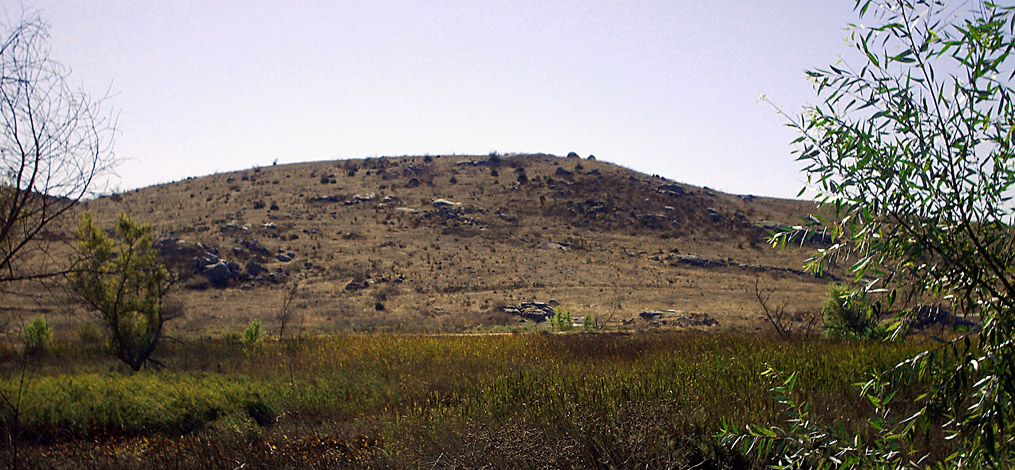
Before there was a town of San Marcos in the San Marcos Valley there was the town of Barham.

The town was founded in 1883 by John Barham and his father James. It covered 640 acres around what is today the southeast corner of San Marcos Blvd. and Rancho Santa Fe Road.

A post office opened in May of 1883. By 1884, the town included a blacksmith shop, feed store, and a weekly newspaper. John Barham operated a farm and also ran the feed store and worked to develop the town. His father James, who had his own homestead, also served for a time as an overseer of the local road district for San Diego County.

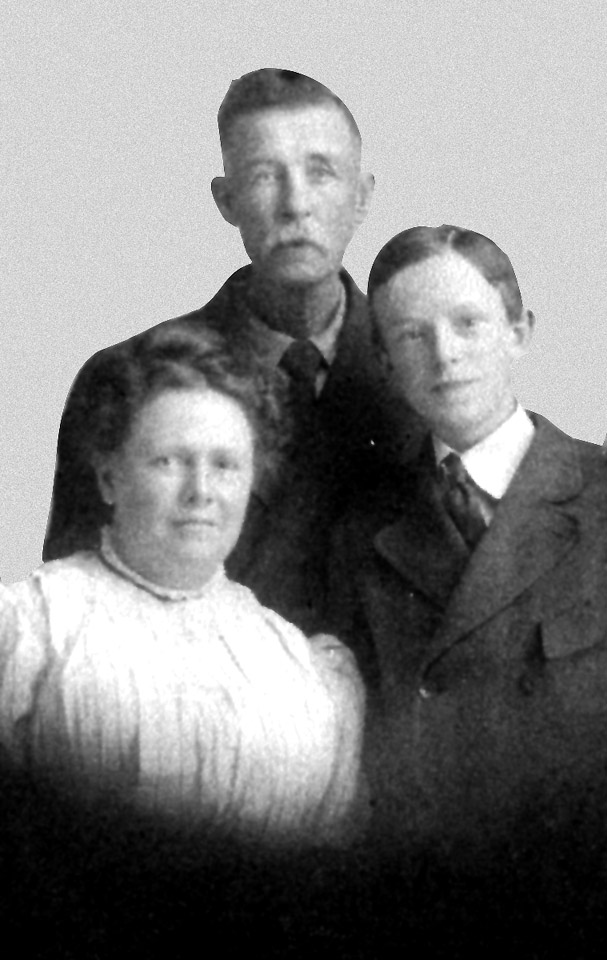
Here’s a photo of John Barham, his wife Olley and son Thomas circa 1911, courtesy of the San Marcos Historical Society:
Barham family


Another town leader was William Webster Borden. In 1884, he founded a weekly called Our Paper, which subsequently became The Plain Truth. Published every Saturday from “Barham, San Diego Co., California,” Borden’s paper combined local and countywide news and gossip with religious instruction and not a little humor.

In an August, 1884 item Borden explained to readers that he’d received a letter from a reader he referred to as “Kus-T-Mur, which with all respect to the writer, we cannot conscientiously publish, as our salary is limited and we do not feel justified in employing a bodyguard…”

An issue early in the newspaper’s first year enthused that Barham was “on the boom,” reporting that “Mr. John Schmaker of Los Angeles (a carpenter by trade) has put up a house, plowed land and planted some crop since the first of May.” The article went on the report the coming of two other new residents who built houses and planted crops.

Making a living, however, was difficult, with water scarce and transportation limited to a few wagon roads. The fortunes of town founder and namesake John Barham reflected those difficulties.

An item in the February 9, 1884 San Diego Union reported that Barham “desires to sell his stock of goods and rent his building.” Just two weeks later, however, the Union announced that “Johnny Barham has changed his mind in regard to selling out; he has laid in a $2,000 stock of goods and believes that ‘opposition is the life of trade’ and will sell ‘cheap, for cash.’”

By April of 1884, the Union was reporting that Barham had enlarged his store and was making arrangements to put up a “steam flouring mill” and a “whiskey mill.” In July of that year, according to the Union, Barham had “20 big stacks of grain and will commence threshing next week.”

Yet, by 1887 John Barham had sold his land and store and left San Diego County. In a 1980 oral history interview for the San Marcos Historical Society, Barham’s son Thomas said his father “sold out due to the general dry weather conditions in the area.”

Another factor affecting Barham’s fate involved the coming of the railroad. When it arrived in early 1888, the line ran two miles north of Barham, much closer to a townsite set up in 1887 by the San Marcos Development Company. The latter site became a stronger attraction for investors and new settlers than Barham.

Early in 1888 Barham’s post office closed. In December of that year William Webster Borden (who’d also been the postmaster) changed the mailing address of his newspaper from Barham to San Marcos. In 1889 the Barham schoolhouse was moved to the San Marcos townsite. Borden himself would later move to Carlsbad.

The town of Barham faded into history. Today two streets in the City of San Marcos, named Barham and Borden, are all that remain to recall the early settlement. Neither of them happens to be anywhere near the site of the old, lost town.

Sources for this post included historic San Diego newspapers, the book San Marcos: A Brief History by William Carroll, and the archives of the San Marcos Historical Society.

Get Updates Automatically-Become A Follower of the San Diego History Seeker

You can get weekly updates of San Diego History Seeker automatically in your email by clicking on the “Follow” button in the lower right corner of the blog page. You’ll then get an email asking you to confirm. Once you confirm you’ll be an active follower.
The Good Doctor

Sometimes in history there’s a backstory as interesting as the main story.

First, the main story, about a health problem in the fields of early 20th century San Diego County.

“The Harvest Bug That Has A Vicious Bite,” was the title of a short article in the San Diego Union October 19, 1919.

The bug, also called a mower’s mite, was very prevalent on farms at the time, mostly found in hay. “Men working about the barns, feeding stock, have been badly bitten,” the article read. “The insect burrows under the skin and makes an extremely itchy area surrounding the point of entrance.”

“For a time,” according to the article, “these mites were so bothersome that they would incapacitate a man. The itching made sleep impossible and the resulting scratching did not improve conditions.”

But a local doctor, who also happened to be a rancher, found a rough but effective cure.

“Dr. Nina Allen Gird of Bonsall, California, in a letter to the Journal of the American Medical Association, tells how, having tried all the remedies spoken of in available books, to no relief, she used kerosene to remove some very greasy ointment which had been applied with no results. Immediate relief followed the application of the kerosene.”

The article went on to say that Dr. Gird found “if a person washed the parts affected with a cloth wet in kerosene as soon as the first itching was noticed, or before the mite had penetrated the flesh deeply, the insect was killed and no further trouble resulted.”

Nina Allen, a native of Ohio, had earned a medical degree from Western Reserve University (now Case Western Reserve) in 1910 and practiced medicine for a time in Cleveland. She came to Fallbrook in 1912 and set up a medical practice there.

Among Dr. Allen’s patients were two elderly Fallbrook pioneers in their late eighties, Henry and Martha Gird, whom she cared for until their deaths in 1913. In 1914 Dr. Allen married Henry and Martha’s son Will Gird.

After the marriage, Nina’s medical practice appears to have been limited to her own family. In the 1920 United States Census, on the line on which her name appears, the column for “Occupation” is marked, “None.”

But the 1919 article shows she obviously tried to continue her healing practice, both as a partner in her husband’s ranch, and, through her letter to the AMA, to the general public.

Over the years, as a clerk of the Bonsall school board and a Red Cross volunteer, she would continue to contribute to the health and welfare of her community, while raising a family and helping run a cattle and horse ranching operation.

After the death of her husband in 1946, Nina Allen Gird sold the ranch and moved to the city, but she stayed active in charitable and civic work. Over the decades until just a few years before her death at the age of 87 in 1972, she wrote numerous letters to the editor of the Union on subjects such as childhood nutrition, recreation and education.

Good work, Doctor.

Sources for this post included the archives of the Fallbrook Historical Society, interviews with Gird family members, and Ronald V. May, RPA.

Get Updates Automatically-Become A Follower of the San Diego History Seeker

You can get weekly updates of San Diego History Seeker automatically in your email by clicking on the “Follow” button in the lower right corner of the blog page. You’ll then get an email asking you to confirm. Once you confirm you’ll be an active follower.

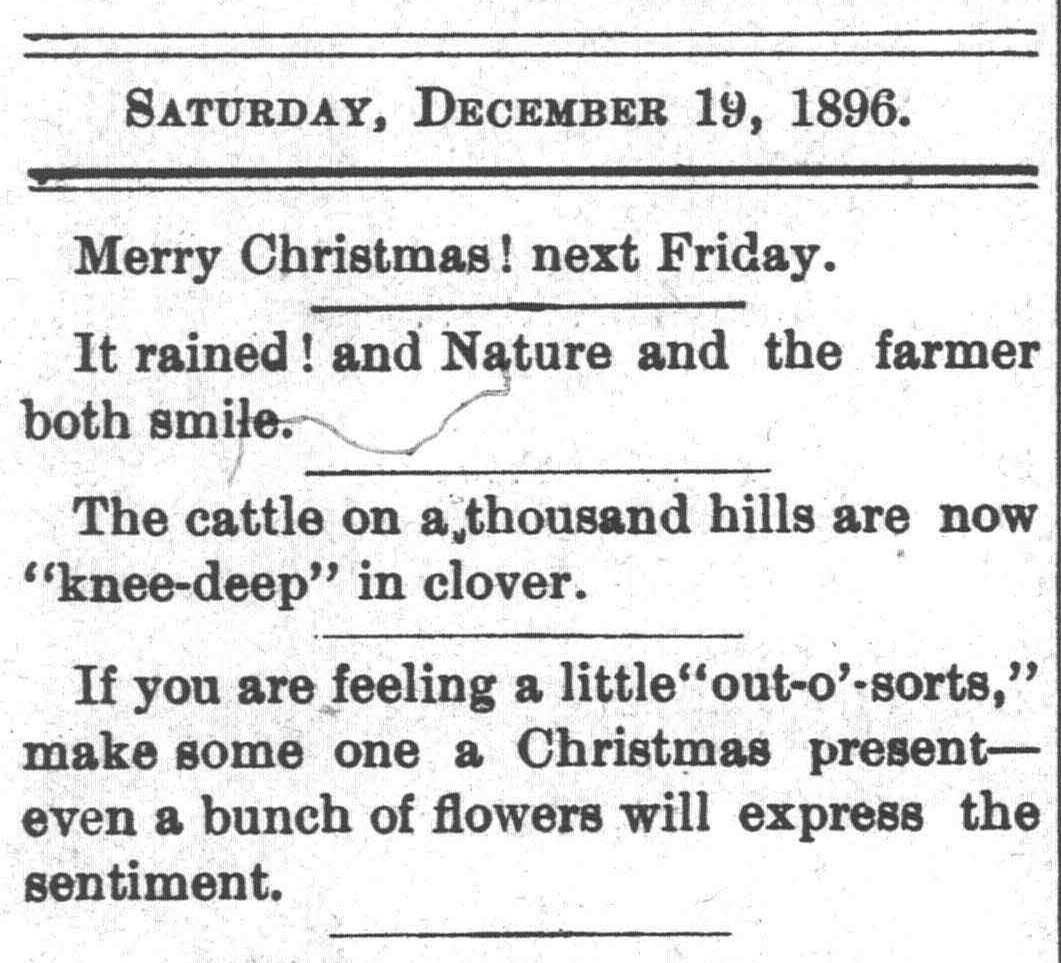
HAPPY AND HISTORIC HOLIDAYS TO ALL!

19 December 1896 page 4

Poway Progress, December 19, 1896, p. 4.

Get Updates Automatically-Become A Follower of the San Diego History Seeker

You can get weekly updates of San Diego History Seeker automatically in your email by clicking on the “Follow” button in the lower right corner of the blog page. You’ll then get an email asking you to confirm. Once you confirm you’ll be an active follower.

The Orizaba-Part II

Last week I wrote about the role that one steamship, the Orizaba, played in the history of San Diego City and County, in terms of the number of residents, noted and ordinary, who first came here on the vessel over its 22-year history carrying people between San Diego and San Francisco.

She also contributed to the development of the local economy by delivering tons of cargo, as demonstrated by this item from the January 21, 1872 San Diego Union, datelined National City:

“J. S. Gordon brought with him on the Orizaba fifty tons of freight. The hay and grain which filled the warehouses of the firm he represents, and the large stock of goods with which their capacious store was literally packed, are fast disappearing, and indicate that another trip to San Francisco will soon be necessary.”

For eleven of the 22 years that the Orizaba made San Diego her home port, she was commanded by the same man, Henry J. Johnston, and he was as well known in San Diego as his ship. In 1878 Johnston was assigned command of a newer steamer, a command he unfortunately never took up as he died on December 28, 1878 after an accidental fall at this San Francisco home.

“The flags on all the buildings in town and on the vessels in the bay were half-masted yesterday,” reported the San Diego Union of January 1, 1879, “out of respect to the memory of the late Captain Henry J. Johnston-a token of the esteem in which he was held by our whole community.”

But that wasn’t the end of the influence of the Orizaba and her long-time skipper on San Diego.

When she came into San Diego the Orizaba docked at Culverwell’s Wharf, which jutted out into the bay from what is now the intersection of Pacific Highway and F Street. As the ship made her way toward the dock, Captain Johnson used a spot on a hill to the north as a navigational aid.

After one particular voyage, Johnston became curious about that geographic point and hired a coach and driver to take him up there. Entranced by what he saw, he bought 65 acres with the hope of constructing a home there on his retirement.

Captain Johnston never lived to carry out his dream. His widow, while remaining in San Francisco, continued to own the San Diego property until May, 1887, when she deeded it to her daughter, Sarah Johnston Miller.

Miller came to San Diego and with her husband built a Victorian house which she named Villa Orizaba. She also filed plans to develop the still-rural landscape around the house as a community designated Johnston Heights in honor of her father, for whom a street in the new tract was also named.

The good ship Orizaba, over 30 years old, had at that point been taken out of service and sold for scrap. Sarah Miller acquired some parts of the ship for the construction of her home.

Villa Orizaba, under different owners over the years and considerably remodeled and relocated, remains standing in its original neighborhood, on a street named Orizaba. The former Johnston Street is now called Sunset Boulevard, and the former Johnston Heights is now better known as Mission Hills.

Sources for this article included historic San Diego newspapers, Richard Pourade’s series of books on the history of San Diego, The Journal of San Diego History, and the website of Mission Hills Heritage.

Get Updates Automatically-Become A Follower of the San Diego History Seeker

You can get weekly updates of San Diego History Seeker automatically in your email by clicking on the “Follow” button in the lower right corner of the blog page. You’ll then get an email asking you to confirm. Once you confirm you’ll be an active follower.


San Diego’s Mayflower

Orizaba


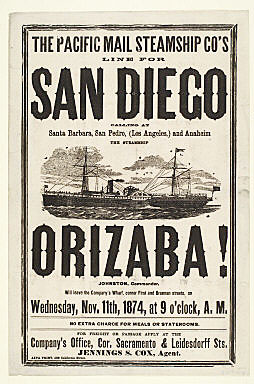
1874 Advertising poster for Pacific Mail Steamship Company service in southern California.

Credit UC Berkeley Bancroft Library.


Steamship arrivals to the port of San Diego were a common topic in the city’s newspapers in the late 19th century. I’ve also found that a number of historical personalities in San Diego history first arrived here and/or subsequently traveled on one particular steamship, the Orizaba.

My curiosity was triggered. As I started digging I discovered that a lot of people sailed to or from San Diego on the Orizaba, which plied the waters between San Diego and San Francisco, with some stops in between, from 1865 to 1887 for the Pacific Mail Steamship Company.

Keep in mind that there were fewer than a thousand people living in the city of San Diego when the Orizaba first arrived here in December, 1865. The railroad wouldn’t arrive until 1885. So overland or over the sea were the only ways to transport people and freight to or from here.

In 1865 the Orizaba was a state-of-the-art workhorse of the sea, a wooden side-wheeled steamer of 1,244 tons, 246 feet long, 35 feet wide 15 feet high from her top deck down to her keel. She made the run to San Francisco in three days and, with layovers at each end, made port in San Diego every 12 days. That comes out to roughly 528 trips over 22 years.

Arrival notices in the newspaper showed that all kinds of people travelled on the Orizaba, and there’s an easy way for today’s reader to tell who travelled first class. For example, a March 27, 1872 listing of passengers arriving from San Francisco lists 58 people by name, including rancho owner Don Juan Forster and others with honorifics like “Prof.” or “Judge.” That list is immediately followed by the phrase: “and 37 others.”

In a 1959 article for The Journal of San Diego History, Jerry Macmullen, a veteran newspaper reporter and student of both San Diego and maritime history, wrote: “In a small way, Orizaba is to San Diego what Mayflower is to New England. ‘I came here from San Francisco on the Orizaba’ or ‘My folks came here on the Orizaba’ are familiar statements to anyone talking to old-timers.”

Sources for this post included historic San Diego newspapers and The Journal of San Diego History.

Get Updates Automatically-Become A Follower of the San Diego History Seeker

You can get weekly updates of San Diego History Seeker automatically in your email by clicking on the “Follow” button in the lower right corner of the blog page. You’ll then get an email asking you to confirm. Once you confirm you’ll be an active follower.