A Good Citizen

“Mr. Cambron has been very busy the past week putting his orchard and vineyard in apple pie order. With working his ranch and taking care of the roads we think friend Tom must have his hands full.”

From the “Poway Points” column in the Poway Progress newspaper, March 23, 1895.

Thomas Jerome Cambron was a busy man indeed. He’d been farming and raising livestock in the Poway Valley since arriving from Illinois around 1873. By the 1890s he was farming some 300 acres and apparently doing pretty well.

“T. J. Cambron last year had some 1,200 pounds of dried peaches, and he anticipates having about the same quantity this year,” proclaimed the Poway Progress on July 21, 1894. “His principal crop of peaches comprises the early and late Crawfords, and they are among the best raised.”

A week later that same paper reported Cambron taking 2,300 pounds of hay over the Poway Grade into San Diego, where he sold it “a the rate of $16.50 a ton.”

Early in 1895, Cambron was appointed a roadmaster. The San Diego County government appointed local citizens to do road maintenance in unincorporated communities. Remember, at that time the Poway Valley and its immediate environs were still considered “the back country.” Locals were hired and paid a nominal wage to grade and clear the then-unpaved roads.

There are a number of accounts in Poway and San Diego papers from the mid-1890s to around 1904 that describe Cambron working to repair various roads, sometimes in the company of one or two others, at other times with what is described as “a force of men.”

“T. J. Cambron and A Danielson have repaired the worst break in the road to Stowe, an improvement which is appreciated by the mail carrier on that route,” read an account in the Progress of August 3, 1895.

He also managed to find the time to participate in the civic life of his community.

“T. J. Cambron and Adams Chapin have been named as deputy county clerks in this township,” announced the “Poway Notes” column in the San Diego Union of January 29, 1903.Cambron’s name also appears in jury lists and as a polling official in Poway during elections.

He wasn’t as well known as some other San Diego pioneers, but he certainly did his civic duty, while also tending a farm and raising two children with his wife Martha.

Here’s to Good Citizen T. J. Cambron!

Sources for this post included historic Poway and San Diego newspapers, the 1880 and 1900 U. S. Censuses, and the archives of the Poway Historical and Memorial Society.

Get Updates Automatically-Become A Follower of the San Diego History Seeker

You can get weekly updates of San Diego History Seeker automatically in your email by clicking on the “Follow” button in the lower right corner of the blog page. You’ll then get an email asking you to confirm. Once you confirm you’ll be an active follower.
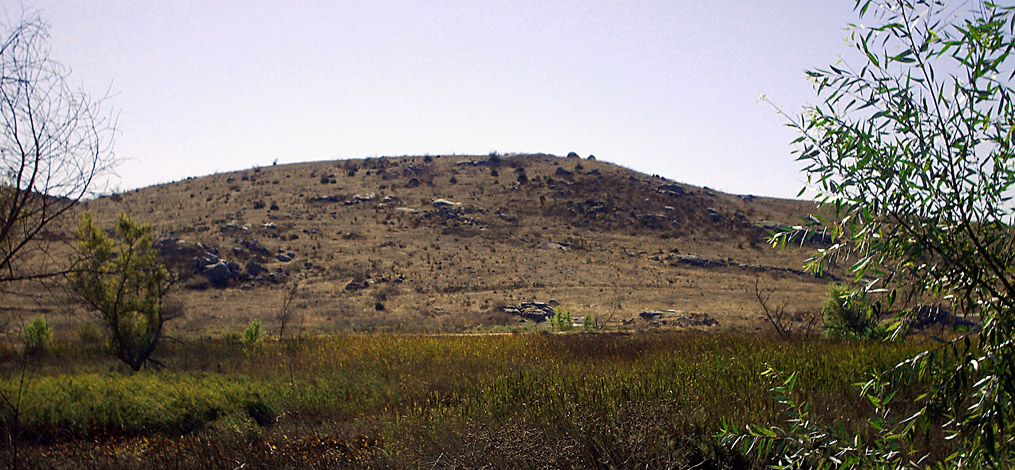
When “Grist for the Mill” Wasn’t Just An Expression

“The New Mill at Pala,” was the subject of an extensive article in the San Diego Sun on December 28, 1881.

“This mill, erected last March by the proprietors, Messrs. M. M. and W. A. Sickler, at considerable expense, is two stories high and a basement; is fifty-five miles from San Diego, and within reach of Poway, Bernardo, Bear valley, San Pasqual, Julian, San Luis Rey, Fallbrook and Temecula, all of which are the best wheat-producing sections in this county.”

Gristmills, or flour mills, were places where farmers brought their crops of wheat, corn or barley to be ground into flour. They were an essential part of the agricultural economy in San Diego County at that time. The Sickler Brothers Mill was the first in the county.

“The advantages of a mill of this kind to the community is very great,” stated the Sun article, “ the farmers being able to procure flour at fully one-third less than formerly….” Up to then San Bernardino was the closest milling location for local farmers. Otherwise, customers seeking flour had to rely on imports “from San Francisco at high charges for freight.”

The Sickler brothers knew their business. Two large grinding stones, built in France, were shipped from Missouri—where the Sickler family had formally lived and operated a mill—to Oceanside and then hauled to Pala by wagon.

The brothers built a flume to divert water from the San Luis Rey River, carrying it down a twenty foot drop to the mill. There the force of the water drove a cast iron wheel, just under 6 feet in diameter, its surface studded with large buckets or paddles.

The milling process was time-consuming. Since it was the only mill in the area and the only way to bring crops there was by horse-drawn wagon, it often took several days to get to and from the mill, and once there “people had to wait from several days to several weeks to get their crop processed,” according to a 2005 report published by the San Diego County Department of Parks and Recreation.

The mill became a community gathering place, with farmers and their families camping out for two weeks or more, “sharing stories and recipes, and trading goods,” the report stated. The Sicklers even set up a makeshift school for farm children.

The mill operated successfully for about a decade. Then as railroad service in the county became more developed, it became easier and cheaper for farmers to transport their crops for processing in Los Angeles and elsewhere.

Today the mill site is part of the Wilderness Gardens Preserve, maintained by the Parks and Recreation Department and open to the public. The tall wooden mill structure is gone, but its stone foundation remains, along with the cast iron water wheel which sits alongside it. For further information, visit http://www.sandiegocounty.gov/parks/openspace/wildernessgardens.html .

Sources for this post included historic San Diego newspapers and the archives of the San Diego County Parks and Recreation Department, with special thanks for the work of Lynne Newell Christenson, former San Diego County Historian, Ellen Sweet, Volunteer Researcher at the Parks Department’s History Office, and Department District Manager Jake Enriquez.

Get Updates Automatically-Become A Follower of the San Diego History Seeker

You can get weekly updates of San Diego History Seeker automatically in your email by clicking on the “Follow” button in the lower right corner of the blog page. You’ll then get an email asking you to confirm. Once you confirm you’ll be an active follower.
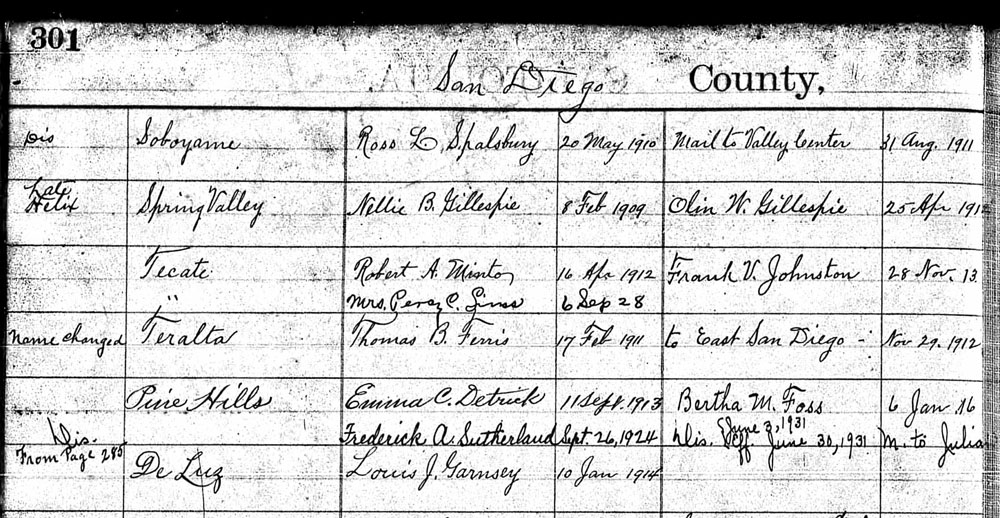
The “Piggly-Wiggly Post Office”

Louis Garnsey postmaster

Entry for Louis Garnsey (bottom) as postmaster of De Luz, California, from Record of Appointment of Postmasters, National Archives and Records Administration.

“Louis J. Garnsey has been appointed postmaster at Deluz, San Diego county,” stated the short notice in the San Diego Union of January 11, 1914.

Louis Garnsey was a busy man, growing grapes, apricots, olives and grain on the family ranch in De Luz Canyon, eight miles north of Fallbrook.

The canyon had experienced somewhat of a boom beginning in the 1870s. There was an influx of homesteaders who built thriving ranches over the next two decades. The establishment of Judson’s Mineral Springs Resort in 1881 helped lead to the building of a railroad station in the canyon.

But by 1910 the resort had closed, and in 1916 the railroad station was swept away by a flood and the railroad re-routed out of the area. But Garnsey and some others stayed on, creating a distinctive rural community.

Garnsey’s tenure as postmaster would last 16 years, and earn him an extensive article in the Union of May 20, 1928 for what the paper called his “piggly-wiggly post office.” The article provides some insightful impressions of Garnsey, his community, and county life in general at that time.

The post office was a tiny building in the yard near his ranch’s farmhouse, a not unusual circumstance in San Diego County during that era.

“It is only eight feet square,” stated the article, and [Garnsey] receives the magnificent salary of $5 a month, in return for which he sorts the incoming mail, distributes it among the 15 boxes which take up almost the entire front wall, sells a few stamps and writes a money order once or twice a year.”

The Union said the post office served a total of 15 families, who “call for their mail whenever they wish, day or night—the office is never closed—and just help themselves. If they want to buy a two-cent stamp they yell ‘Louie, oh Louie” at the top of their voices, and if the postmaster doesn’t come they either wait or look for him somewhere on the 320-acre ranch.”

The article also claimed that “The postmaster hasn’t been off the ranch in almost a year.”

“No occasion to,” they quote Garnsey in explanation, “This postoffice job isn’t very rushing but there’s always plenty to do on the ranch.”

It should be pointed out that another newspaper article about Garnsey’s ranch in preceding years described deliveries of produce way off the farm, specifically a delivery of 4,000 boxes of grapes to Santa Ana, with another family member “acting as salesman and distributor.” So Louis may not have left his property very often, but his produce sure did.

Get Updates Automatically-Become A Follower of the San Diego History Seeker

You can get weekly updates of San Diego History Seeker automatically in your email by clicking on the “Follow” button in the lower right corner of the blog page. You’ll then get an email asking you to confirm. Once you confirm you’ll be an active follower.

“Out West in San Diego County…”

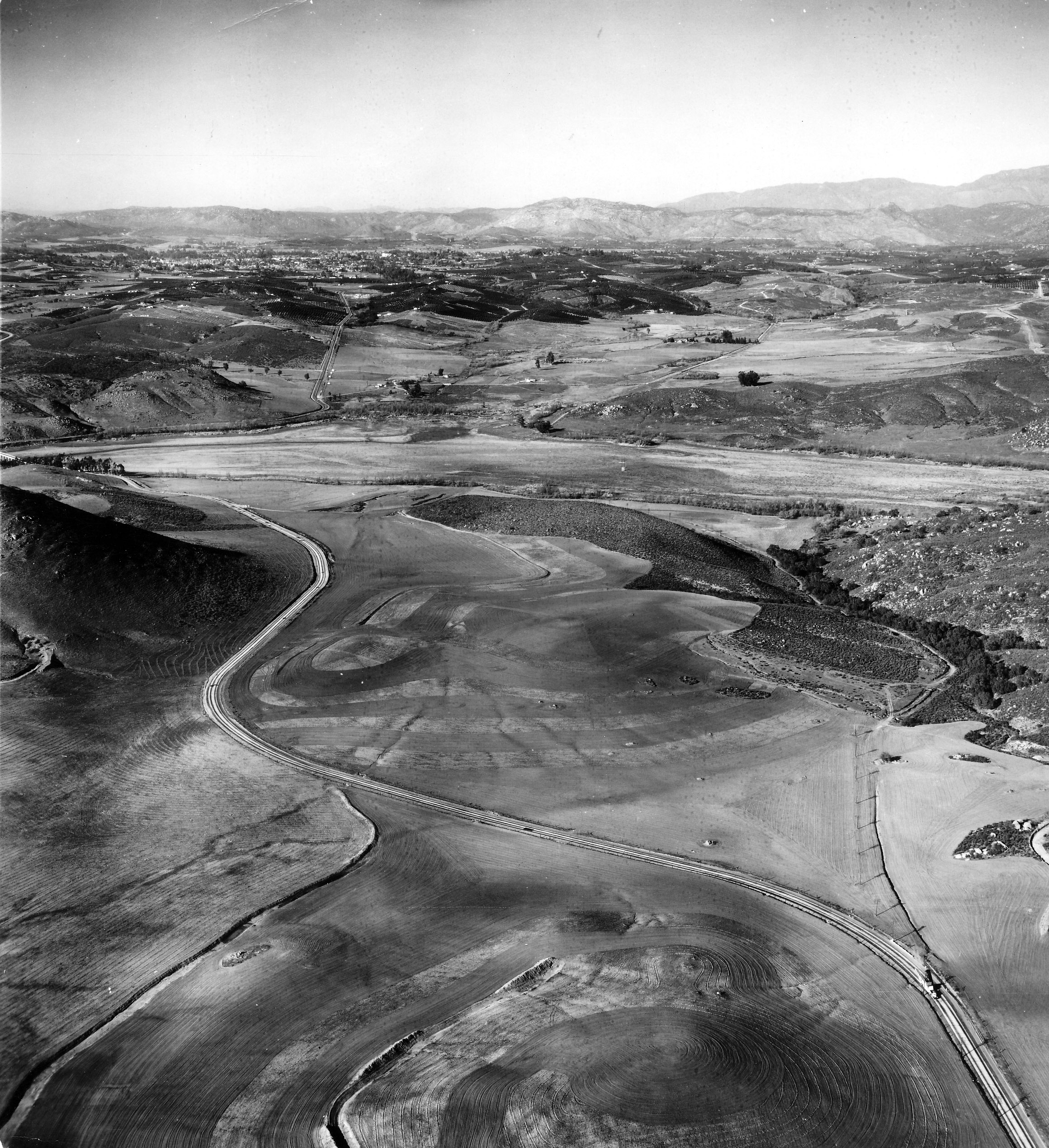
Daley Ranch aerial photo 19 Jan 1948

Grain fields at Daley Ranch, 1948, from the archives of the Rancho Bernardo Historical Society.

“Out West in San Diego County, Where Wide Open Spaces Still Are Found,” was the headline on a brief article in the San Diego Union on February 2, 1927. The subject of the item was the ranch of George R. Daley, “situated in the rolling hills of Bernardo, near picturesque Lake Hodges of the city’s water system.”

Rancho San Bernardo was indeed a wide open space then, 6,000 acres of grain and pasture bordered by Lake Hodges on the north, Rancho Penasquitos on the south, the Bermardo Winery on the east, and 4S Ranch on the west.

“We raised oat hay on the red lands and barley on the adobe hills where you could thresh it,” said Donald Daley, Sr. in a 2006 interview with me. Donald Daley, who died in 2007, and his brother Lawrence, who died in 2002, were the last ranchers on the land that became today’s urban neighborhood of Rancho Bernardo.

At first they raised horses and mules for their farming and construction businesses. Cattle came later, in the 1930s. Up to the early 1950s, cowboys from the Daley ranch and neighboring spreads were leading cattle drives along Highway 395, the two-lane road that in those days was the only link between the city of San Diego and North County.

Into the mid-1950s ranch hands could still be seen wearing holstered Colt revolvers on the streets of downtown Escondido.

In 1961 the Daley brothers agreed to a joint venture with Harry Summers and W. R. Hawn to develop Rancho San Bernardo into a planned urban community, to be called Rancho Bernardo.

Sources for this post included historic San Diego newspapers, interviews with members of the Daley family and with Bob Williams, another rancher and Daley family friend, and the archives of the Rancho Bernardo Historical Society.

Get Updates Automatically-Become A Follower of the San Diego History Seeker

You can get weekly updates of San Diego History Seeker automatically in your email by clicking on the “Follow” button in the lower right corner of the blog page. You’ll then get an email asking you to confirm. Once you confirm you’ll be an active follower.


Banner

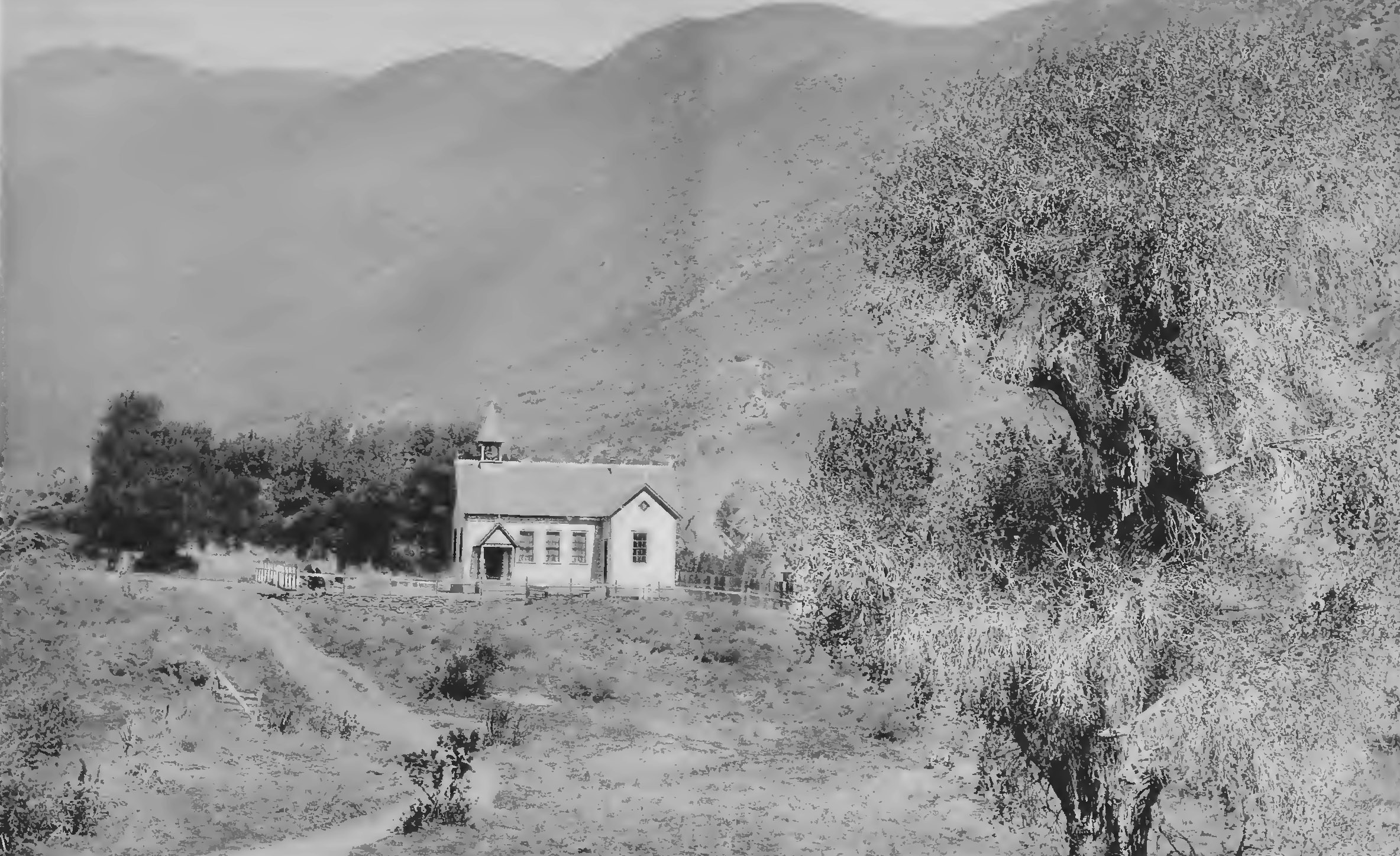
Once there was a town in San Diego County called Banner. Here’s a photo of its public school as it looked in 1887, from the book Picturesque San Diego:

Banner school

Looks idyllically rural, doesn’t it? Well, it was rural, but most of its residents made their living in a pretty gritty (in the most meaningful sense of the word), noisy and dangerous environment. Of course, it could be lucrative work too. It was gold mining country.

“Banner is the leading mining center of San Diego County,” began the description for the town’s listing in the 1897 Directory of San Diego City and County. “It is in the Julian country, four miles east of Julian and 64 miles north-east from San Diego, on the desert side of the mountain range.”

That description was followed by a list of 50 residents and their occupations. Of the 50, 36 were miners. Four were mine owners, the remaining ten farmers, stockmen and a merchant.

The four mine owners were brothers, the Baileys, who established the mine they named Ready Relief in 1870. The name is said to have come from the fact that one of the brothers, Drury D. Bailey, was down on his luck when they struck gold while digging near Banner Canyon. That change of fortune turned into a successful mining and milling operation during the heyday of mining in the Julian area in the late 19th and early 20th centuries.

“The Ready Relief Mining Company is engaged in getting its new pumping apparatus and hosting machinery into place in the Redman mine,” noted an item in the San Diego Union on April 11, 1895. “All the machinery will be in place in a few days and will be operated by water power from the plant at the Ready Relief.”

The Redman mine was owned by Louis Redman, whose discovery of gold in 1870 in what was called Chariot Canyon triggered a rush of other diggers like the Baileys to the country east of Julian. Redman is said to have planted a banner to mark his discovery, which is why the canyon and mining town wound up being called Banner rather than Redman. That’s history for you.

Sources for this post included historic San Diego newspapers and two books by Richard Fetzer, San Diego County Place Names A to Z, and A Good Camp: Gold Mines of Julian and the Cuyamacas.

Get Updates Automatically-Become A Follower of the San Diego History Seeker

You can get weekly updates of San Diego History Seeker automatically in your email by clicking on the “Follow” button in the lower right corner of the blog page. You’ll then get an email asking you to confirm. Once you confirm you’ll be an active follower.