Why We Need Librarians

The San Diego Public Library formally opened for business on July 15, 1882. In its first few years, the library was housed in donated space in the rooms of different local businesses. By the end of the decade, the new library was doing quite well, according to the book, An Illustrated History of Southern California, published in 1890, which included a report on the library as part of its chapter on San Diego City and County.

“During the year 1889 this institution has been installed in new and commodious quarters in the Consolidated Bank building. The quarters are comfortably furnished, and well lighted and heated. There are reading rooms for ladies and gentlemen, and in this department alone the record shows the use of 4,717 books during the latter seven months of the year, since these rooms have been opened.”

That’s not a bad figure in a city with, at that time, a total population of around 16,000 people.

The book noted, diplomatically, that one of the features of the library’s new headquarters was “the presence of attendants to issue the books, instead of the old system by which the patrons were allowed access to the shelves for that purpose, which was most conducive to the loss of books, now stopped almost entirely.”

“Fiction is the branch most sought by the patrons of the library,” the report concluded, with historical and biographical works holding a good second. The present number of volumes is 7,000, or 1,500 more than last year, and this library supplies more reading matter in proportion to its size than any other in the State.”

You can get weekly updates of San Diego History Seeker automatically in your email by clicking on the “Follow” button in the lower right corner of the blog page. You’ll then get an email asking you to confirm. Once you confirm you’ll be an active follower.

Zenas Sikes

Below is a page from the list of registered voters in San Diego County for the year 1873. It shows the listing for Zenas Sikes. The columns to the right of his name show that he was 39 years old at the time, and had been born in Massachusetts. His occupation was “farmer” and his legal residence was San Pascual (Pasqual), meaning then the area served by the San Pasqual post office, which included the San Pasqual Valley and immediately adjacent areas.

Below that list is the 1880 voter register. Zenas Sikes is still on there. He is now 50 years old but he continues to be a farmer. Right above him is Harry Sikes, 21 years old and also a farmer. Harry is Zenas’ son, born in Michigan when his father and mother briefly visited that state on the journey that would eventually bring them to California. Zenas and Eliza Sikes and their six children moved to San Diego County in 1868.

 Zenas Sikes San Pascual


Zenas Sikes Bernardo

Courtesy California State Library, Sacramento.

In the “Legal Residence” column Harry is listed as living in “Bernardo,” where Zenas is listed as residing as well. Had Zenas Sikes moved since his name appeared on the 1872 voter register?

Not at all. The Sikes family’s address changed but they were all living on the same place, a 2,400 acre farm that had formerly been part of the former Mexican land grant Rancho San Bernardo. Zenas’ purchase was the beginning of the subdivision of the great rancho, which sprawled over 17,000 acres 23 miles north of San Diego city.

By the early 1870s, references to “Bernardo Valley” or “the Bernardo” or “San Bernardo tract” had begun appearing in local newspapers. A sizable enough community had formed to require their own post office. The Bernardo Post Office was officially established on December 3, 1872. The first postmaster of Bernardo was Zenas Sikes, and the post office was in his home.

Bernardo would eventually have a stand-alone post office building, along with a blacksmith shop and several other buildings. Those buildings are all gone but the Sikes house still stands, now part of the San Dieguito River Park. It’s open to the public for tours and for special events. To find out more, go to http://www.sdrp.org/projects/sikes.htm .

To find out more about The Lost Town of Bernardo, you can order my book by going to the website https://sandiegohistoryseeker.com/ and pressing the “My Books” tab.

Get Updates Automatically-Become A Follower of the San Diego History Seeker

You can get weekly updates of San Diego History Seeker automatically in your email by clicking on the “Follow” button in the lower right corner of the blog page. You’ll then get an email asking you to confirm. Once you confirm you’ll be an active follower.
Occupation: Cowboy

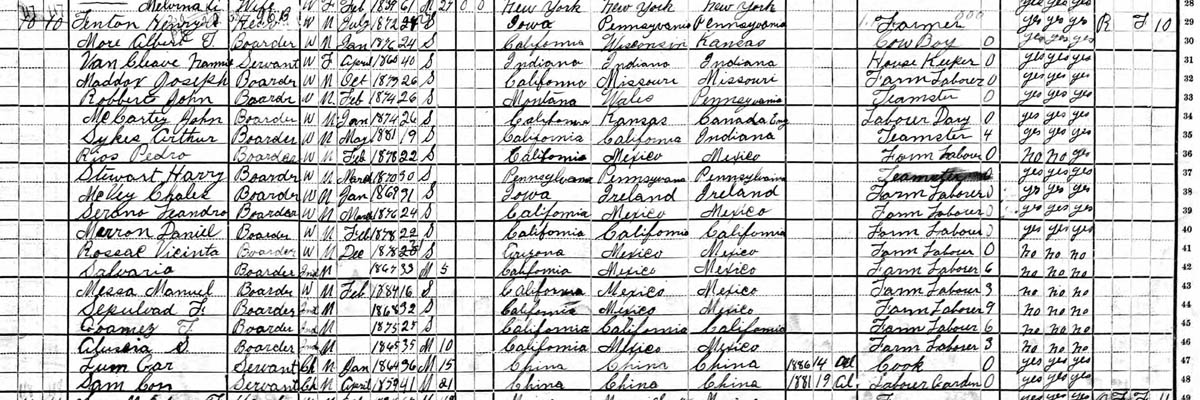
1900 Henry Fenton census

Excerpt of page from the 1900 United States Census for Jamul Township, San Diego County, showing household of Henry Fenton.

You can learn a lot from census figures, whether you’re researching someone’s family history or the history of San Diego County. As one who does both for a living, I can vouch for what you can learn about a person, or about life at a particular time or place, from looking at basic records like censuses.

Case in point, the 1900 United States Census for a part of San Diego County then called Jamul Township, and the household of one Henry Fenton.

For those not familiar with census forms, the enumeration for each household begins with the head of the household, and in 1900 Henry Fenton is the head of a household under which some 19 other names were listed. This might seem extraordinary at first glance, especially when one notes that under marital status, Henry is listed with an “S” (for single). But under occupation, Henry is listed as a farmer, and reading further along, one sees that Henry is a renter, rather than an owner, of this particular farm.

Going down to the next line will provide further clarification on this quite populous household. The next resident name, Albert More, is listed as a “boarder,” and his occupation is described as “cowboy.”

Of the next 18 names, 15 are listed as boarders and three as servants, including the lone female in the group, Nannie Van Cleave, whose occupation is listed as “House keeper.”

Of the remaining names for this household, twelve are listed as farm laborers, three as teamsters, one as a cook, and one a gardener. This census asked each occupant’s birthplace, and in the case of this ranch the places of origin of the boarders and servants ranged from Indiana to Mexico to China.

Henry Fenton would come to own a lot of farmland in the county during his life. For now let us note the range of occupations it took to run one farm in San Diego County in 1900. Let’s also note that ethnic and racial diversity in the county is nothing new.

Get Updates Automatically-Become A Follower of the San Diego History Seeker

You can get weekly updates of San Diego History Seeker automatically in your email by clicking on the “Follow” button in the lower right corner of the blog page. You’ll then get an email asking you to confirm. Once you confirm you’ll be an active follower.

Mr. Allison’s Springs

Like many another San Diegan, Robert Allison came to San Diego County from the midwest, and he came for the climate. Born in Ohio in 1814, he came west in 1868 seeking a milder climate for his then failing health.

The climate appeared to do him good. With his wife and four children he was soon running a major sheep and cattle ranch. He’d bought 4,200 acres in the foothills of eastern San Diego County on the western boundary of the old El Cajon Rancho. It was considered an out-of-the-way place, even in the then very rural county. But the tract included some natural springs, the only water source for miles around. The area came to be called “Allison Springs.”

An item in a Tucson, Arizona newspaper, picked up in the April 1, 1875 San Diego Union, noted that “Fifteen hundred sheep arrived here from San Diego County on Wednesday, having been three months on the way. They were in the charge of Mr. Allison….”

The 1880 United States Census shows the Allison household consisting of father Robert, 66, his wife Tempe, 65, and two sons, Joseph, 28, and Juan, 23. Under “occupation,” Robert and his older son Joseph are listed as “Stock Raiser,” while younger son Juan is listed as “Butcher.” Wife Tempe is “Keeping House,” which undoubtedly understated what she contributed to the ranch.

Short local news items over the next few years tell of Robert and his sons doing things like “milking cows and making cheese.” But his name also began appearing in legal notices or real estate transactions, showing Allison’s involvement in land sales and the promotion of railroads in the county.

Allison would live to see the San Diego, Cuyamaca and Eastern Railroad build a line into his little community before his death in March 1891. He in fact was an investor in and director of the railroad. He may have also played a role as well in the evolution of his community’s name, since references from the late 1880s and 1890s no longer identify it as “Allison Springs,” but rather “La Mesa Springs,” “La Mesa Colony,” or just “La Mesa.” The rest, as you might say, is history.

Sources for this post included historic San Diego newspapers, The Journal of San Diego History, the 1880 United States Census and the website of the La Mesa Historical Society, https://lamesahistory.com/ .

Get Updates Automatically-Become A Follower of the San Diego History Seeker

You can get weekly updates of San Diego History Seeker automatically in your email by clicking on the “Follow” button in the lower right corner of the blog page. You’ll then get an email asking you to confirm. Once you confirm you’ll be an active follower.

Of Eagles, Omens and Real Estate

The Sunday edition of the San Diego Union for October 8, 1871 included among the items in its “National City” column, a story that began this way:

“On Wednesday afternoon, people in the immediate vicinity of the flag staff in front of Kimball Brothers’ land office were surprised by the appearance of a huge eagle which lighted on top of the staff.”

A little background here. The Kimball brothers—Frank, Levi and Warren—had in 1868 purchased the Mexican-era land grant Rancho de la Nacion, some 26,000 acres spreading south of Old Town San Diego and fronting the bay. They subdivided it and began offering lots for sale in the community they renamed “National City.”

Along with seeking land buyers, they also quickly began trying to interest railroad companies in extending a line to their town and connecting it to the developing transcontinental route. They offered thousands of acres to various railroad entrepreneurs in exchange for the building of a station and other facilities.

At the time of the article in question, no deal had been officially announced, but the idea of a transcontinental terminal in the San Diego area was very much in the news. So there’s the context for this tale of the eagle’s landing on a real estate office flagpole.

The eagle hung around for a while, long enough, stated the Union reporter, that “the believers in signs and wonders predicted that the appearance of this strange visitor was the herald of good times coming, and would now allow the bold bird to be brought down…”

The article went on to state, “The [railroad] terminus being the most important matter under consideration, it was supposed that this prophetic bird had come among us for the purpose of pointing out the coveted spot. This belief was confirmed by its taking wing and going in a straight line to the railroad lands, which it sailed around a few minutes, but returned to the flag pole again, as if dissatisfied with the reconnaissance, where it remained all night.”

At daylight the next morning, the eagle had disappeared, “leaving the superstitious and the skeptical to discuss the object of the eagle’s visit.”

A decade and a half later National City would get a station as the terminus of the transcontinental railroad, along with repair yards. But a few years after that the railroad owners changed their plans and moved the facility to the Los Angeles area.

Maybe that bird was right.

Sources for this post included historic San Diego newspapers and the books San Diego County Place Names A To Z by Leland Fetzer and City of San Diego and San Diego County:Birthplace of California, by Clarence Alan McGrew.

Get Updates Automatically-Become A Follower of the San Diego History Seeker

You can get weekly updates of San Diego History Seeker automatically in your email by clicking on the “Follow” button in the lower right corner of the blog page. You’ll then get an email asking you to confirm. Once you confirm you’ll be an active follower.