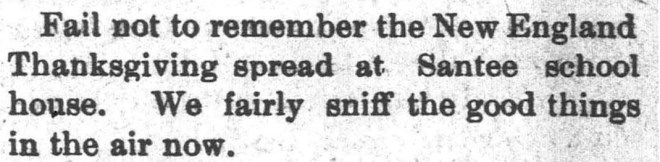
From the “Santee Sentences” column of the Poway Progress, November 16, 1895.
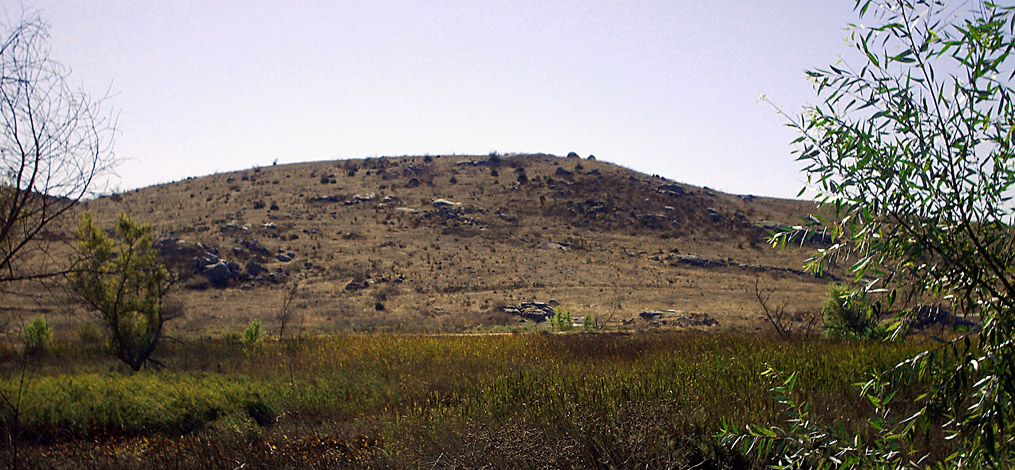
From the “Santee Sentences” column of the Poway Progress, November 16, 1895.
“Escondido Picks Old Hotel Site for New Hospital” proclaimed the headline of an article in the June 24, 1945 edition of the San Diego Union.
“Selection of the site of the old Escondido hotel, a well known landmark 25 years ago, as the location of Escondido’s Palomar Memorial Hospital was announced by the hospital committee which is raising funds for the enterprise,” began the article. “The site, on Grand Avenue, is just east of the local civic center.”
The Escondido Hotel, one of the first buildings erected in the then-new town of Escondido, stood on Grand Avenue from 1886 until its demolition in 1925. When the newly-formed Escondido Valley Hospital Association selected the Grand Avenue site for their new complex, they also announced a combination community celebration and fundraiser to be held on the upcoming Fourth of July in Grape Day Park.
Escondido’s annual Grape Day celebration in the park had been on hiatus since Pearl Harbor, and the community may have been glad to get together again in the summer of 1945, with the war in Europe over and peace seeming to be on the horizon in the Pacific. An estimated 4,000 to 5,000 people showed up for the event, putting the hospital building fund “well over its goal,” according to the Union of July 5, 1945. Keep in mind that Escondido’s population at that time stood at around 4,500 total.
It sounded from the press coverage like a good old-fashioned community party, with a barbecue, parade, horsemanship exhibitions and other entertainment including dances, singers and “several San Diego radio stars and war plant entertainers,” including “Therman Landreth, world champion top spinner.”
That single hospital on Grand Avenue would evolve into today’s Palomar Pomerado Health District.
Sources for this post included historic Escondido and San Diego newspapers and the history section of the Palomar Pomerado Health website, http://www.palomarhealth.org/about-us/about-us-our-story .
Get Updates Automatically-Become A Follower of the San Diego History Seeker
You can get weekly updates of San Diego History Seeker automatically in your email by clicking on the “Follow” button in the lower right corner of the blog page. You’ll then get an email asking you to confirm. Once you confirm you’ll be an active follower
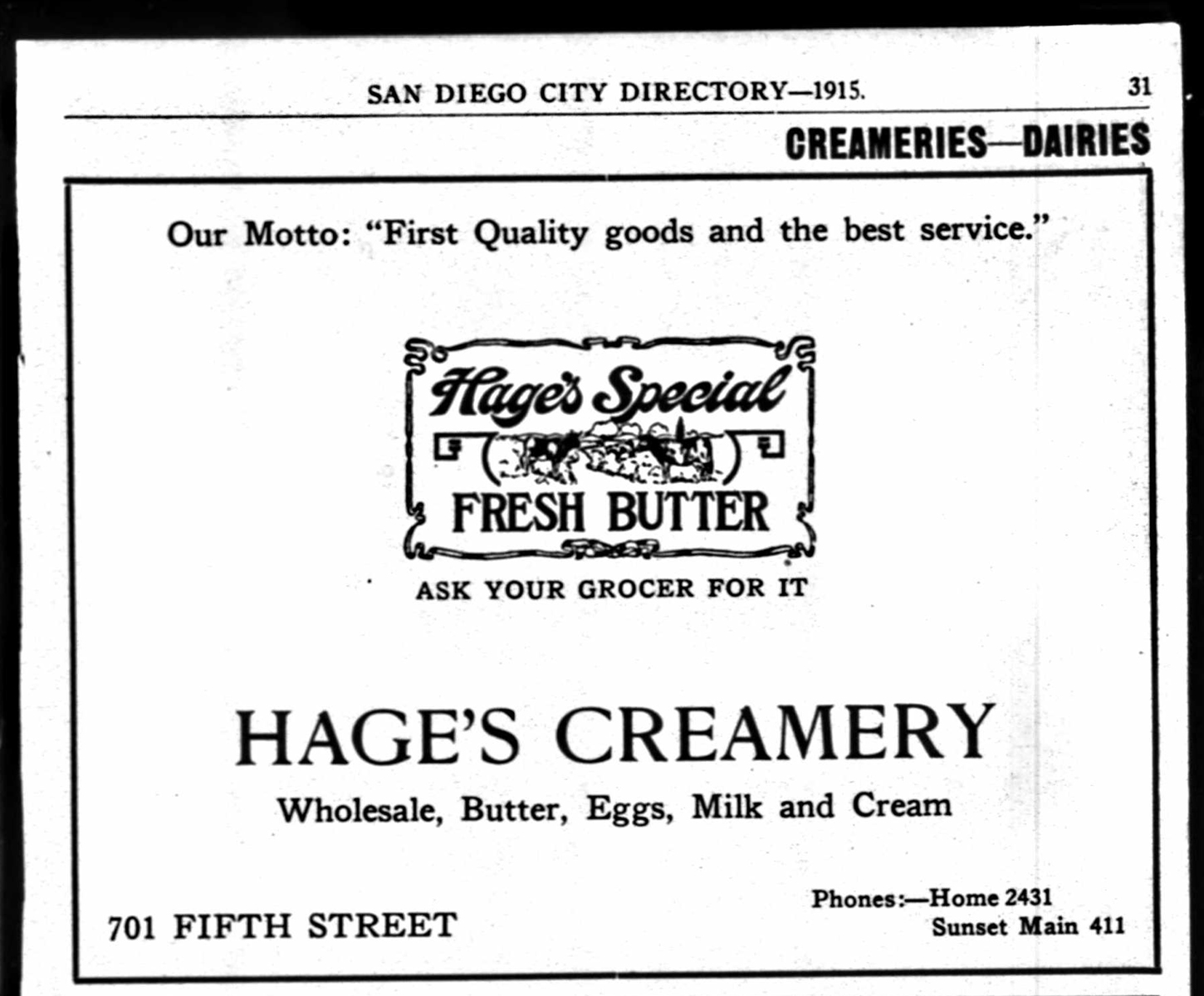
The ad shown above is from the 1915 San Diego City Directory.
Willard B. Hage was born into a dairying family in Wisconsin in 1868. He brought his dairying skills with him when he came to San Diego in 1891.
Starting out delivering milk with his own wagon and a single horse, he did well enough that by the early 1900s he owned creameries in the cities of San Diego, Escondido and Poway.
An article in the January 1, 1916 San Diego Union noted how Hage “became impressed with the possibilities in San Diego’s back country. Backing up his belief, he adopted a novel and liberal policy of supplying modern dairying equipment to back country ranchers and allowing them to pay for it on easy terms.” This, the article stated, “made it possible to develop the dairy industry out in the county in a section that was formerly given over to the raising of grain.”
Interestingly, in both the 1900 and 1910 United States Censuses, Willard Hage lists his occupation as “Dairyman,” while in 1920 he describes himself as “President, ice cream company.”
Willard Hage died in 1925. His business would continue under the family name and ownership and be a San Diego institution until its merger with Foremost Dairies of San Francisco in 1954.
Sources for this post included the 1915 San Diego City Directory, historic San Diego County newspapers, the Los Angeles Times, the United States Census Bureau, and the 1922 book, City of San Diego and San Diego County: The Birthplace of California, by Clarence McGrew.
Get Updates Automatically-Become A Follower of the San Diego History Seeker
You can get weekly updates of San Diego History Seeker automatically in your email by clicking on the “Follow” button in the lower right corner of the blog page. You’ll then get an email asking you to confirm. Once you confirm you’ll be an active follower.
Hard to imagine now, but the first appearance of a telephone in the city of San Diego occurred in 1877, and that was just a demonstration by a local member of the U. S. Weather Service.
“The first public exhibition of the telephone in San Diego was made by Lieutenant Reade, U. S. Weather Officer, on December 5, 1877,” wrote William Smythe in his 1908 book, History of San Diego: 1542-1908. It wasn’t until May of 1882, according to Smythe, that the San Diego Telephone Company was organized and began stringing phone lines. When the first phone calls were made on June 11 of that year, there were a total of 13 subscribers in the San Diego exchange.
The company was at first not incorporated, Smythe wrote, “but was operated as a mutual affair, as the telephone business was thought to be in an experimental stage.”
In 1890 the San Diego Telephone Company was succeeded by San Francisco-based Sunset Telephone and Telegraph, which began efforts to connect the city of San Diego with the rest of California. Service reached Escondido in June of 1897, but the phone remained a relative novelty in the next few years. For example, Sunset’s 1899 phone directory showed listings for the entire Pacific Coast! There were only 18 telephone numbers in the Escondido exchange, in a city of around 700 people at the time.
In 1926, Sunset’s successor, the Pacific Telephone and Telegraph Company, threw a party to celebrate the fiftieth anniversary of the telephone in San Diego, inviting surviving original subscribers and employees. They did it with a sense of humor too, according to an article on the bash in the June 9, 1926 San Diego Union.
“The place cards for the invited guests indicated their seats only by telephone numbers,” the article stated. “A tiny desk telephone was at each place , as was a list of the pioneers and a replica of the first San Diego telephone directory.”
The central table ornament was “a big synthetic birthday cake lighted with 45 telephone switchboard electric lamps,” the Union stated.
One of the invited pioneer subscribers was department store owner George W. Marston. But he began his remarks with an apology for not having his business’s name in the very first directory in 1882.
“He explained,” said the Union article, “that he feared at first that the telephone was only a toy and that it took a year to convince him that it would amount to something here.”
Sources for this post included the Smythe book, historic San Diego and Escondido newspapers, and the archives of the Escondido History Center.
Get Updates Automatically-Become A Follower of the San Diego History Seeker
You can get weekly updates of San Diego History Seeker automatically in your email by clicking on the “Follow” button in the lower right corner of the blog page. You’ll then get an email asking you to confirm. Once you confirm you’ll be an active follower.
Today a brief historical snapshot of the risks of ranching life and the duties of a doctor in San Diego County in 1874.
A brief item in the “Local Intelligence” column of the San Diego Union on Thursday, July 23, 1874 began: “At San Pasqual, on Monday last, James P. Jones, who keeps a bee ranch in the valley, was seriously injured by the premature explosion of a blast while engaging in removing some rocks.
“A portion of one of his hands was carried away and the forearm was fractured. Dr. Remondino was sent for and went out and brought the man in. Yesterday [Wednesday, July 22nd] the arm was amputated by Dr. Remondino, assisted by Drs. Gregg, Fenn and Winder.”
Mr. Jones survived his horrific accident and injuries, as shown by the fact that he turns up six years later in the 1880 United States Census, listed as an “apiarist,” on his north county farm.
Dr. Peter Remondino, the man who saved Mr. Jones’ life, had recently opened a medical office on Fifth Avenue between B and C Streets downtown. He would go on to have a distinguished career as a surgeon, medical lecturer and author and entrepreneur. He helped many people in his life as a skilled and compassionate physician, practicing medicine until just two years before his death in 1926 at the age of 80.
Sources for this post included The Journal of San Diego History, historic San Diego County newspapers and the 1880 United States Census.
Get Updates Automatically-Become A Follower of the San Diego History Seeker
You can get weekly updates of San Diego History Seeker automatically in your email by clicking on the “Follow” button in the lower right corner of the blog page. You’ll then get an email asking you to confirm. Once you confirm you’ll be an active follower.
 San Diego History Seeker