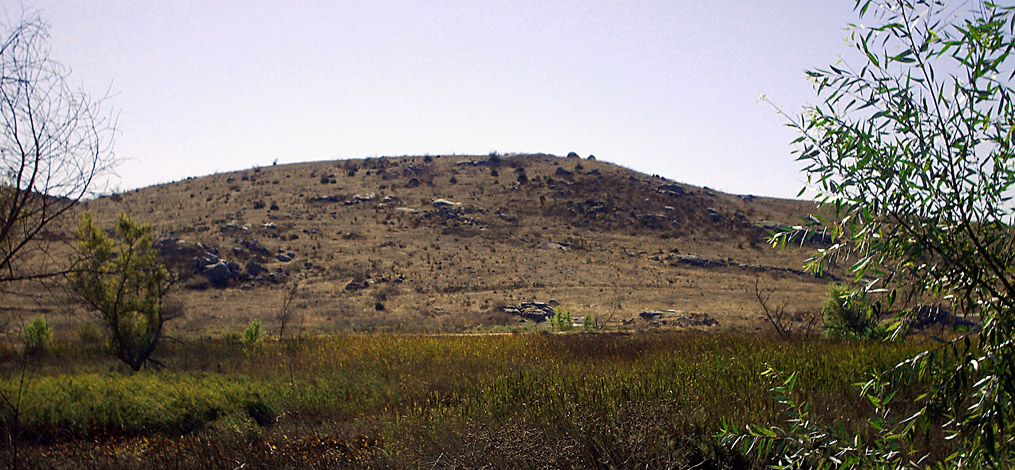
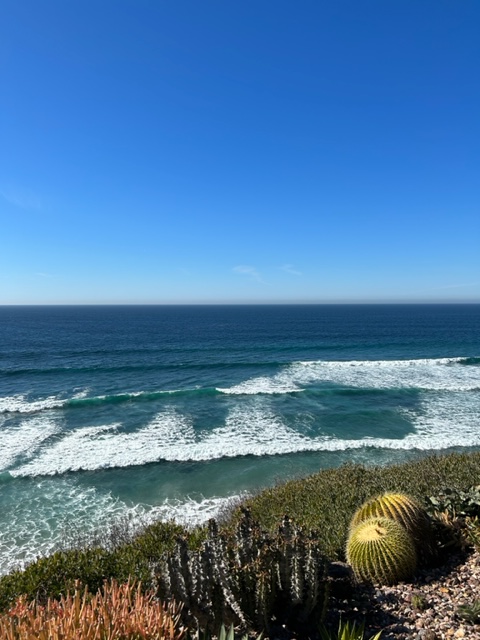
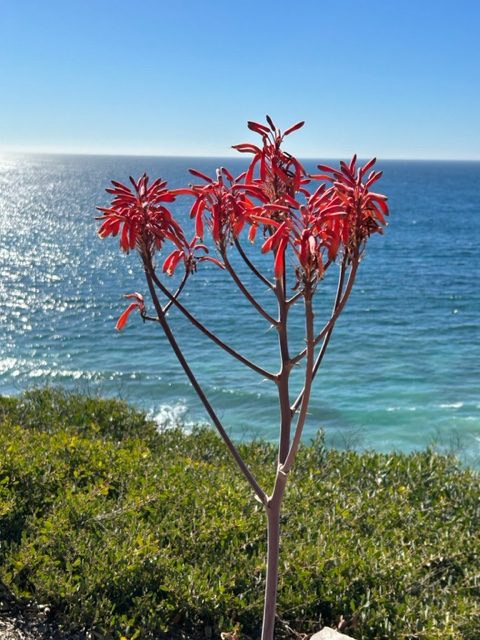
This past Saturday my wife Peggy and I sought some time away from work and the world at a favorite spot of ours—the Self-Realization Fellowship Hermitage, Retreat and Meditation Gardens in Encinitas. Strolling along the bluffside paths among ponds and gardens, stopping to sit here and there and gaze out at the ocean, all served as the ultimate refresh. Here are some visual examples of what that spot offers:
.
The SRF Encinitas Ashram Center was founded in 1937 by Paramahansa Yogananda. From 1938 to 1942 the grounds also included a structure called the Golden Lotus Temple, which attracted visitors and worshippers until erosion of the bluff on which it stood caused the building to slip off its foundation and slide almost two-thirds of the way down to the sea before it was dismantled in the summer of 1942. The rest of the campus remained intact, and continued to attract visitors and worshippers. Through the founding of various ashrams and the authorship of books like The Autobiography of a Yogi, Yogananda had by the time of his death in 1952, earned worldwide recognition as an advocate of the principles of yoga and meditation. In the words of an informational brochure published by the center, he “dedicated his life to uniting East and West in the lasting ties of spiritual understanding, and to helping others toward realization of the limitless resources fof love and peace that exist within every human being.” Food for thought as well as nourishment for the rest of your senses. SRF is open to visitors Tuesdays through Saturdays from 9 a.m. to 5 p.m. and on Sundays from 11 a.m. to 5 p.m., closed Mondays. For further info 760-753-1811 or visit their website, www.yogananda-srf.org
Spoken to me in an interview for a newspaper article in 2007, these were the words of a woman who’d moved to Rancho Bernardo from the Los Angeles area in 1970. At that time, Rancho Bernardo had a population of maybe 5,000 people (compared with 65.000+ today), and there were still cattle grazing in some areas of this neighborhood that its developers still called “the ranch.”
Less than a decade earlier, the urban neighborhood today called Rancho Bernardo had been a working cattle ranch, populated by maybe a dozen people, members of the ranch owning Daley family and their ranch hands. But in 1961 the Daleys joined with developers Harry Summers and Fritz Hawn, creating a joint venture, Rancho Bernardo, Inc. to transform the ranch into a planned urban community.
The first residents moved into the new community in 1963, and Rancho Bernardo was soon growing rapidly. By February 1964 the population had reached 1,300. By June of the same year it was up to 2,000.
At that point RB, Inc. was advertising their new community in newspapers and magazines across the country, and the results of their efforts were reflected in the influx of new residents from, well, everywhere.
Summers and his team were inspired to create a questionnaire which they sent out to all the new residents asking where they’d moved from. Here’s a photo of Summers and RB, Inc. Vice-President Dick Weiser at the information center in the RB sales office in November 1964, taken from that month’s issue of Bernardo Brandings, a community newspaper published by the developers. It shows Summers putting in the first pin on a map of the United States reflecting some of the first survey results.
The first published figures showed RB residents came from 43 states, the Commonwealth of Puerto Rico and five foreign countries.
Survey results showed some interesting details. California was, not suprisingly, the biggest contributor of residents with 190 families. Fifty-one of those families were from the Los Angeles area, while 26 came from San Diego.
The next biggest contributor was the state of Illinois, from which 39 families came, 25 of them from the Chicago metro area. Ohio ranked third with 20 families, six of them from the Cleveland metro area. Then came New York state with 18 families, nine of them from New York City and vicinity.
Foreign countries represented in the new community included the UK, Canada, The Netherlands, Germany, and Saudi Arabia.
The fate of this map is unfortunately unknown today, along with the fate of an enormous relief map of the RB area that was also on display during those promotional years.
Fortunately, the original survey results did survive and, thanks to the efforts of the archives team at the Rancho Bernardo History Museum, they have been scanned and are now available to the public on the museum’s online collections database. Go to rbhistory.org, the homepage of the Rancho Bernardo Historical Society, scroll down to “Search Our Online Collections Database” and click on the link labeled “Rancho Bernardo Online Collections Catalog.” Then click on “Keyword Search” and type “residents’ register”.You’ll get access to all 93 surviving pages of the survey. You can click on each individual page and enlarge them.
A shout-out to the museum archives team, led by museum archives manager Peggy Rossi—who also happens to be my life and business partner and an expert at uncovering and preserving history!
Earlier this week I gave a talk at the invitation of the Archives Department of the San Diego City Clerk’s Office. It was part of their annual Archives Month program, held every October and featuring stories from historical archives throughout San Diego County. (Thanks again to the Archives Department folks for holding this event and for inviting me to participate.)
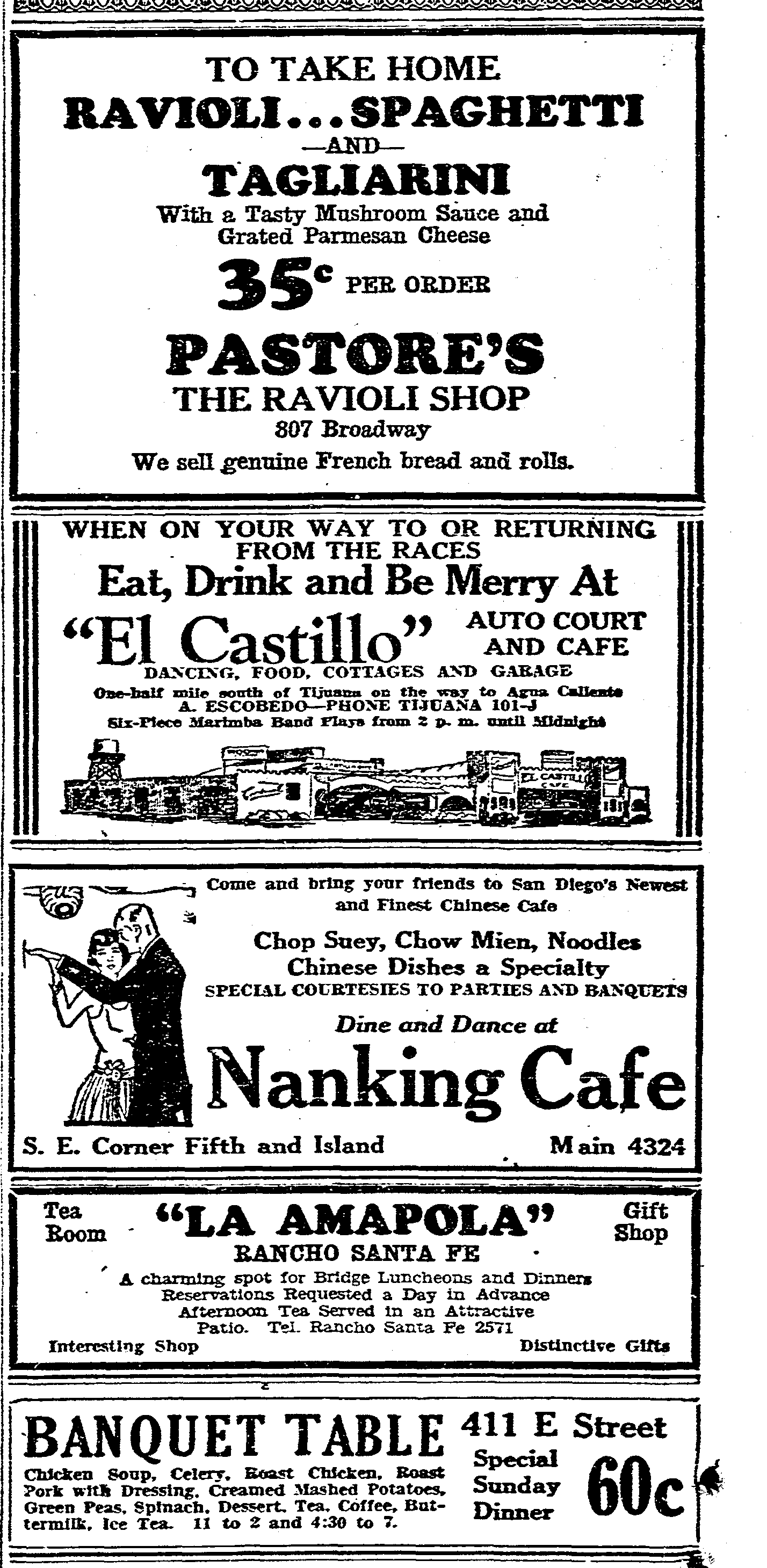
The subject of my talk was “Eating Local In the Roaring Twenties.” One of my lecture points was that eating out in San Diego in the 1920s offered a diverse menu of dishes, reflecting the diverse communities growing within the city and county. As an example, here’s a typical bunch of restaurant ads you’d find in 1920s San Diego newspapers, in this case from one page of the San Diego Union’s edition of December 16, 1928:
We see cuisines on offer from Italian to Mexican to Chinese to what some might consider your basic Anglo meat-and-potatoes dishes. I could show you more ads for French, Japanese and Kosher offerings as well. My research indicated that many, if not most of these places were run, at least at the start, by individuals and families who’d immigrated to San Diego from other parts of the world. And their clientele came to cross racial and ethnic borders as well. These places often became popular hang-outs and meeting places for all local residents, regardless of race or ethnicity, as the “Dine and Dance” reference on the ad for the Nanking Café illustrates.
Food for thought, you might say
Get Updates Automatically-Become A Follower of the San Diego History Seeker
You can get updates of San Diego History Seeker automatically in your email by clicking on the “Follow” button in the lower right corner of the blog page. You’ll then get an email asking you to confirm. Once you confirm you’ll be an active follower.
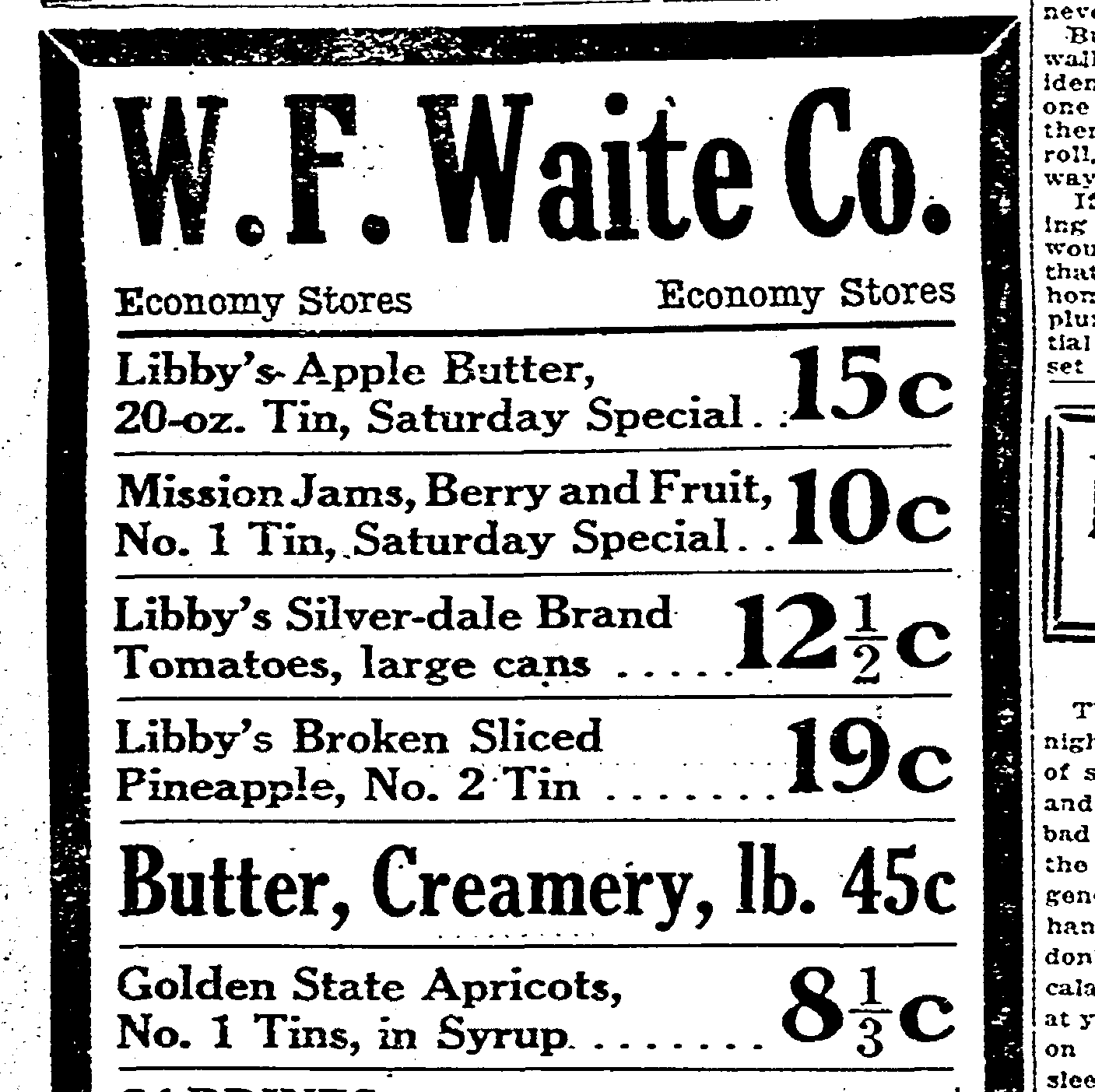
Below is part of an ad in the San Diego Union of January 3, 1925 for Waite’s Economy Stores:
As of January 1925, Waite’s had 10 stores in San Diego County, eight in San Diego city and one each in Coronado and La Jolla.
They weren’t through growing. Just a few months later, in its April 26 issue, the Union announced, “As a necessary part of its expansion program, Waite’s, Inc., one of San Diego’s big grocery chain concerns, has moved its headquarters into a new warehouse, 753-56 Union Street.”
The chain was up to 13 stores, according to the article, and the company was in the process of building a new store “in Escondido, on one of the best corners,” and planning on opening one in National City as well as another new one in San Diego city.
“Their business has grown rapidly,” the article concluded. “Large volume buying makes it possible for this company to sell merchandise at low prices.”
Waite’s had grown to 20 stores by September 1925, but the ads under that name disappeared from local newspapers. The reason for that was found by your History Seeker research team which uncovered this item in the September 1925 issue of a marketing publication of the day, The Tea and Coffee Trade Journal:
“The Safeway Stores, Los Angeles, have taken over the 20 stores of the Waite’s Incorporated Chain of San Diego and will operate them under the Safeway name and system. This gives the Safeway chain a total of 306 stores.”
Here’s a sampling of goings-on in a few San Diego County communities according to the Poway Progress newspaper’s edition for the week of August 24, 1895.
Over in Dehesa, “It was very hot last week and somewhat uncomfortable, but is considered good for grapes.”
Farmers raising other crops in the area were doing well too, apparently. For example, “E. E. Davis is hauling his peach crop to San Diego…[and] reports good prices.”
Likewise, “J. S. Harbison is hauling his honey to San Diego. A good crop is reported.”
In the El Cajon valley, “Mr. Fisher of the Chase ranch has been shipping very nice pears, peaches, apples and grapes to [produce and commission merchants] Nason, San Diego.”
Even back then, the market for county produce wasn’t just limited to San Diego or even California or the the southwestern United States. The paper’s “La Mesa Lines” column reported that “The La Mesa Lemon Co. are packing a car load of lemons for shipment to an eastern market.”
But while agriculture was becoming big business, the local farming community was still a relatively tight-knit community where people knew each other by family names rather than geographic location. That’s evident in this entry in the “Poway Points” column: “The road from the creek crossing along in front of Mrs. Higby’s place and to the corner north of it is undergoing a much needed overhauling.”
I guess most of the paper’s readers knew where “Mrs. Higby’s place” was then!
That same column also provided some foreshadowing of the area’s potential as both a tourist and retirement destination. Reporting on the visit of a couple and their young son to the Poway valley, the item noted that “They are recently from the east and were much pleased with their stay here, so much so that it is within the range of possibilities that they may make their home here. They were for 12 years teachers in Wellesley College, and are now seeking rest.”
Get Updates Automatically-Become A Follower of the San Diego History Seeker
You can get updates of San Diego History Seeker automatically in your email by clicking on the “Follow” button in the lower right corner of the blog page. You’ll then get an email asking you to confirm. Once you confirm you’ll be an active follower.