100 Years Ago: Real Horsepower Still In Demand

“Allied Army Seeks Horses, Mules in San Diego,” proclaimed the headline in an article on page two of the San Diego Union on Sunday morning, June 6, 1915.

“H. P. McKee, a San Diego horse dealer, received a contract from an agent of the French government to furnish 700 horses and 100 mules for the French army,” began the article, which noted that the contract “calls for good sound horses, five to nine years old, weighing 1,050 to 1,400 pounds and fifteen and a half to sixteen hands high. The horses to be used for cavalry must weigh from 1,050 to 1,200 pounds. Those to be used for artillery are required to weigh 1,200 to 1,400 pounds.”

McKee would start immediately on purchasing stock, the article said, and bringing them to “McKee’s barns, 1036 First street, where they will be inspected every Saturday. They will then be sent by train to Galveston and later removed to Newport News for shipping.”

The United States at that point was still a neutral observer of the war then raging in Europe. But clearly France and Britain, who were fighting Germany, considered the US a reliable supplier of material for their military campaigns.

“This is the largest contract for horses for a foreign country ever let for a San Diego dealer,” stated the Union article, which added in closing, “There is said to be a supply of good horses in San Diego county.”

That there was a supply of good horses, or at least stables and horse dealers, in San Diego may be vouched for by this page from the 1915 San Diego City and County Directory. It shows Mr. McKee as being among 26 livery stable owners and horse sellers in the county, 16 of them within San Diego city limits:
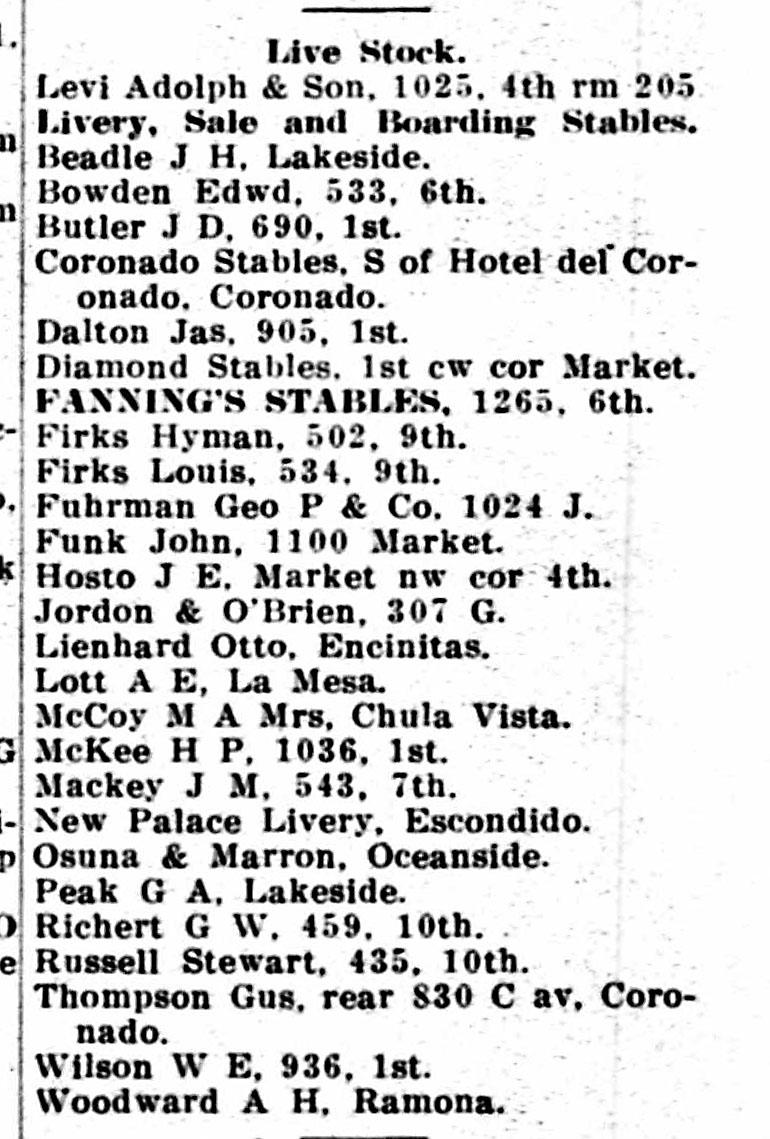
McKee page 1915

Sources for this post included historic San Diego newspapers and the San Diego City and County Directory 1915.

Get Updates Automatically-Become A Follower of the San Diego History Seeker

You can get weekly updates of San Diego History Seeker automatically in your email by clicking on the “Follow” button in the lower right corner of the blog page. You’ll then get an email asking you to confirm. Once you confirm you’ll be an active follower.
Immigration: Then and Now?

“This country has taken a step in the right direction to preserve the strain of the pioneer stock that founded this nation and has brought it to its present standard of Americanism.”

That sentence is from an editorial that appeared in the San Diego Union on May 24, 1921. The editorial, entitled “Saving the Race,” praised the passage a few days previously of a bill restricting immigration to “three percent of the existing alien population.” This was the beginning of a quota system of immigration restriction that would be U. S. government policy for the next four decades, but at that point in time it was considered “experimental,” in the words of the editorial. And it was an experiment that the editorial writer obviously approved of.

Citing the research of one Prescott F. Hall, who was described as “a high authority on the subject of the sterilizing effect of incoming low-grade aliens,” the Union bemoaned alleged higher birthrates of “foreign” over “native-born” mothers. But it also claimed that “native-born people who migrate to regions in which the pioneer stock is still dominant show little or no lessening of their former fruitfulness. The real American strain is still paramount west of the Mississippi. It is, therefore, the policy of the West to keep its stock as free as possible from alloy of the American ‘melting pot’ now seething in the great cities along the Atlantic seaboard.”

Does any of this sound familiar? I present it in an attempt to put the question of immigration in some historical perspective. If you are curious about more of that perspective, I invite you to attend the OASIS talk I’m giving on the History of Immigration in the United States on Wednesday, June 17 at 10 a.m. at the Escondido Senior Center. To sign up or find out more visit http://www.oasisnet.org/San-Diego-CA/Classes and type “Immigration” in the “Search” box.

A Different Kind of Furnace

On a research trip into family history for a client, looking at tax records m Lebanon County Pennsylvania from the mid to late eighteenth century, I was curious to see “furnaces” listed as being among the assets of a few residents. I questioned some local historians and found out that these weren’t for home heating, but referred to iron smelting furnaces. They melted iron ore mined in the hills of Pennsylvania into usable metal for the production of stoves, horseshoes and armaments like cannons. These operations were the ancestors of the steel mill and were the beginning of the United States of America as an industrial power.

Check out this website on one such furnace that we visited recently. From the home page, click on the “History” and “Furnace Tour” tabs.

http://www.cornwallironfurnace.org/index.htm


East Coast History

Hello History Seekers!

I’m on the East Coast for two weeks, visiting family and also doing some family history research for clients. So I’m looking at local history in places like New Jersey, Pennsylvania and Maryland, three states in which many of you San Diegans undoubtedly have roots in addition to myself. So today I’d like to offer a website for you to check out from New Jersey. It’s the website of the Wheaton Arts and Cultural Center in Millville, New Jersey. Millville is in southern New Jersey, an area that in addition to farming was at one time a center of glass production for the nation in the eighteenth and nineteenth century.

When you get to the home page, scroll down to the bottom where there’s a link to the Museum of American Glass for a little background. Then check out the rest of the site. Sample a little history from another part of the country!

 Here’s the website:

http://www.wheatonarts.org/


Virginia, CA

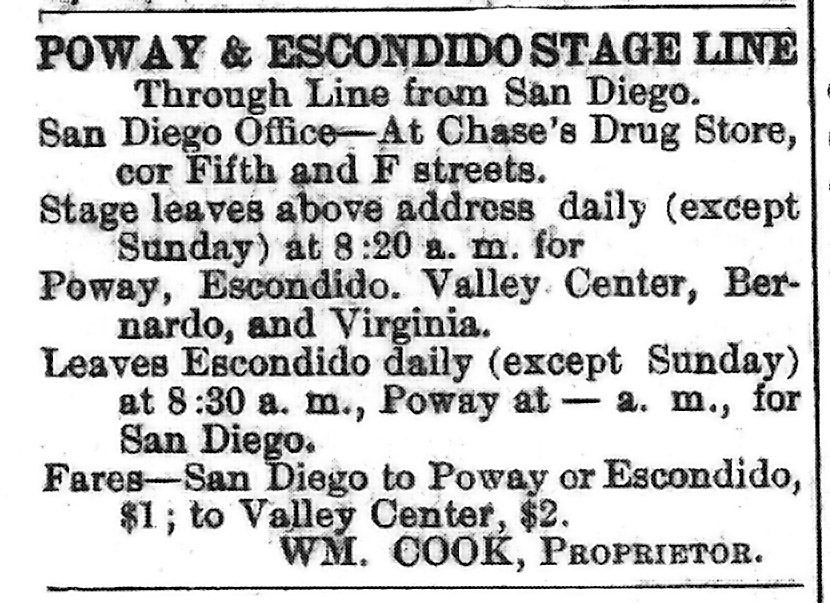
Please see the ad below from the Poway Progress newspaper of February 10, 1894 for the Poway & Escondido Stage Line. Take a look at the line about halfway down listing the main stage stops: “Poway, Escondido, Valley Center, Bernardo, and Virginia.”

Virginia

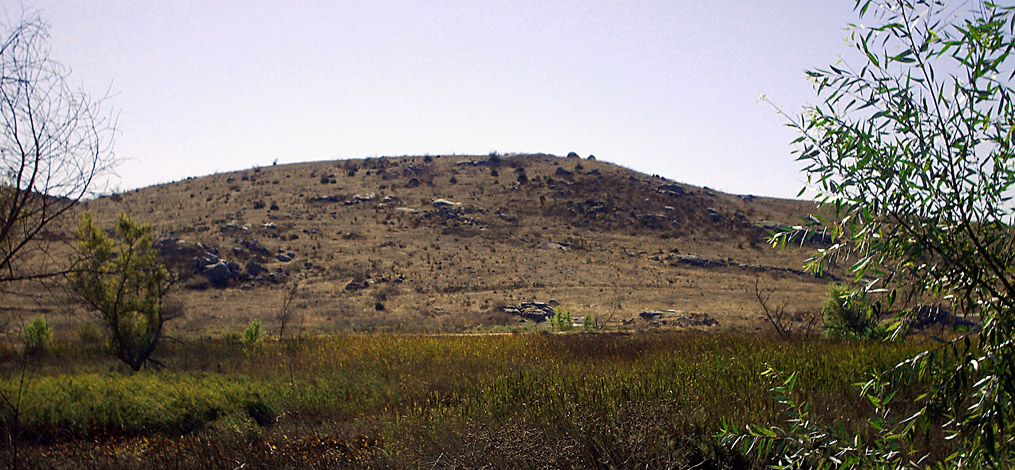
Virginia? That would seem at first glance like one BIG detour! But no, there was, for a few years anyway, a place, essentially just a post office, in San Diego County called Virginia. It was in the southern end of the Poway Valley.

In the very rural, sparsely populated north San Diego County of those days, post offices moved around a lot, based often at the ranches of individual families. The notice about the creation of the Virginia post office offers a typical example.

“The 320-acre ranch of Dr. Wright, which lies in the Clemente valley on the Escondido stage road about three miles northeast of the old adobe postoffice, has been purchased by Mr. and Mrs. Frank Tower,” began an item in the San Diego Union of January 21, 1891.

The article went on to say that the Towers “have just finished a comfortable dwelling and are running a store and postoffice also. The name of Virginia, for Mrs. Tower, has been chosen for this new postoffice instead of Linda Vista, as after the lower office was discontinued its name was given the office at Wells’ place on the Southern California [Railway].”

The 1897 San Diego City/County Directory described Virginia a “A postoffice near the foot of the Poway grade, south side, about 15 miles north of San Diego.” Listed underneath that description was a grand total of five residents’ names, one of them being “Tower, F.C., rancher.”

Listings in directories over the next few years showed the same handful of people in Virginia. Apparently it was a bit out of the way for people in the northern and eastern parts of what was then called “Linda Vista mesa.” Residents in that area petitioned for another post office not long after Virginia had been established. That petition was granted, creating a postoffice whose name is familiar to all of us today.

“Benjamin Myers has received his commission as postmaster at the new office of Miramar, near the Scripps ranch,” announced the San Diego Union of May 12, 1892.

The Virginia post office was formally closed October 31, 1900.

Sources for this post included historic San Diego city and county newspapers, San Diego county directories, and the U.S. National Archives listings of postmaster appointments.

Get Updates Automatically-Become A Follower of the San Diego History Seeker

You can get weekly updates of San Diego History Seeker automatically in your email by clicking on the “Follow” button in the lower right corner of the blog page. You’ll then get an email asking you to confirm. Once you confirm you’ll be an active follower.