Great New Book on County Park History

Like many of you, I’ve enjoyed hiking and camping in San Diego County’s parks. But I also enjoy them as a history seeker. There’s a lot of history to be found in the county park system, which covers 55,000 acres and more than 100 parks and preserves.

I’ve been enjoying a great new book on this history which I highly recommend: San Diego County Parks: Over 100 Years. Authors Ellen Sweet and Jennifer Grahlman are local researchers and historians who work at the San Diego County Parks History Center, part of the San Diego County Department of Parks and Recreation.

Drawing on the archives at the County Parks History Center as well as other historical archives across the county, Sweet and Grahlman have created a book that reveals newly discovered history, corrects some popular misconceptions, and offers new insights. Their passion for researching history and sharing it with others shows, and we the public are the better for it.

There are great stories about Mexican-era ranchos, an overland stage station, remnants of an early gristmill, Victorian mansions, traces of flume systems, and Depression-era construction projects among other subjects. And you’ll meet the people behind these stories, like Kate Sessions, Elisha Babcock, Felicita la Chappa, Alonza Horton and William Heise, to name just a few. And it’s loaded with historic photographs.

San Diego County Parks: Over 100 Years is available on Amazon. It’s also on sale at a number of County Parks facilities. A portion of the proceeds from sales will go to County Parks to promote ongoing park preservation efforts.

Here’s a link to the County’s website with more info, including how to order copies:

http://www.sdparks.org/content/sdparks/en/news-events/news-stories/100YearsofParkMemories.html .


Remembering October 2007

October 22, 2007 was the morning many of us in North County woke up to a realtime nightmare. A police loudspeaker blaring orders to evacuate. An infernal red glow in the hills above our homes, or, worse, flames at our backyard fences.

October 21 marks the tenth anniversary of the most destructive fires in San Diego County history.

On October 21, 2007, a fire broke out in the Witch Creek area east of Ramona. By four o’clock the following morning, the Witch Creek Fire had reached the San Diego City limits, where, merging with the Guejito fire which had broken out in the San Pasqual Valley on October 22, it tore a path of destruction across the county.

Rancho Bernardo, my neighborhood, was in the middle of that path

My household was fortunate. When the evacuation ended, we had a home to return to. 365 of our RB neighbors did not.

The Rancho Bernardo Historical Society will mark the tenth anniversary of the firestorm with an exhibit at the Rancho Bernardo History Museum starting October 20. 

The exhibit will include a display of newspaper front pages from that fateful week, along with photographs from the museum archives taken by officials and residents on the scene as the fires raged. There will also be photos and documents from earlier fires in the Rancho Bernardo-Poway area in the 1960s and 1980s, as a reminder of the ever-present danger of fire in our region.

In addition, the exhibit will include quilts made in memory of the fire by Rancho Bernardo residents who lost their homes during that horrible week.

The exhibit will run for about three weeks in the museum, located in the Bernardo Winery, 13330 Paseo del Verano Norte, San Diego 92128. I urge all my readers to attend, and to remember. As the blazes going on right now to the north remind us, the danger of fire is part of our history and our daily lives.

Get Updates Automatically-Become A Follower of the San Diego History Seeker

You can get updates of San Diego History Seeker automatically in your email by clicking on the “Follow” button in the lower right corner of the blog page. You’ll then get an email asking you to confirm. Once you confirm you’ll be an active follower.

PO Site Reports – Another Source for History Seekers

Back in August I related a story about the Bernardo General Store, which served the farming village of Bernardo, which was located about a mile south of today’s Westfield North County mall.

The store also contained the town’s post office. The town had been emptied out by the early 1920s and all traces of its buildings were gone a few years after that.

The founding of a post office, as well as its relocation or closing, marked an important point in the history of a community. An important source for my research on local history has been the website of the National Archives and Records Administration (NARA). Readers may remember my references to “Appointments of U. S. Postmasters, 1837-1950,” which is a NARA site available to subscribers of certain genealogical websites.

I recently discovered another NARA site which has been made available by NARA directly to the general public, “P. O. Reports of Site Locations, 1837-1950,” https://www.archives.gov/research/post-offices/locations-1837-1950.html .

In 1837 the U. S. Postal Service (today known as the Post Office Department) appointed its first official Topographer of the Post Office to create maps of post offices and postal delivery routes. (Prior to that they’d relied on maps done by private commercial firms or individuals.)

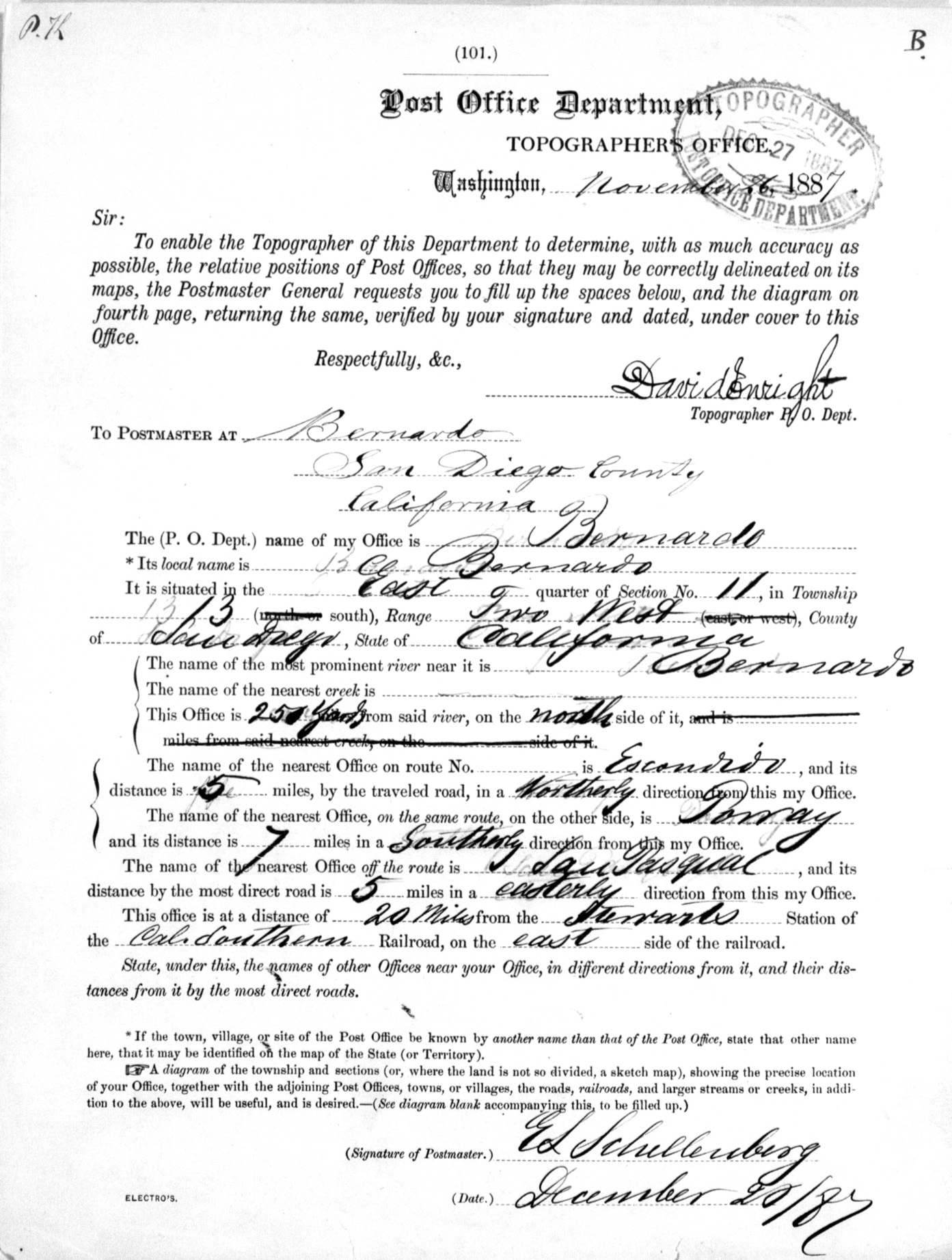
The records on this website are chiefly forms sent out by the topographer to postmasters across the country to determine the exact locations of their post offices in relation to neighboring post offices, transportation routes and facilities.

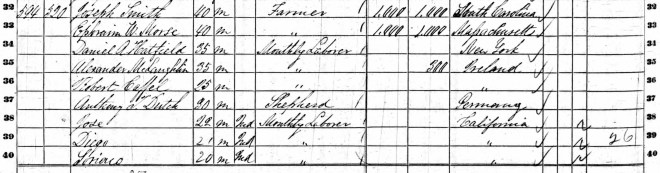
Below is a report filled out in December 1887 and submitted to the topographer by E. L. Schellenberg, postmaster of Bernardo:


Among other things, it tells us that the post office was located 250 yards north of the Bernardo River (actually the San Dieguito River), that the nearest neighboring post offices were Escondido, five miles north, and Poway, 7 miles south, and that the Bernardo office was 20 miles east of the “Stewart Station of the Cal. Southern Railroad.”

History seekers can find similar information about post offices all over the county as well as across the state and in other states and territories. A lot of history available here! Check it out!

Get Updates Automatically-Become A Follower of the San Diego History Seeker

You can get updates of San Diego History Seeker automatically in your email by clicking on the “Follow” button in the lower right corner of the blog page. You’ll then get an email asking you to confirm. Once you confirm you’ll be an active follower.
Snapshot of San Diego 1874

Here’s a figurative snapshot of San Diego, 143 years ago.

It’s from a book, published in 1874, entitled: Descriptive, Historical, Commercial, Agricultural and Important Information Relative to the City of San Diego, California, Illustrated with 22 Photographic Views, Containing also A Business Directory of the City.

Yes, that’s the title. Books in those days boasted titles that could be a chapter in themselves. Almost wore out the italics key on that one.

At any rate, the book was published in 1874 by the San Diego Chamber of Commerce as a way to promote the city and the county. It was printed by the offices of a relatively new paper called The San Diego Daily Union, which had transitioned from a weekly to a daily only a few years before.

The book has all kinds of interesting info about the region at that time. Of course it was a promotional document, but it also employed a lot of factual information, like statistics on weather, the local economy, and a business directory drawn from official sources of the day. And even the boosterism offers an instructive picture of San Diego and its movers and shakers in the day.

The population of the city at that point was “about three thousand….who have sought this locality for its health-giving climate and the near prospect of a large commercial town. The population of the county may be safely set down at nine thousand.”

“Adjacent to the city, and adjoining its lands on the south, is the pleasant little town of National City. It is a portion of the Rancho de la Nacion, which has a frontage of six miles on the bay. The population is not numerous, but it is steadily increasing. Here are an excellent wharf, stores, post-office, public school, fine residences, and a large number of vegetable and fruit gardens and nurseries….All the travel via Fort Yuma from Arizona and New Mexico passes through National City.”

“It is confidently predicted that in a few years hence one great city will extend for miles along the bay, including what is now National City and San Diego.”

The book is in the public domain, accessible on Google Books, https://play.google.com/store/books/details/Descriptive_Historical_Commercial_Agricultural_and?id=AXpNAAAAYAAJ&hl=en . We can thank Judy Russell, a lawyer and genealogical blogger, for revealing its existence on her fine blog, The Legal Genealogist, http://www.legalgenealogist.com/ .

Get Updates Automatically-Become A Follower of the San Diego History Seeker

You can get updates of San Diego History Seeker automatically in your email by clicking on the “Follow” button in the lower right corner of the blog page. You’ll then get an email asking you to confirm. Once you confirm you’ll be an active follower.

Happy Labor Day!

“The labor of the world is the foundation of the world. If you don’t stand for your rights today your rights tomorrow will be fewer still. The human stomach cannot fight a bank vault. The stomach will get empty, but the bank vault holds its own. Keep on pulling and working together and labor will be rewarded. Place men in your legislative halls who have the nerve and the brain to stand up for the rights of labor. Then money will not mould nine-tenths of the legislation of this country as it does now. I want you to feel that my soul is with you if my mouth does not do you much good.”

Excerpt from a talk given by J. L. Dryden to an open meeting of the San Diego Carpenters Union No. 182 on May 2, 1890 at a hall downtown. Reported in the San Diego Union, May 3, 1890.

Dryden was a lawyer active in civic affairs in San Diego County in the late nineteenth and early twentieth centuries. Among other things, he was one of the original trustees for the San Diego Normal School, which would eventually become San Diego State University. Dryden was also a candidate for the state senate and assembly for the county Populist party during the 1890s.

Sources for this post included historic San Diego and Poway newspapers and the book, City of San Diego and San Diego County: The Birthplace of California, by Clarence Alan McGrew, published in 1922.

Get Updates Automatically-Become A Follower of the San Diego History Seeker

You can get weekly updates of San Diego History Seeker automatically in your email by clicking on the “Follow” button in the lower right corner of the blog page. You’ll then get an email asking you to confirm. Once you confirm you’ll be an active follower.