Tent City

For almost forty years, from 1900 to 1939, Coronado was home to a resort called “Tent City.” Readers today may think only of the Hotel Del Coronado when Coronado comes to mind, but Tent City was owned and run as a resort by the same people who owned the Del, the Coronado Beach Company.

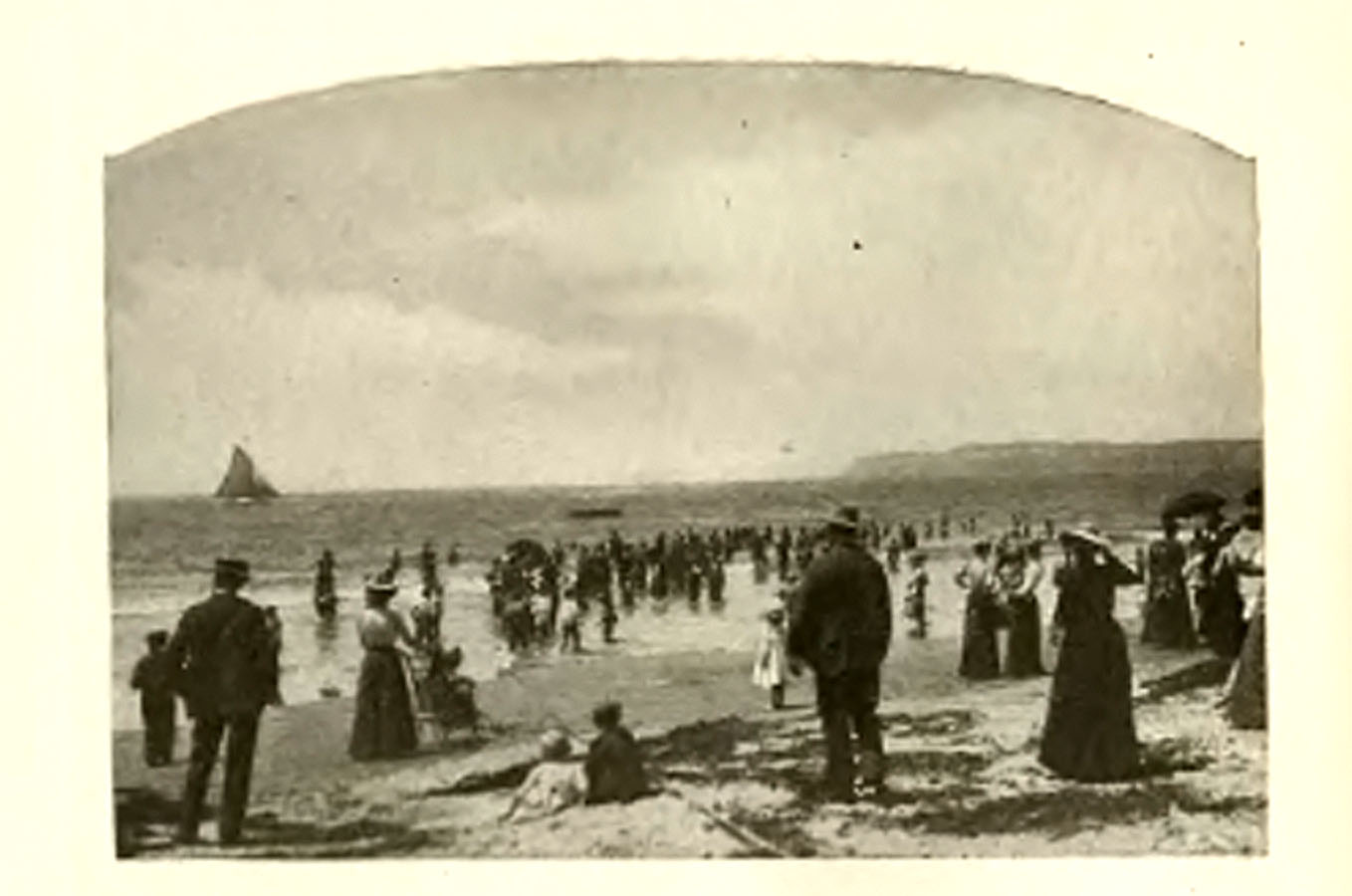
John Spreckels, who’d acquired the Coronado Beach Company in 1889, a year after the Del opened, established Tent City in 1900. Here’s a photo from a promotional booklet published by the beach company in 1903:


In his 1908 book on the history of San Diego, historian William Smythe paid tribute to Tent City as “one of [Coronado’s] most attractive features. On the narrow peninsula east of the hotel, several hundred tents and palmleaf-covered cottages are erected early each summer, where a large number of people go to spend a few weeks beside the ocean…It is one of the coast’s most popular resorts, especially with those who seek to escape the summer heat of the warm interiors.”

Here’s another photo from 1903 of some of those bathers cooling off.


Tent City drew 10,000 residents during its June-through-September season in 1914. It would continue as a destination until 1939, when it closed to make way for highway construction.

Here’s a link to the 1903 booklet, which is in the UCSD archives:

https://library.ucsd.edu/dc/object/bb7784398w/_1.pdf

In addition to the abovementioned book and website, sources for this post also included historic San Diego County newspapers and the website of the Coronado Historical Association.

Get Updates Automatically-Become A Follower of the San Diego History Seeker

You can get weekly updates of San Diego History Seeker automatically in your email by clicking on the “Follow” button in the lower right corner of the blog page. You’ll then get an email asking you to confirm. Once you confirm you’ll be an active follower.
March, 1894

I offer one of my periodic snapshots of life in San Diego County in past times, courtesy of the weekly Poway Progress newspaper’s edition of Saturday, March 3, 1894.

The paper’s Encinitas correspondent noted that on the previous Tuesday, “J. W. Bond took his fine cow to San Diego to sell.”   And the day before that, “W. L. Hannah hauled a load of hogs to the city” as well.

Over in the Poway valley, “Dry weather still holds on,” the paper stated, “and everybody is becoming anxious as to the outcome of the season. Instead of six to ten inches of growth by this time as a rule, the grain is but barely visible on most of the ground.”

So as not to keep you in suspense, I can report that in the issue of the following week, the paper’s Poway-datelined entry reported: “We have had a fine rain.”

On more up to date matters, I will be giving my talk, “Homefront San Diego in World War Two” this coming Saturday at 11 a. m. at the Rancho Bernardo History Museum. My talk slides include period photos and newspaper articles as well as newsreel footage. I’ll be offering my book, Valleys of Dreams, for sale too.

Come join us at the museum in the Bernardo Winery at 13330 Paseo Del Verano Norte.

Get Updates Automatically-Become A Follower of the San Diego History Seeker

You can get weekly updates of San Diego History Seeker automatically in your email by clicking on the “Follow” button in the lower right corner of the blog page. You’ll then get an email asking you to confirm. Once you confirm you’ll be an active follower.
 

Remembering Camp Vista

A section of Vista off Sycamore Avenue that’s known today as Green Oak Ranch was, from 1935 to 1941, the location of Camp Vista. The camp was part of a nationwide network of facilities operated by the Civilian Conservation Corps. The corps, known more familiarly as the CCC, was one of the first programs instituted by the administration of President Franklin Roosevelt to relieve massive unemployment in the depths of the Great Depression.

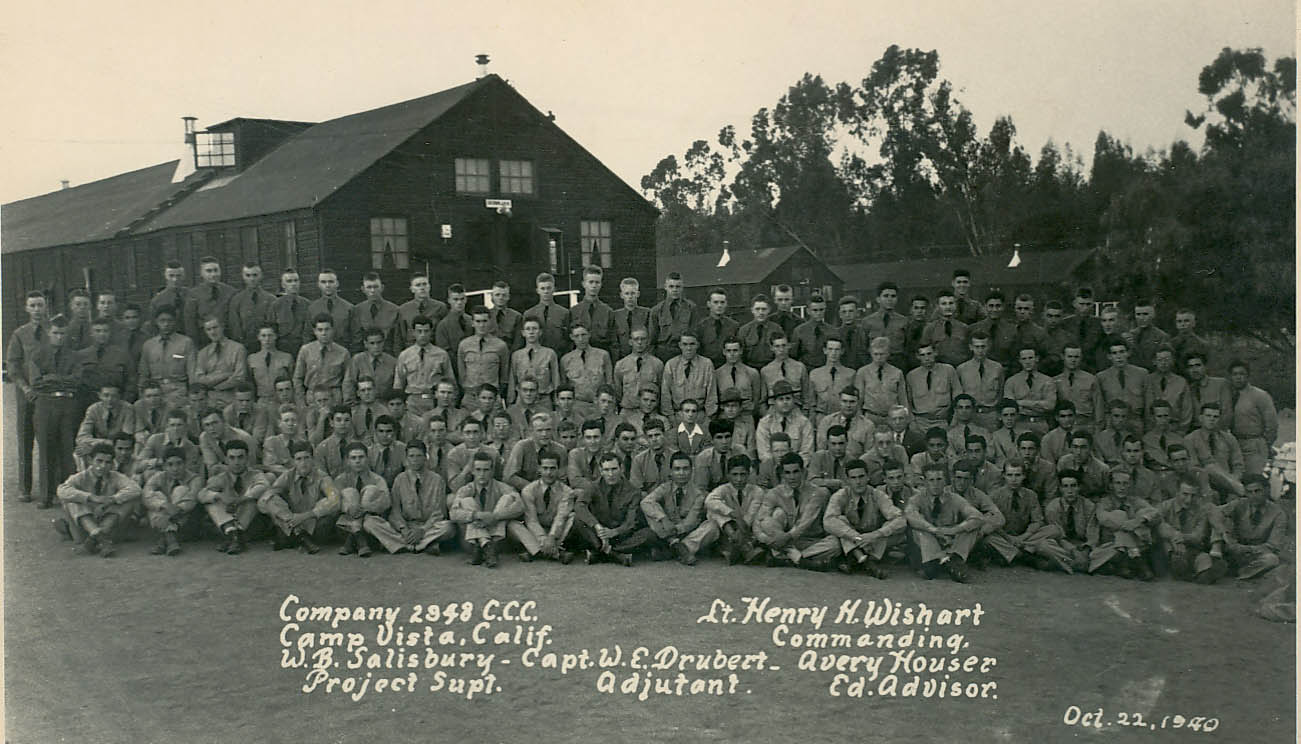
At its height the camp was home to 200 enrollees, unemployed young men between the ages of 17 and 28 who were put to work on projects involving soil conservation, tree planting, preservation of wildlife habitat and road building.

Here’s a photo of Camp Vista’s enrollees taken around 1940, courtesy of the Vista Historical Society:

It wasn’t just “busy-work” that those young men performed. One report published in the pages of the Vista Press newspaper in March 1936, just five months after the camp had opened, noted that enrollees had constructed  “47 permanent dams, over 4,500 feet of diversion ditches, one mile of terraces, and 70 permanent terrace outlet structures” on local ranches. During that same period, the camp workers planted “over 2,600 soil-holding, drought-resistant trees…to protect gully banks and eroding hillsides.”

That’s some history worth remembering.

Sources for this post included the archives of the Vista Historical Society and the book, The Tree Army: A Pictorial History of the Civilian Conservation Corps, 1933-1942.

Get Updates Automatically-Become A Follower of the San Diego History Seeker

You can get weekly updates of San Diego History Seeker automatically in your email by clicking on the “Follow” button in the lower right corner of the blog page. You’ll then get an email asking you to confirm. Once you confirm you’ll be an active follower.
Talking History


Earlier this week I had the pleasure of giving one of my talks, “Homefront San Diego in World War II,” for San Diego OASIS. I spoke at the Linda Vista Library. That was an apt location for the talk, as the Linda Vista neighborhood was created as a result of San Diego’s incredible growth during the war years.

The neighborhood began with a massive housing project that got under way in late 1940, with the motto, “3,000 houses in 300 days.” This was part of the effort to accommodate the influx of defense workers and military personnel that saw the city of San Diego’s population grow almost 200 percent between 1940 and 1943.

Here’s one of the slides from my talk, showing part of a trailer camp set up to accommodate people who were moving into San Diego at the rate of 1,500 a week. The photo is courtesy of the Library of Congress:


I’ll be giving this talk and more for OASIS later in the year, and I’m available to give talks for other groups as well, on a variety of historical topics. To find out more, click on the “About” tab on this website.

Immigration: Does Any of This Sound Familiar?

What follows is the text of a post I originally published in June of 2015. I put it up then to provide some historical perspective on the subject of immigration. The need for historical perspective has gotten, if anything, more essential today. Spoiler alert: This is brought to you by a descendant of people who were among those referred to in the cited news article below as “low-grade aliens.”


“This country has taken a step in the right direction to preserve the strain of the pioneer stock that founded this nation and has brought it to its present standard of Americanism.”

That sentence is from an editorial that appeared in the San Diego Union on May 24, 1921. The editorial, entitled “Saving the Race,” praised the passage a few days previously of a bill restricting immigration to “three percent of the existing alien population.” This was the beginning of a quota system of immigration restriction that would be U. S. government policy for the next four decades, but at that point in time it was considered “experimental,” in the words of the editorial. And it was an experiment that the editorial writer obviously approved of.

Citing the research of one Prescott F. Hall, who was described as “a high authority on the subject of the sterilizing effect of incoming low-grade aliens,” the Union bemoaned alleged higher birthrates of “foreign” over “native-born” mothers. But it also claimed that “native-born people who migrate to regions in which the pioneer stock is still dominant show little or no lessening of their former fruitfulness. The real American strain is still paramount west of the Mississippi. It is, therefore, the policy of the West to keep its stock as free as possible from alloy of the American ‘melting pot’ now seething in the great cities along the Atlantic seaboard.”