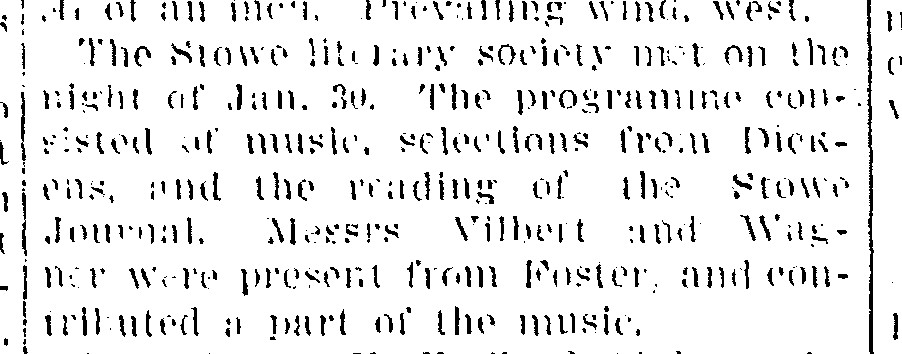
Below is an item from the San Diego Union of February 11, 1904:
The Stowe Literary Society met every other Saturday for a number of years at the schoolhouse in the town of Stowe. The presentation of music, discussion of the works of noted authors, and readings from a journal written by local residents on life in the town were part of the regular meeting agenda. Reading about it now makes me think of it as an early form of social media, in real time as opposed to online, and showing an interest in facts and learning.
Note also that among the musicians contributing music were two people “present from Foster.” Foster, like Stowe, was another San Diego County town which once thrived but then disappeared.
To find out more about such places, join me for my Oasis talk, “Lost Towns of San Diego County,” on Friday, January 17th, at 1 p.m. at the Oasis Grossmont Lifelong Learning Center. Click on the link below to sign up:
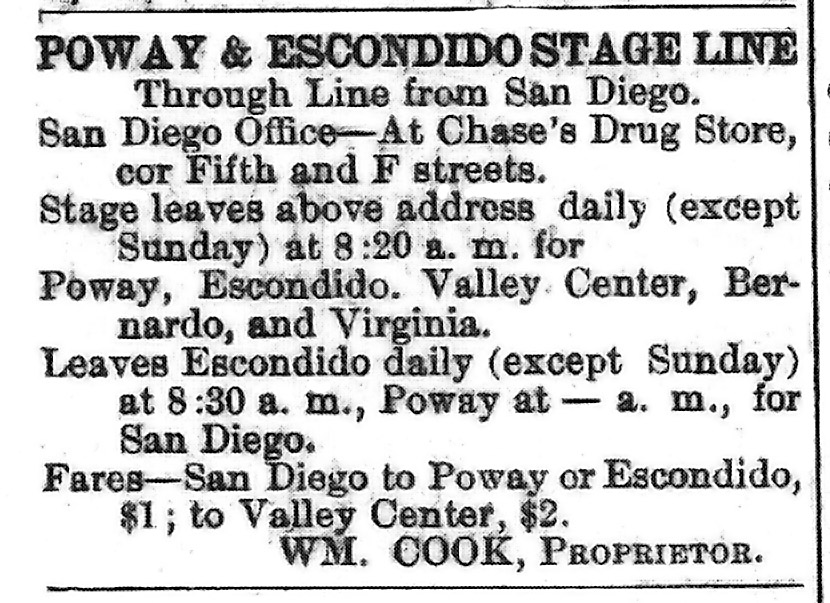
Above is an ad from the Poway Progress newspaper of February 10, 1894, typical of ads for stagecoach schedules that appeared in San Diego city and county newspapers in the stagecoach era.
But for a few decades at least, the term “stage” apparently survived the transition from the original horsepower to gasoline-fueled horsepower. Here’s an ad below from The San Diego Union of April 28, 1924:
The “stages” depicted in the two ads are automobiles, though they’re still operating out of a “stage depot.”
Eventually the terminology would evolve from “autostage” to “motorcoach” to “bus.” Company names in the field would evolve as well, such as the Pickwick Corporation, which merged in 1929 with a Minnesota-based company, Northland Transportation Company, which then renamed itself the Greyhound Corporation.
In addition to historic San Diego newspapers, sources for this post were mnopedia.org and coachbuilt.com, two websites examining Minnesota and bus-building history, respectively.
Ever wonder who Felicita was, as in Felicita Park? Or who put the Warner in Warner Springs? Join me this Wednesday at 1 p.m. at Oasis Rancho Bernardo Lifelong Learning Center as I present my class: “Who Were Those People?,” putting together the human stories behind some of our county’s familiar place-names. Go to the link below to sign up for the class.
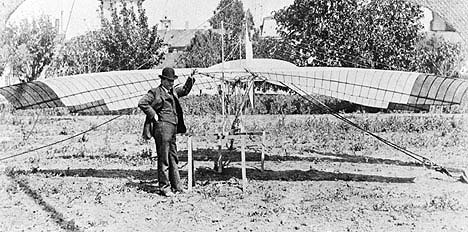
Aviation’s role in San Diego history can be summed up in the lives—and names– of two men. One was John Montgomery. In the late 19th and early 20th century, Montgomery was a physics professor at Santa Clara University in northern California, but he was also a researcher, experimentor and inventor in the then-new field of aviation, which at that point in time was still confined largely to hot-air balloons. The photo below, courtesy of Wikimedia Commons, shows Montgomery in 1905 standing beside one of the gliders he built to engage in experimental, and brief, flights :
Some years earlier, in 1883, Montgomery took a similar device to a ridge at Otay Mesa, where his family owned some ranch property. There he leaped off the ridge and glided roughly 600 feet before landing, completing what’s considered one of the earliest controlled-wing flights in history.
San Diego’s sunny climate would be a boon to the development of aviation, both civil and military. World War I and its aftermath would see the establishment of Army and Navy air stations as well as aircraft manufacturing companies like Ryan and, in the mid-1930s, Consolidated.
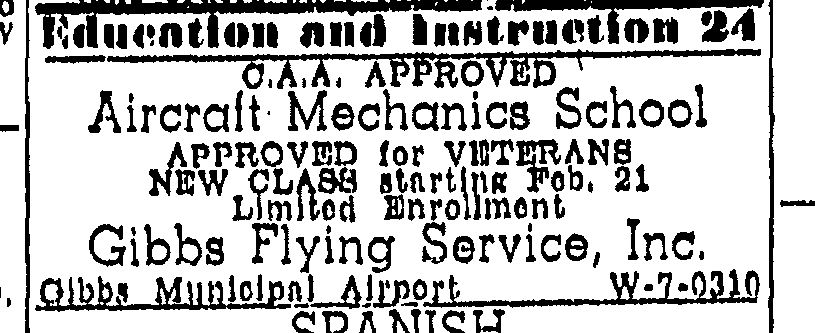
Lindbergh Field would be opened in 1928 as the city of San Diego’s first municipal airport, but the ensuing decades would see smaller, privately-owned airfields pop up, often by private pilots offering air excursions as well as flight and mechanic schools and other flight-related services. One example of that was Bill Gibbs, a young pilot who took tourists on aerial tours and used the proceeds to buy his own plane. He did well enough offering excursion flights, as well as flying lessons, to take out a bank loan in 1937 that he used to buy land on Kearney Mesa where he built an airfield. Gibbs Field became the base for Gibbs Flying Service.
Below is a typical ad seen in San Diego newspapers from the 1930s through the late 1940s:
The City of San Diego purchased Gibbs Field from Bill Gibbs in 1947. In May of 1950 the city officially changed the name of Gibbs Field to Montgomery Field to honor John Montgomery’s pioneering flight on San Diego territory.
In a sense the city came full circle in 2016, when the airport’s name was changed again to Montgomery-Gibbs Executive Airport, the name it carries to this day.

 San Diego History Seeker