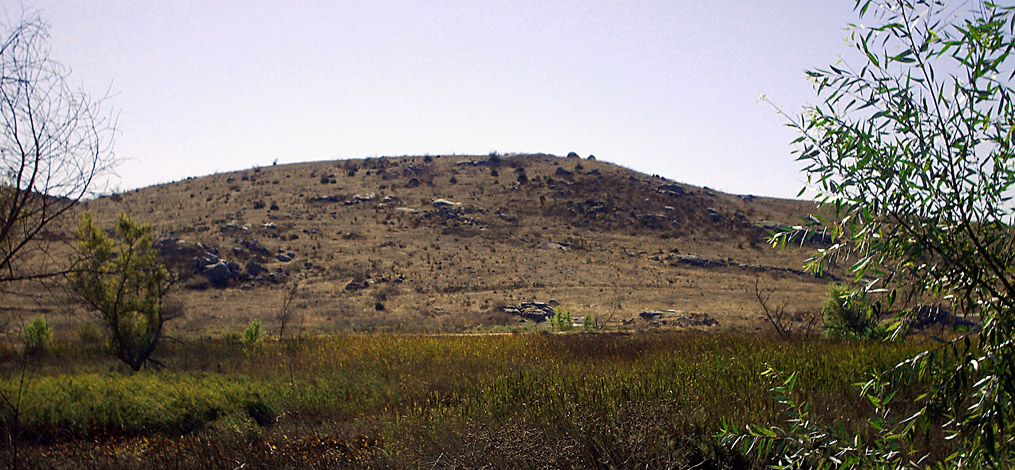
Foster: Quite Literally A Boom Town

Below is a timetable which ran regularly in San Diego County newspapers in the mid to late 1890s:
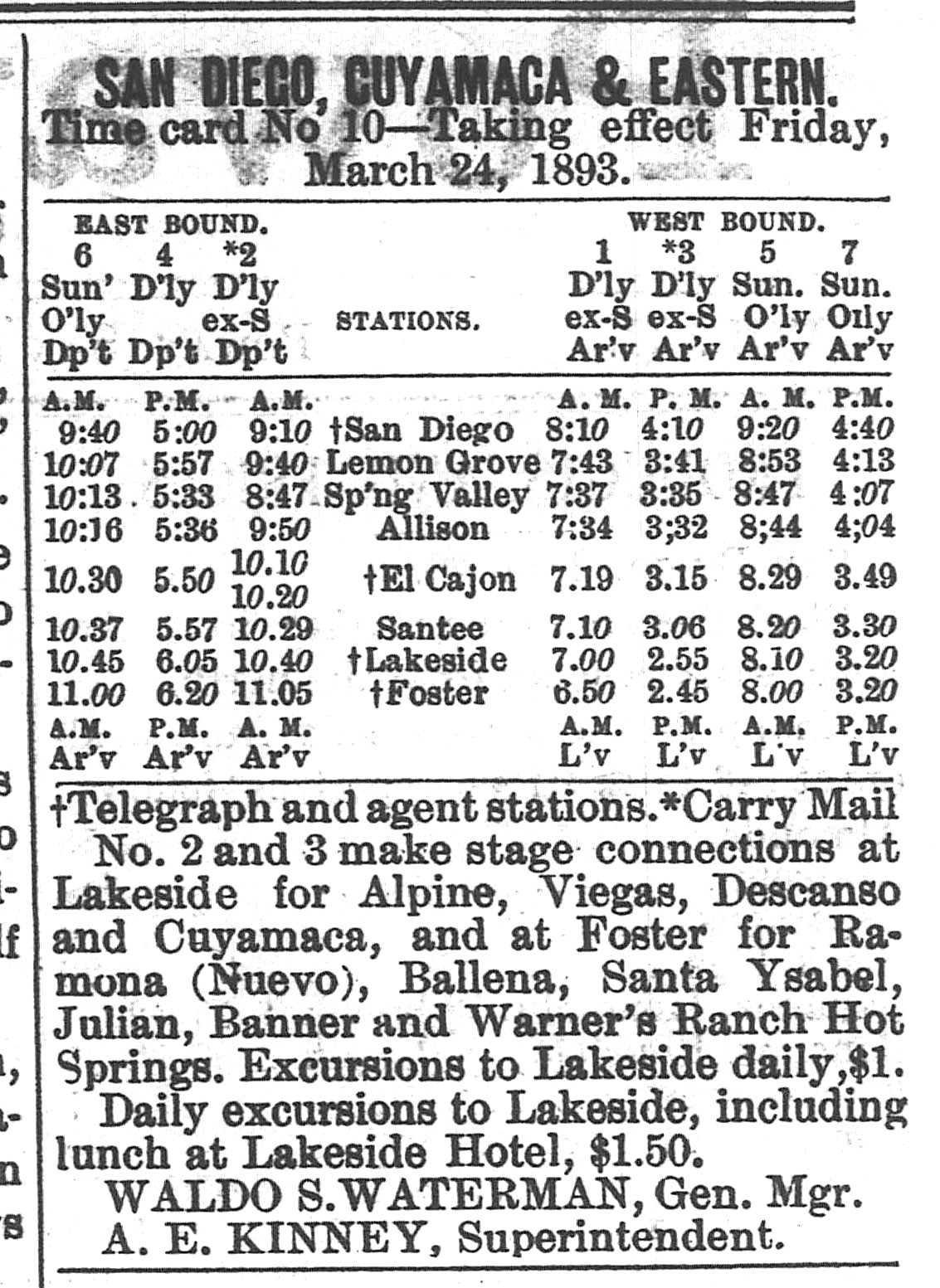
San Diego, Cuyamaca and Eastern schedule

It’s for the San Diego, Cuyamaca and Eastern Railroad, one of a cluster of lines formed during an 1880s land boom in southern California. The road’s name indicates an ambitious goal of forging a rail link from San Diego to points east, specifically to join up with other railroads coming from the eastern United States.

It turns out that eastern San Diego County was as far east as the SD, C & E ever got, but that’s a whole other story. For now, please note the station listed at the end of the line. Foster is another lost town from San Diego County history.

Foster had its own railroad depot from 1889 to 1916, and its own post office from 1893 to 1916.

Here’s the listing for Foster in the 1897 Directory of San Diego City and County (it covered parts of two pages):

1897 directory page for Foster

There were a total of 40 people listed, with occupations ranging from ranchers and apiarists to a locomotive engineer, brakeman, quarryman and stonecutter.

The town was situated on a ranch owned by Joseph Foster, the only resident whose listing is in boldface and all caps. In addition to being a rancher and hotel owner, Foster also was co-proprietor of a stagecoach line. People disembarking from the train at Foster could ride the stage on to Ramona, Ballena (now part of Ramona), Warner Springs and Julian.

Farming, railroading and quarrying made Foster a busy place, and a noisy one too.

“Some heavy blasting is going on at Foster’s quarries these days,” noted an item in the June 30, 1894 Poway Progress. “One explosion in the evening shook things like unto an earthquake, and made windows rattle lively some seven miles away. It was thought at first the magazine had exploded.”

The quarries were a source of rock for construction. And they were almost the little town’s undoing in 1904.

“People at Foster, a quarrying town at the end of the S.D., C. & E railway, twenty-five miles northeast of this city, had a hard battle with brush fires early yesterday morning,” reported the San Diego Union of October 27, 1904.

The entire town’s population turned out en masse to fight the fires which came within two hundred feet of the railroad depot and hotel, wrote the Union.

In addition to fighting the flames, the townsfolk had to deal with dynamite stored in a house belonging to one of the quarries. The Union reported that “the citizens decided to move it and bury it in the bed” of the nearby San Diego River. “They took great risk in this removal, for there was more than a ton of the stuff.”

Their efforts, aided by a change in the wind, saved the town.

The great San Diego County flood of 1916 wiped out the railroad line to Foster, never to be rebuilt. The flood also sounded the death knell for the post office.

The Foster townsite is today at the foot of the San Vicente Dam and is considered part of Lakeside. The area is presumably much quieter now than in what might be called its noisier, and potentially explosive, heyday.

_____________________________

Sources for this post included historic San Diego and Poway newspapers, the website of the Lakeside Historical Society, and the book, Ramona and Roundabout, by Charles R. LeMenager.

Get Updates Automatically-Become A Follower of the San Diego History Seeker

You can get weekly updates of San Diego History Seeker automatically in your email by clicking on the “Follow” button in the lower right corner of the blog page. You’ll then get an email asking you to confirm. Once you confirm you’ll be an active follower.

History Happenings-Upcoming Events in the Local History Community

Explore 10,000 years of history at the San Diego Archaeological Center. The center’s museum offers changing exhibits and hands-on activities revealing San Diego County history through the archaeological record, from the earliest Native American residents through the many immigrants and groups which followed. For more info visit http://www.sandiegoarchaeology.org/ .

The San Marcos Historical Society offers a variety of programs for elementary students. Tours and activities are designed to fit the grade level of the students participating. For more information call 760-744-9025.

Escondido History Center and Escondido Citizens Ecology Committee co-sponsor Tuesday evening walking tours of historic city sites twice a month from April through August. For details visit: http://www.escondidohistory.org/2014_walking_tour_brochure.pdf .
“Remittance Men”

Your San Diego History Seeker first came across the phrase “remittance man” when researching the history of the Ellis Hotel. This building had been a prominent landmark in downtown Fallbrook for almost 70 years until its demolition in 1958. In its heyday from 1911 to the early 1920s it was a popular venue for county, civic and business events and drew visitors from across the nation and the world.

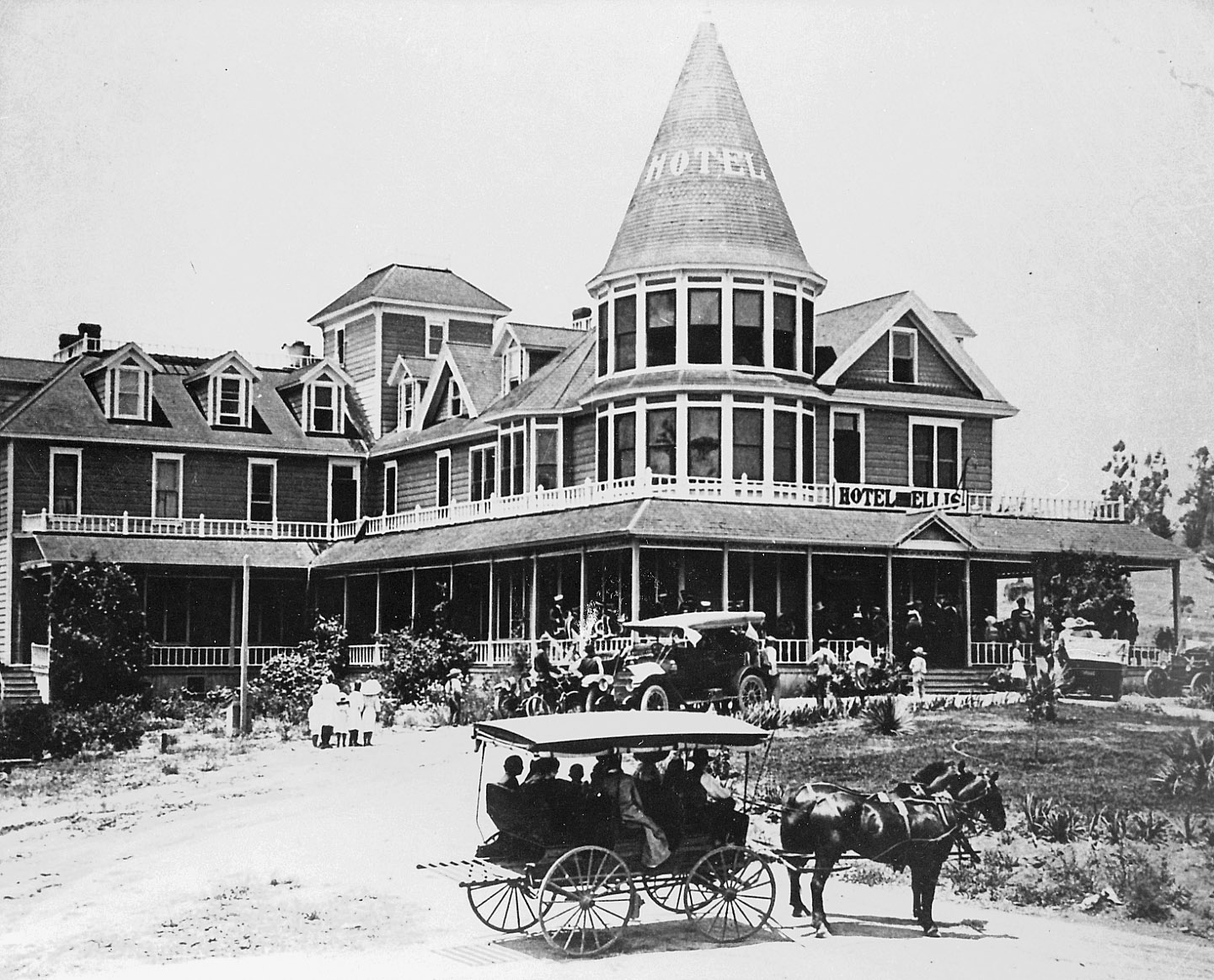
The handsome structure included a veranda winding around the front of the first floor. Here’s an undated photo from the archives of the Fallbrook Historical Society:

Hotel Ellis

According to local papers at the time, among those often staying at the hotel or just stopping by to spend some time on its veranda were so-called “remittance boys.” As one former Fallbrook resident familiar with the situation described it, it was the custom of the English gentry “to give the eldest son property and the youngest a given income [remittance] each year.” Some of these young men migrated to Australia, Canada, or the United States. According to the Fallbrook Enterprise, some who were “ranching” in the Fallbrook area used to “ride into town on their horses” and sit on the veranda to “pass the time of day.”

It seems that there were a lot of “remittance” boys and men in San Diego County in the late nineteenth and early twentieth centuries, if references in local papers are any indication. The references weren’t always positive. A May 1912 San Diego Union article on one C.V. Humphries, arrested for passing bad checks downtown, stated “The police believe Humphries is a ‘remittance man’ who is under restraint in the drawing of funds.”

“Humphries is said to have admitted that he was the ‘black sheep’ of a wealthy family of high social standing,” reported the Union, adding “Officers expect that relatives will make the check deficiencies good, in which event the losers say they will not prosecute.”

That same year, the remittance boys of Fallbrook made a much nicer impression, recalled some years later in the Fallbrook Enterprise. A Mr. Stinton, on a driving trip from San Diego to Santa Monica with his wife and young son, hit a heavy rainstorm which caused the car’s fabric roof to leak. They pulled into Fallbrook to ride out the storm, checking into the Ellis, and wound up staying two days.

Cars were still rare enough that the Mr. Stinton’s Locomobile attracted a lot of attention. The newspaper reported that “the remittance-men and their friends relaxing on the veranda of the hotel all asked for rides and Stintin obliged.”

On the day of his departure, Stinton was presented with “$12 in payment for the Locomobile rides.” He must have appreciated the hospitality, because Stinton ultimately moved to Fallbrook.

____________

Sources for this post included the archives of the Fallbrook Historical Society and historic San Diego newspapers.

History Happenings-Upcoming Events in the Local History Community

Escondido History Center and Escondido Citizens Ecology Committee co-sponsor Tuesday evening walking tours of historic city sites twice a month from April through August. For details visit: http://www.escondidohistory.org/2014_walking_tour_brochure.pdf .


Snook, Forster and Warner: The Three Anglo Rancheros

When I give a talk on the history of Rancho Bernardo, I always get chuckles when I describe the case of Don Jose Snook.

Snook was an Englishman by birth, born in Weymouth, Dorsetshire on the southern coast of England in 1798 into a family of agricultural laborers. Seeking a better life, he went to sea, and by 1830 he was a captain, commanding ships for merchants trading goods between ports in California, Mexico and Peru. California was then Alta California, a province of Mexico.

After winning its independence from Spain in 1821, Mexico was anxious to colonize its northernmost territories, fearing, as the Spaniards had, the encroachment of foreign powers including the United States.

So the Mexican government offered massive tracts of land to anyone agreeing to settle on and work the lands.

During his times ashore in California, Captain Snook fell in love with the place and wished to acquire some land. In order to do so under the then Mexican government, Snook had to become a Catholic and a Mexican citizen. So in April 1833 he petitioned for a letter of naturalization. It was granted two years later, and in November 1835 he was baptized.

The baptism took place at Mission Santa Clara in northern California. The baptismal record, in the mission archives in Santa Barbara, gives his birth name and also the baptismal name he chose, Jose Francisco de Sales. There is a reference to his being of English descent, and of Protestant religion. From thenceforward, he would become Jose Francisco de Sales Snook. Sounding out that name for an audience, with a slight pause before “Snook,” always elicits the chuckles.

Snook’s baptism occurred in northern California because he apparently liked it better up there. Jose acquired a grant for a rancho north of San Francisco in 1836, hoping to settle down there with Maria Antonia Alvarado, the daughter of a prominent San Diego family, whom he wished to marry.

Don Jose and Maria did indeed marry in 1837. However, Maria didn’t want to live in an area that was then the northern frontier of Alta California, and her young husband soon sold the rancho there.

Sometime in 1841 Don Jose petitioned Mexican authorities to grant him the then-vacant Rancho San Bernardo. Territorial governor Juan Bautista Alvarado, who happened to be a cousin of Maria’s father, approved the grant in February 1842.

Don Jose Snook was far from the only person from an Anglo background to go through such a metamorphosis in Mexican California. Some of the numerous examples include John Forster, another Englishman who became Don Juan Forster and owned several ranches in the San Diego area. And how about Jonathan Trumbull Warner, a Connecticut Yankee who became Juan Jose Warner, proprietor of the ranch and springs that still bear his name?

Early examples of multiculturalism? Or the melting pot? Or a merger of both? Hey, that’s history for you.

__________

Sources for this post included the essay, “Joseph Snook: English Mariner, California Don,” by Ruth Collings, from the Fall 1997 issue of The Journal of San Diego History, the Santa Barbara Mission Archive-Library, and two books, Some Old Ranchos and Adobes by Philip S. Rush and History of San Diego County Ranchos by Robert W. Brackett.

History Happenings-Upcoming Events in the Local History Community

Escondido History Center and Escondido Citizens Ecology Committee co-sponsor Tuesday evening walking tours of historic city sites twice a month from April through August. For details visit: http://www.escondidohistory.org/2014_walking_tour_brochure.pdf .


A Look At An Earlier Tax Deadline

Since April is the month for filing income taxes, the History Seeker looks back to an earlier and historically significant filing deadline.

The first federal income tax had been passed by Congress during the Civil War, then repealed in 1872. Congress passed another one in 1894 only to have it struck down as unconstitutional by the U. S. Supreme Court.

The sixteenth amendment to the U.S. Constitution, passed by Congress in 1909 and ratified by the requisite number of state legislatures by early 1913, established the federal power to tax incomes. An income tax was included in tariff legislation passed by Congress in October 1913 and signed by President Woodrow Wilson the same month, with a tax filing deadline set for March 1, 1914.

In the months between the law’s passage and the filing deadline, the San Diego Union ran a daily “Income Tax” column publishing readers’ questions and providing answers on how to comply with the new law. Several columns provide a picture of how San Diegans dealt with tax preparation at that point.

The column of February 22 reported on “a puzzled real estate dealer…who applied to the financial department of the Union yesterday” to determine how much of his gross income was taxable.

In going over the details, the Union discovered that “the gentleman, although of sufficiently keen insight into business and handling real estate to secure an income during 1913 which made him subject to the income tax, kept no books, but carried the bookkeeping end of his business ‘in his hat.’”

The amazed columnist asked readers, “How long think you would a bank, which sells money, a store selling groceries, a doctor selling his professional services, or an attorney doing likewise, conduct their several businesses at a profit if they kept no books?”

The rest of that column elaborates on the need to keep careful records. It also reminded taxpayers that their forms “should be posted prior to March 1 in order to insure receipt of same at the collector’s office by 4 o’clock on the afternoon of March 1.”

The column for March 1 began: “March 1 falling on a Sunday, belated returns may be made Monday. Persons whose returns have not been made will be within the law if same are filed by 4 o’clock Monday afternoon.”

The Union went on to note that the deputy internal revenue collector at the San Diego office had remained at his desk on Saturday, February 28 “until after 4 o’clock,” even though “the closing hour on Saturday is noon.”

The deputy had received more returns on that last Saturday “than on any one day since filing returns began,” stated the Union. Those returns were from San Diego residents.

“Fully 75 per cent of the returns filed at first were by eastern people spending the winter in San Diego,” the column reported. Those returns had all been taken care of, and the collection office was being “cleaned up by delayed filings of returns from San Diegans.”

From the number of returns posted to that point, it appeared “practically a certain thing” that many San Diegans would be paying penalties for late filing.

File all that under The More Things Change, Etc.

History Happenings-Upcoming Events in the Local History Community

Rancho Bernardo Historical Society’s Speakers Series will present a free program featuring Jack Larimer, Director of the Vista Historical Society and Museum, on Wednesday, April 16, at 10 a.m. For details visit http://www.rbhistoricalsociety.org/ .


Escondido History Center and Escondido Citizens Ecology Committee co-sponsor Tuesday evening walking tours of historic city sites twice a month from April through August. For details visit: http://www.escondidohistory.org/2014_walking_tour_brochure.pdf .


“Armed With Opera-Glass and Note-Book”

The notes contained in this book were taken from March to May, 1889, and from March to July, 1894, at Twin Oaks in southern California.

From preface to A-Birding On A Bronco, by Florence A. Merriam

A-Birding On A Bronco is a remarkable book by a remarkable person. Florence Augusta Merriam Bailey (as she would be known professionally after her 1899 marriage to Vernon Bailey) was a pioneer in the fields of ornithology and nature writing. Her first book, Birds Through An Opera Glass, published in 1889, is considered the first modern field guide for birdwatchers.

At a time when most bird study was still based on studying specimens killed and brought into a laboratory, Bailey preferred to study them in the wild, on foot or horseback.

“I had no gun, but was armed with opera-glass and note-book,” she says on page one of A-Birding On A Bronco, her third book, published in 1896.

The Twin Oaks Valley, today part of San Marcos, then held the homestead of Florence’s uncle, Major Gustavus Merriam. Originally from upstate New York, Gustavus was the first European-American to settle in the area, in 1875. He’d named his ranch Twin Oaks after two joined 70-foot oak trees on the grounds. By the time that Florence and her father Clinton Merriam, who still lived in New York, came to visit in 1889, the name Twin Oaks had come to be applied to the whole valley.

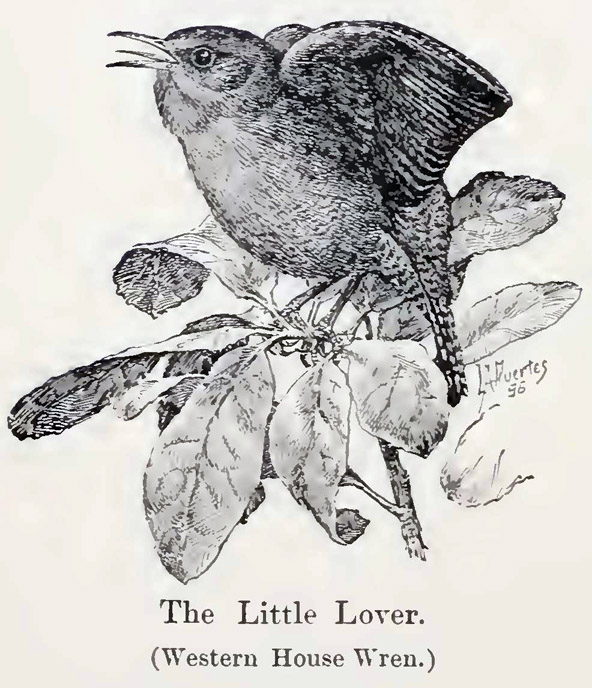
Here’s one of the book’s illustrations, which were done by Louis Agassiz Fuertes, one of the best ornithological illustrators of the day:

The Little Lover

Here’s a photo of Augusta Merriam Bailey from a 1904 issue of The Condor, an ornithological journal:

FlorenceMerriam1904[1]

Bailey offers detailed observations of valley birds hunting, nesting, singing. She writes with the sensibility of a scientist, but with a humanistic and poetic sensibility as well.

“From the ranch-house,” she begins in one early passage, “encircled by live-oaks, the valley widened out, and was covered with orchards and vineyards….It was a veritable paradise for the indolent field student. With so much insect-producing verdure, birds were everywhere at all times.”

Bailey waxes almost lyrical: “Flocks of migrating warblers were always to be found here: flycatchers shot out at passing insects; chewinks scratched among the dead leaves and flew up to sing on the branches; insistent vireos cried tu—whip’ tu-whip’ tu-whip’ tu-wee’-ah, coming out in sight for a moment only to go hunting back into the impenetrable chaparral…”

And there are impressionistic, almost sensuous descriptions of the valley at sunrise and sunset. Here’s one example:

In the East we are accustomed to speak of ‘the peace of evening,’ but in southern California in spring there is a peculiar interval of warmth and rest, a langorous pause in the growth of the morning, between the disappearance of the night fog and the coming of the cool trade wind, when the southern sun shines full into the little valleys, and the peace of the morning is so deep and serene that the labor of the day seems done. Nature appears to be slumbering. She is aroused slowly and gently by the soft breaths that come in from the Pacific.

And that’s just the first half of the paragraph. A sunset description is just as good. See for yourself. The book is in the public domain at www.archive.org .


Upcoming History Events

Every second Tuesday of the month the San Diego History Center invites local community and cultural groups to celebrate their history with exhibits in the center’s atrium. This Tuesday, April 8 from 10 a.m. to 5 p.m., north county communities will be represented. For further info visit http://www.sandiegohistory.org/calendar/detail/57836 .


The Rancho Bernardo Historical Society’s Speakers Series will present a free program featuring Jack Larimer, Director of the Vista Historical Society and Museum, on Wednesday, April 16, at 10 a.m. For details visit http://www.rbhistoricalsociety.org/ .