The Townsend Club

For a number of months in the year 1935, in the midst of the Great Depression, “Townsend Club Activities” was a regular column in Vista’s weekly newspaper, The Vista Press.

“The Townsend chicken dinner at the Community church on Monday evening was an outstanding success, both financially and in the number attending,” began the column for October 10, 1935. “The committee in charge had to order the doors closed at 7:30, as people continued to stream in.”

The columns describe dinners and musical events among club members, but the social movement was also dedicated to a public policy goal. The official name for the movement was Townsend Old Age Pension Clubs.

It began in 1933 with a Long Beach physician, Francis Townsend, then in his early sixties, who was moved by his observations of elderly people living in poverty after a lifetime of work. He proposed a plan for a guaranteed federal pension of $200.00 per month to every person over the age of 60. He proposed the system not only to keep older people out of poverty but as a means of creating more job opportunities for unemployed younger workers.

That idea clearly resonated with many of the Vista Press’s readers, its publisher, and leaders of the local and regional agricultural community. An example can be found on the paper’s front page on January 3, 1935. At the top of the page, along with two articles on an upcoming election of directors for the Vista Irrigation District, was another article headlined “The Future of American Democracy.”

The article reprinted the text of an address given not long before at Whittier College by C.C. Teague, then president of the California Fruit Growers Exchange.

Teague wrote that in his opinion, “a democracy…cannot stand the strain of long-continued unemployment of a large percentage of the people and must find some way where this condition can be avoided if it is to live.” He then called for a “compulsory” retirement system to pension off older workers and create employment for younger ones.

The “Townsend Club Activities” column described activities jointly sponsored by clubs in Vista, San Marcos, and Oceanside. They, along with clubs from San Diego city and elsewhere, sent delegates to a Los Angeles rally of 10,000 in late September 1935 and a national convention in Chicago in late October which included a nationally broadcast radio address by Dr. Townsend.

The Social Security Act was passed by Congress and signed by President Franklin Roosevelt in August, 1935, in obvious response to the growth of the Townsend Clubs and similar campaigns.

Sources for this post included the websites of the Vista Historical Society and the Social Welfare History Project.

Get Updates Automatically-Become A Follower of the San Diego History Seeker

You can get weekly updates of San Diego History Seeker automatically in your email by clicking on the “Follow” button in the lower right corner of the blog page. You’ll then get an email asking you to confirm. Once you confirm you’ll be an active follower.

History Happenings-Upcoming Events in the Local History Community

The San Marcos Historical Society offers tours of the historic Cox and Bidwell houses Tuesdays, Thursdays and Saturdays at 2 and 3 p.m. or by appointment. For further info visit http://www.smhistory.org/historic-home-tours .
 

Dancing At The Water’s Edge

Lake Hodges Station

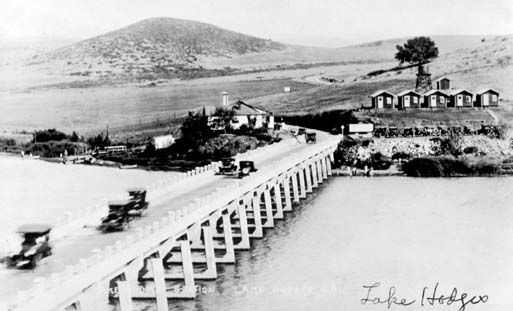
The Lake Hodges Station, circa 1920s. Courtesy Pioneer Room, Escondido Public Library.

“Dancing!

Wednesday, Saturday Nights!

To the twinkle of the gleaming Lake—at the water’s edge.”

So proclaimed the headline of a huge ad on page 1 of the San Diego Union on Thursday, June 5, 1924, inviting people to enjoy the newly remodeled Lake Hodges Station.

Long before there was an I-15, or even a Rancho Bernardo, the unincorporated rural area of Bernardo was connected with Escondido by Inland Mission Road. That road (renamed Highway 395 in 1934) crossed Lake Hodges on a bridge erected in 1919. A small general store erected on the Bernardo side of the bridge in 1919 was expanded in the mid-1920s into a restaurant and dance hall. It also became a fishing resort, with a boat dock, cabins and other facilities.

A five-piece jazz band from San Diego, “Jordan’s Harmony Boys,” provided the music for the dance pavilion’s grand opening on Saturday, June 7, 1924.

An account of the festivities the following Monday in the Escondido Daily Times-Advocate reported that dancing got underway at 9 p.m. “At midnight came a serpentine and confetti battle and the dances then continued until three o’clock,” reported the paper, adding that Manager L. A. Hinshaw was “greatly pleased with the big success of his opening night.”

The “Harmony Boys” were among a number of featured bands over the years at the Station, also called the Lake Hodges Pavilion. The resort would be a popular gathering spot through at least the late 1940s.

The Bernardo Winery was a neighbor to the Pavilion. In an interview shortly before his death in 2008, then-winery owner Ross Rizzo, Sr. recalled fisherman coming down from San Diego with their families and staying at the resort’s cabins. They would catch fish and “pan fry them right out there” on the lakeshore, Rizzo said. “The kids would pitch lines in the lake. The more people came the more kids there were, getting acquainted. It was good old family fun.”

The site of the pavilion was covered over when Highway 395 was realigned in 1952. That spot now lies underneath the entrance ramp for I-15 off Pomerado Road.

Get Updates Automatically-Become A Follower of the San Diego History Seeker

You can get weekly updates of San Diego History Seeker automatically in your email by clicking on the “Follow” button in the lower right corner of the blog page. You’ll then get an email asking you to confirm. Once you confirm you’ll be an active follower.

History Happenings-Upcoming Events in the Local History Community

Vista Historical Society presents their Summer Barbecue at the Vista Historical Museum Saturday, August 16, 4-7 p.m. Good food, live music and free silhouettes by Sweet Silhouette. Tickets $30 per person, $50 per couple, $10 for kids 12 and under. For more info call 760-630-0444.

The San Marcos Historical Society offers tours of the historic Cox and Bidwell houses Tuesdays, Thursdays and Saturdays at 2 and 3 p.m. or by appointment. For further info visit http://www.smhistory.org/historic-home-tours .


Another Election Cycle

Poway Progress 1894 Populist Party


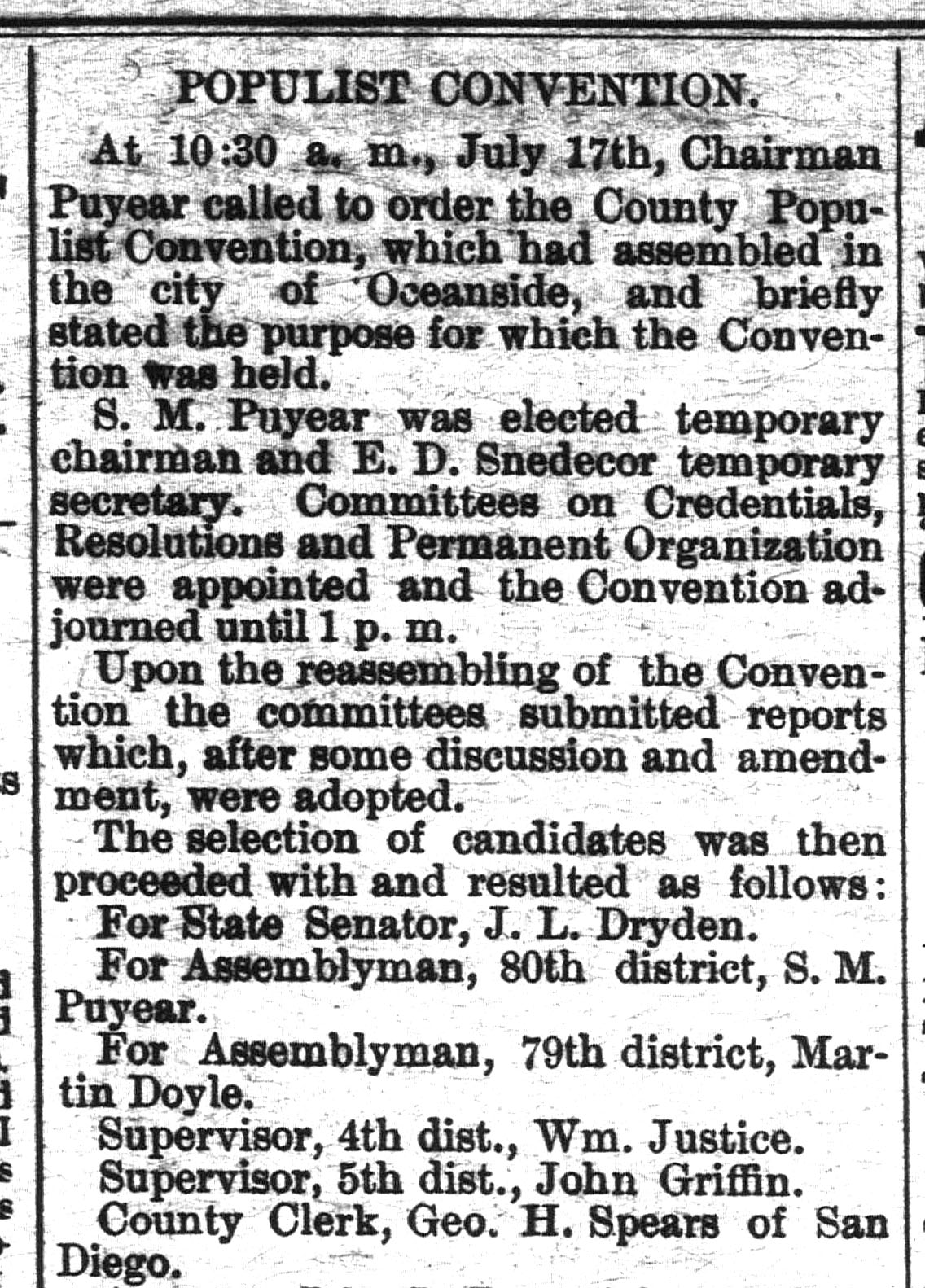
“Populist Convention” was the headline of an article in the Poway Progress of July 21, 1894. It reported on the San Diego County Convention of the Populist Party held a few days previously in Oceanside.

The San Diego Union reported on the convention as well, albeit in a little less detail than the Poway paper. Perusal of the two papers during that period shows the Progress to be a bit more evenhanded in its reportage on the Populists, compared to the staunchly Republican Union.

But the overall coverage shows that the Populists’ organizational gatherings and campaigns were getting roughly the same attention as the Republicans and Democrats. Clearly the Populist, or People’s Party, had a number of followers in San Diego County at that time.

The party nominated candidates for the state senate, two state assembly districts and two supervisorial districts, as well as for countywide offices like sheriff, treasurer, and district attorney. The party’s nominee for county school superintendant was a woman, Stella Murdock. This was at a time when women didn’t yet have the vote in California.

Among the resolutions passed by the convention was one “endorsing and approving the A.R.U. strike…” This was a strike by members of the American Railway Union against the Pullman Car Company in Illinois. Another pledged the “nominees of the party for county offices to work at least eight hours per day if elected, and to make an earnest effort to run their respective offices on the salaries allowed by law.”

The Populist Party was founded in Omaha, Nebraska in 1892. Among the planks of the party’s national platform were demands for a graduated income tax, government ownership of the railroads, telegraph and telephone systems, women’s suffrage and constitutional amendments limiting the President and Vice-President to one term and for the direct election of U. S. Senators.

Between 1892 and 1900, 40 members of the Populist Party were elected to the United States House of Representatives, two from northern California districts. The same period saw six Populists elected to the U. S. Senate and seven to state governorships, in some cases elected on a fusion ticket with Democrats or Republicans.

Sources for this post included historic San Diego and Poway newspapers, the Library of Congress website and the book, Grand Illusion: The Myth of Voter Choice in a Two-Party Tyranny, by Theresa Amato.

______________________________________________

Get Updates Automatically-Become A Follower of the San Diego History Seeker

You can get weekly updates of San Diego History Seeker automatically in your email by clicking on the “Follow” button in the lower right corner of the blog page. You’ll then get an email asking you to confirm. Once you confirm you’ll be an active follower.

History Happenings-Upcoming Events in the Local History Community

The Escondido History Center and the City of Escondido Recreation Department present summer Movies in the Park at Grape Day Park on Saturdays. Next up: Despicable Me 2, August 9. For further info, visit http://www.escondidohistory.org/movies_2014_flyer.pdf .

Vista Historical Society presents their Summer Barbecue at the Vista Historical Museum Saturday, August 16, 4-7 p.m. Good food, live music and free silhouettes by Sweet Silhouette. Tickets $30 per person, $50 per couple, $10 for kids 12 and under. For more info call 760-630-0444.

The San Marcos Historical Society offers tours of the historic Cox and Bidwell houses Tuesdays, Thursdays and Saturdays at 2 and 3 p.m. or by appointment. For further info visit http://www.smhistory.org/historic-home-tours .


Summer, San Diego County, 120 Years Ago

You can learn a lot about local history from reading the columns of old newspapers. Ranging from local gossip to hard news and points in between, these columns offer snapshots of local life in San Diego County.

Come to think of it, can we, in this digitized age, still talk about “snapshots?” Hey, it’s my blog. So here are a few snapshots of life in San Diego County, gleaned from newspaper columns in late July and early August, 1894, 120 years ago.

In the Poway Valley:

“Niles Nelson hopes to harvest about 2 ½ tons of peaches, ½ tons of prunes, and 25 tons of raisin grapes.”

“J. C. Kear took a load of barley hay to San Diego last Saturday and brought back a load of flour and sugar.”

“B. F. Fickas is deepening Rev. H. C. Abernethy’s well, it having failed to do its duty at a depth of 42 feet.”

Meanwhile, over in the El Cajon Valley:

“Geo. A. Telford was in Tuesday from Nuevo [that’s Ramona today] and sold 3 tons of barley hay to Bascom & Co. for $15.50 a ton. Mr. Telford has considerable more baling yet to do.”

“Judge J. T. Cox’s deciduous trees are making a fine showing—apple and pear trees being loaded with choice fruit. Irrigation, through cultivation, and good soil are prime factors in profitable horticulture.”

Some samplings from Encinitas:

“Figs are ripening.”

“Harvesting beans has begun.”

“A steam thresher has been at work on the Metcalf ranch.”

“Sweet corn is in roasting ears.”

“The Derby house has been beautified with a new coat of paint.”

And this from a Poway Progress column titled “Busy Jamul”:

“The name Harmony was given to the new precinct in Jamul by Supervisor Nason. From all available evidence the general harmony that has prevailed in Jamul for the last year has given occasion for this unique and not altogether inappropriate name.”

The column goes on to describe a number of different farms “busily engaged in drying and preserving fruit,” and closes with this other hint of why Jamul might be so “busy”:

“E. S. Babcock is going to run a branch of the water line from Mount Tecate through Jamul. Those who wish to buy land in this garden spot of San Diego county should apply at once, as a consequent raise will be made as soon as the water is brought in.”

Then we swing back to the coast, where, according to the August 2, 1894 San Diego Union:

“Quite a number of families from the interior valleys are camping at Oceanside, enjoying the sea breezes. Most of them pitched their tents along the bluff.

The pleasure wharf is completed to low-water line. The iron to build it to 450 feet to deep water is expected here next week…”

__________________________________________________________

Get Updates Automatically-Become A Follower of the San Diego History Seeker

You can get weekly updates of San Diego History Seeker automatically in your email by clicking on the “Follow” button in the lower right corner of the blog page. You’ll then get an email asking you to confirm. Once you confirm you’ll be an active follower.

History Happenings-Upcoming Events in the Local History Community

Rancho Bernardo Historical Society presents the 4th annual RB Tastings Festival Saturday, August 2, 1-4 pm at the Bernardo Winery. Your ticket gets you live music, local wines, craft beers, food tastings, a fabulous silent auction, a classic car show, and a free logo wine glass! Tickets $25 per person in advance, $30 at gate. Advance tickets available at www.rbtastings.com . Further info at www.rbhistoricalsociety.org .

The Escondido History Center and the City of Escondido Recreation Department present summer Movies in the Park at Grape Day Park on Saturdays. Next up: Despicable Me 2, August 2. For further info, visit http://www.escondidohistory.org/movies_2014_flyer.pdf .

Vista Historical Society presents their Summer Barbecue at the Vista Historical Museum Saturday, August 16, 4-7 p.m. Good food, live music and free silhouettes by Sweet Silhouette. Tickets $30 per person, $50 per couple, $10 for kids 12 and under. For more info call 760-630-0444.

The San Marcos Historical Society offers tours of the historic Cox and Bidwell houses Tuesdays, Thursdays and Saturdays at 2 and 3 p.m. or by appointment. For further info visit http://www.smhistory.org/historic-home-tours .


The “All Saints River”

 Bernardo River

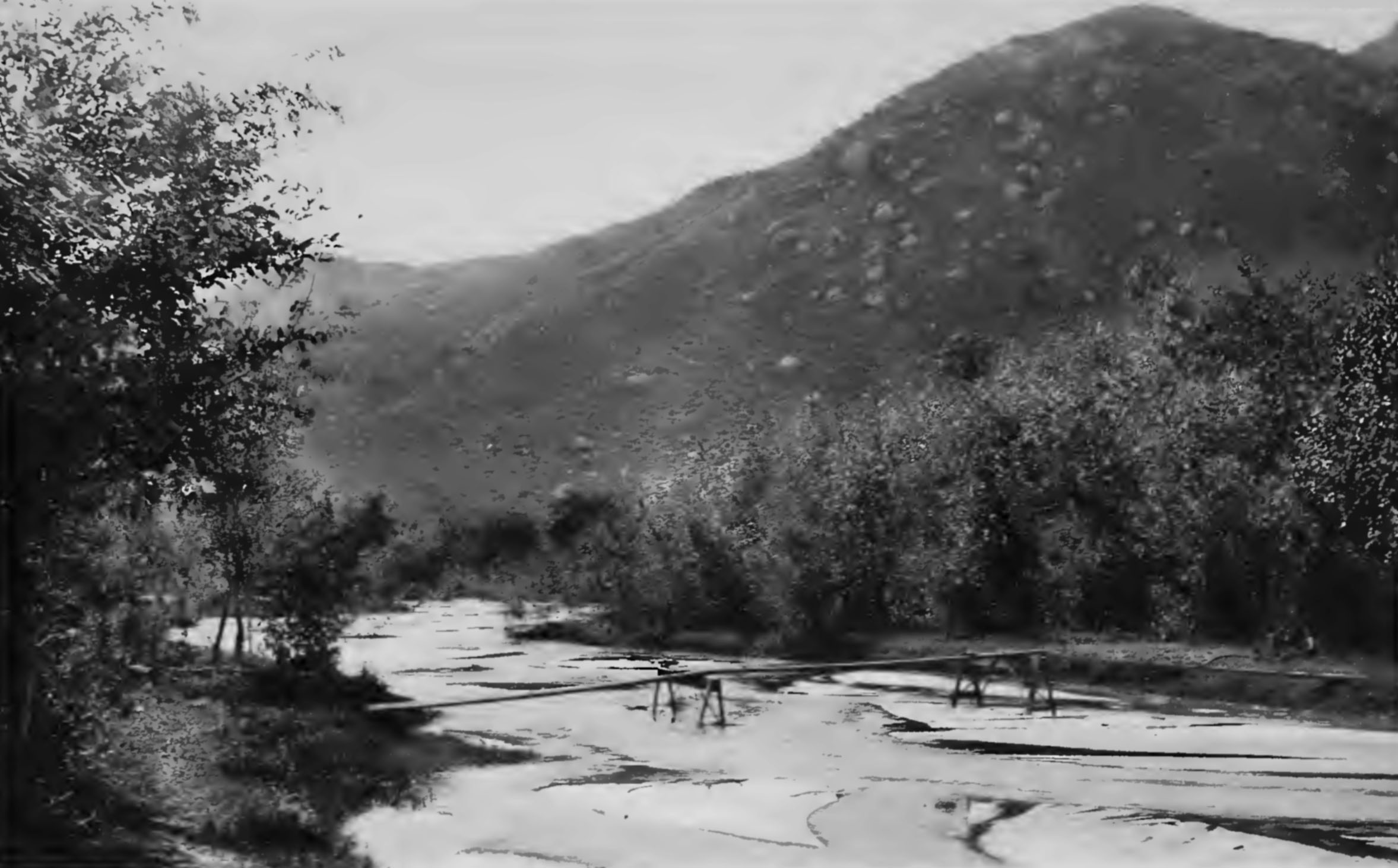
From the book, Picturesque San Diego, published in 1887. Caption reads, “San Pasqual Valley–Bernardo River.”

The above photo is interesting in part because it provides a view typical of a lot of northern San Diego County at the time it was taken. For today’s purposes, however, please focus on the caption, particularly the reference to the “Bernardo River.”

Now note this entry from a legal notices column in the San Diego Union on December 24, 1896: “William Roesling yesterday filed notice in the county recorder’s office appropriating 10,000 inches of water in the San Dieguito River, sometimes known as the Bernardo, to be used for irrigation purposes…”

That item pertained to irrigation needs in the area we know today as Rancho Bernardo, but if you peruse the local press of the period you find the San Dieguito River flowing under a number of “aliases,” depending on the particular area it happened to be passing through.

One man who summed it up nicely was Ed Fletcher, who knew something about rivers, especially exploiting them for irrigation and development purposes. Fletcher’s life and works could fuel many stories for the History Seeker, but for today’s purposes let’s just say that he, along with William Henshaw and the Santa Fe Railroad, had a hand in many if not most of the dams and irrigation systems built in San Diego County in the first two decades of the 20th century.

In his memoirs, published in 1952, Fletcher talks about a point early in his career as a land and water developer when he was surveying an area of the then Pamo Ranch near Ramona.

“The water in the mountains running through the Pamo Ranch was known as the Pamo River,” wrote Fletcher, “ and as the water continued running down hill and entered the San Pasqual Valley, it was known as the San Pasqual River; then as it continued to the sea it was known as the San Bernardo River, running through the San Bernardo Ranch; thence it entered the San Dieguito Spanish grant and again it was marked on the U. S. Topographical maps as the San Dieguito River until it entered the ocean just north of Del Mar—all one river and should have been named the ‘All Saints River.’”

Hmm, “All Saints River.” In addition to land and water, this guy knew something about marketing. Too bad the cartographers didn’t take him up on it.

Get Updates Automatically-Become A Follower of the San Diego History Seeker

You can get weekly updates of San Diego History Seeker automatically in your email by clicking on the “Follow” button in the lower right corner of the blog page. You’ll then get an email asking you to confirm. Once you confirm you’ll be an active follower.

History Happenings-Upcoming Events in the Local History Community

The San Marcos Historical Society offers tours of the historic Cox and Bidwell houses Tuesdays, Thursdays and Saturdays at 2 and 3 p.m. or by appointment. For further info visit http://www.smhistory.org/historic-home-tours .


The Escondido History Center and the City of Escondido Recreation Department present summer Movies in the Park at Grape Day Park on Saturdays. Next up: The Lego Movie, July 26. For further info, visit http://www.escondidohistory.org/movies_2014_flyer.pdf .