A Man Called Rainbow

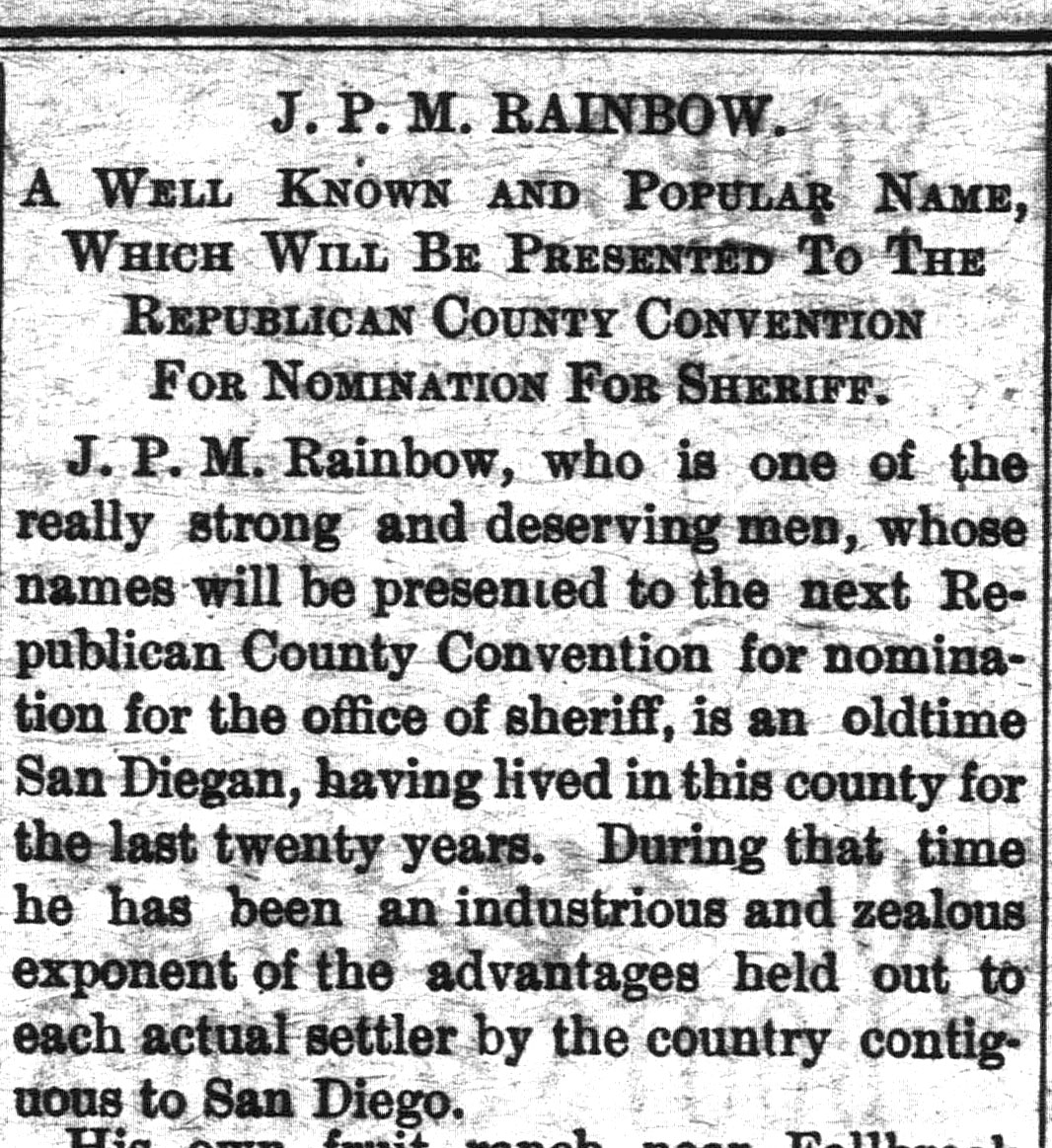
Mr. Rainbow

Poway Progress, July 21, 1894, p. 4.

It was a good week in the county for rain, and also for rainbows. With the sun intermittently coming out between the showers in my neighborhood, I observed four or five in one day. This, naturally, led me to think of the small valley near Fallbrook called Rainbow (yes, readers, this is how my brain works). And I remembered my surprise at discovering that this valley didn’t get its name from anyone ever seeing a rainbow over it or anything like that, but was rather named for a real live person: J. P. M. Rainbow.

James Peebles Marshall Rainbow, usually referred to as J. P. M. Rainbow, came to San Diego County from his native Pennsylvania in 1875. He settled in the Fallbrook area with his wife Augusta and began growing fruit.

He apparently did pretty well as a farmer.

“Mr. Rainbow had the honor of shipping the first carload of fruit that was ever shipped from this county,” stated an article in the Poway Progress newspaper in July, 1894. The shipment “consisted of muscat grapes grown upon his twenty-acre ranch near Fallbrook.”

While working at his own ranch, the article noted that Rainbow “has found time to assist in locating a colony of twenty other families in its neighborhood, and today their holdings are largely planted in deciduous fruits.”

Rainbow also found time to serve in county government. He was elected to the county board of supervisors for two terms, from 1882 to 1884 and again from 1891 to 1895.

When J. P. M. Rainbow died in 1907 at the age of 71, the San Diego Union saluted him as “for many years a well-known and respected resident,” and concluded its obituary by stating “The town and post office of Rainbow, near Fallbrook, was named in his honor.”

The Rainbow post office closed in 1914, but the name remains.

Sources for this post included historic San Diego and Poway newspapers, the book San Diego County Place Names by Leland Fetzer, and the database Records of Appointments of Postmasters, 1832-1971 at the National Archives.

Get Updates Automatically-Become A Follower of the San Diego History Seeker

You can get weekly updates of San Diego History Seeker automatically in your email by clicking on the “Follow” button in the lower right corner of the blog page. You’ll then get an email asking you to confirm. Once you confirm you’ll be an active follower

Homer Williams: He Helped Bring Water to Poway

The story that follows was written by me in 2006 for the San Diego Union-Tribune. It was subsequently republished in my book From Field To Town: Chronicles of North County History in 2008. I present it to blog readers now in tribute to the memory of Bob Williams, who passed away on December 12, 2015 at the age of 77. Bob was an invaluable source on the history of the Poway-Rancho Bernardo area in the early to mid-twentieth century. He knew that history well because he lived it. He was a living bridge between the days of cowboys and cattle drives (which he participated in during his youth), and the development of the urban neighborhoods of today, which his family helped to develop. He was a successful businessman, but he was also a horseman and lover of the trail all his life. Thank you, Bob, for sharing your memories.

The area of Poway encompassing the subdivisions of Valle Verde, Green Valley and Silver Saddle was once all Valle Verde Ranch.

Rancho Valle Verde was a still-functioning but run-down ranch until the arrival of David Homer Williams in 1948. Williams gave the ranch new life. He also played a pivotal role in the transformation of Poway from an unincorporated rural area to a thriving city.

Williams –all his friends knew him as Homer– was born in 1909, one of eight children born to a Tennessee farming family, according to his son Bob. Bob Williams, 62, runs a real estate consulting business and still resides in the last Poway house his parents lived in.

When Homer was nine his family moved to Oklahoma. “It was tough going” there for Homer’s cotton-farming father, said Bob Williams.

Around 1925, at the age of 16, Homer and an older brother headed for California. There Homer started working on the Murphy Ranch in Whittier tending horses and mules. He worked there for 18 years, rising to general manager. While working there in 1933 he married Elizabeth Nichols. They raised two children, Robert, born in 1938, and Julianne, born in 1943.

From Murphy Ranch, Williams moved to La Habra, where he became general manager of the Imperial Ranch. When he came to Poway to become general manager of Valle Verde in 1948, the 1,280-acre property was in a state of disrepair, Bob Williams said. The ranch’s longtime owner, Dr. William Wickett, a physician and investor from Fullerton, had sold the ranch shortly after World War Two. The buyer reneged on payments and neglected to work the land, leading Dr. Wickett to foreclose.

Within a year of Homer’s arrival, Wickett was so impressed with the improvements that he offered his general manager a one-percent ownership share in the ranch for every year Homer remained on the job.

The two men developed “a strong friendship,” according to Bob Williams, so much so that Wickett “left almost all the decision-making with regards to the ranch up to my dad,” he said.

Williams added grains to the ranch’s existing citrus operation.

“Most of the citrus was on the hills,” said Williams. Low-lying areas, which were too cold for citrus crops, were planted in barley and oats instead. The ranch sold a lot of oat hay to the Del Mar Racetrack.

“He was a good farmer,” said Williams of his father. “He knew how to raise hay so that it was properly cured to insure its sweetness but still retain the grain, which is where the food is.”

From 1949 until his death in 1994, Homer Williams recorded the monthly rainfall at the ranch in a little black book. His records were so meticulous that in the early 1960s, Bob Williams remembered his father getting a phone call from the National Weather Service asking to make copies of the book. The service sent Homer Williams a new rain guage as thanks.

The lack of a steady water supply became critical in the Poway Valley by the early 1950s. It was during this period, Bob Williams said, that his father approached his friend Dave Shepardson, suggesting they go to the Metropolitan Water District of Southern California for help.

The district told Williams and Shepardson they couldn’t deal with individuals, only organizations. Out of that meeting evolved the Water Committee of the Poway Chamber of Commerce. That committee in turn evolved into the Poway Municipal Water District, which brought Colorado River water to Poway in 1954.

In a June 2006 interview, Don Short, who was the chief engineer on the 1954 project, said, “As a person who was there on the spot at the time, I have nothing but the greatest respect for those individuals who are truly responsible for bringing water to Poway and those individuals are Dave Shepardson, Homer Williams and Harry Frame.”

Homer Williams served as secretary of the water district’s board of directors from 1954 to 1958, and as president of the district from 1958 to 1960.

A steady water supply made Poway more desirable for residential development, and at Valle Verde as at other Poway ranches, farming began giving way to housing subdivisions. Homer Williams teamed with Wickett, Short and Shepardson to form the Valle Verde Ranch Company, which developed the first phase of Valle Verde Estates in 1955.

Homer Williams was not through with farming, though. In the early 1970s, at the age of 62, he took up the offer of his friends, the Daley family, to clean up and manage 200 acres of avocados on the Daleys’ Escondido ranch.

“He did that until the day he died,” Bob Williams said.
The Short Life of Forster City

The San Diego Union of May 22, 1879 included a short item titled, “The Forster Colony.”

“A new road is suggested from Forster City to Temecula,” the story began, “in order to assure cheaper freight rates. The wharf at Forster City is to be constructed at once. The bean crops in that settlement are looking very well, and considering the comparatively short time since the settlers arrived on the ground they have accomplished wonders. They are full of confidence in the future.”

Just two months earlier, in March, 1879, a petition, signed by 24 residents, had been filed with the San Diego County Board of Supervisors to form a Forster City Voting Precinct.

By early 1880, according to an essay published in the Summer 2000 Quarterly of the Fallbrook Historical Society, “Forster City appeared on the official Judicial Township, Precinct and Road District Map of San Diego County.”

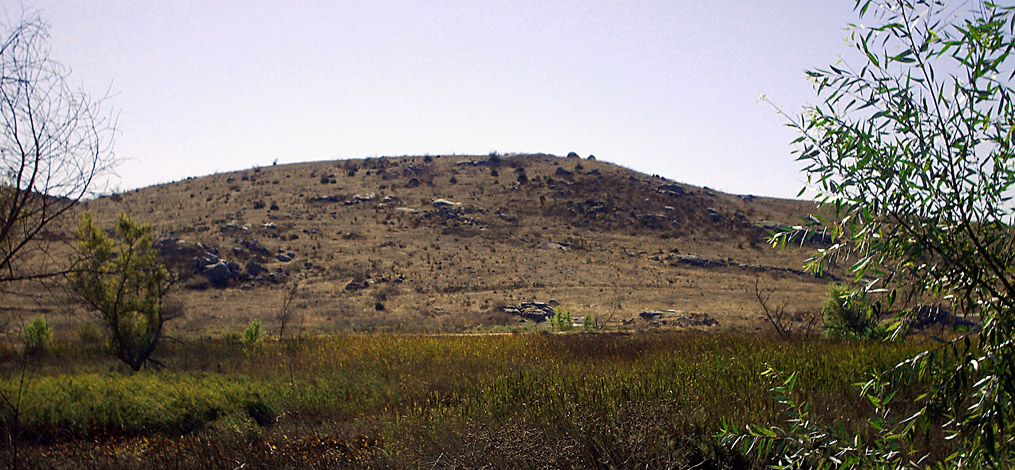
Forster City was located on the northwest edge of Rancho Santa Margarita along the San Onofre River.

The colony was the brainchild of Don Juan Forster, a transplanted Englishmen who married into the Pico family of Mexican era California and became the owner of several ranchos in San Diego County, of which Santa Margarita was the largest.

Within a couple of years of its founding Forster City had a post office, blacksmith shop and lumber yard. But Don Juan was a land-rich and cash-poor wheeler-dealer. An indication of that might be found in a notice of a sheriff’s sale that appeared in the Union of January 17, 1880, ordering the sale of Rancho Santa Margarita under a decree of foreclosure by the Hibernia Savings and Loan Society against Forster and two other defendants.

Foster managed somehow to hold on to Santa Margarita until his death in February 1882, but his heirs soon had to sell it. The end of Forster family ownership also marked the end of Forster City, which disappeared from county records and maps within a few years.

Get Updates Automatically-Become A Follower of the San Diego History Seeker

You can get weekly updates of San Diego History Seeker automatically in your email by clicking on the “Follow” button in the lower right corner of the blog page. You’ll then get an email asking you to confirm. Once you confirm you’ll be an active follower

Professionalizing the “Fire Laddies”

Never heard the phrase “fire laddie” until I saw a reference in some historic newspapers. Apparently it was a common term throughout the United States to describe firefighters in the nineteenth century.

“The Fire Laddies” was the headline of an article in the San Diego Union on Wednesday, June 5, 1889 about a meeting of the city’s fire commission set for that evening.

“Some important business will come before the commission,” read the article’s first paragraph, “such as the adoption of rules and regulations by which the department will be governed, the selection of a Chief Engineer [today called Fire Chief] and two assistants, and a full quota of men to make up the department.”

Much of the rest of the article focused on candidates for Chief and some assistant positions. But near the end one of the commissioners, J. K. Hamilton, gave a revealing quote on the state of the fire department at that time.

“The new rules and regulations,” Hamilton told the Union, “have been so arranged that they can cover either a paid or a volunteer department. Mr. Rockfellow [another commissioner] and myself are in favor of having at least a partially paid force of firemen.”

The city’s population had swelled from 3,000 in 1880 to 30,000 in 1887. An amendment to the city charter in 1889 set up the fire commission and began the transformation of what had been a volunteer operation into a paid profession.

According to a department history on the city’s website, “The department started with forty-one men, eleven horses, two steam fire engines, one hose wagon, two hose carts, one hook and ladder, and four thousand feet of hose.”

The first Chief Engineer appointed under the reorganization was A. B. Cairnes, who’d been a New York City firefighter before coming to San Diego just three years previously.

That first pay structure ranged from $100 a month for the Chief to $75 per month for engine and hose carriage drivers, and $10 for rank-and-file firemen.

Sources for this post included historic San Diego newspapers, the city of San Diego’s website and the book, An Illustrated History of Southern California, published in 1890 by the Lewis Publishing Company.

Get Updates Automatically-Become A Follower of the San Diego History Seeker

You can get weekly updates of San Diego History Seeker automatically in your email by clicking on the “Follow” button in the lower right corner of the blog page. You’ll then get an email asking you to confirm. Once you confirm you’ll be an active follower