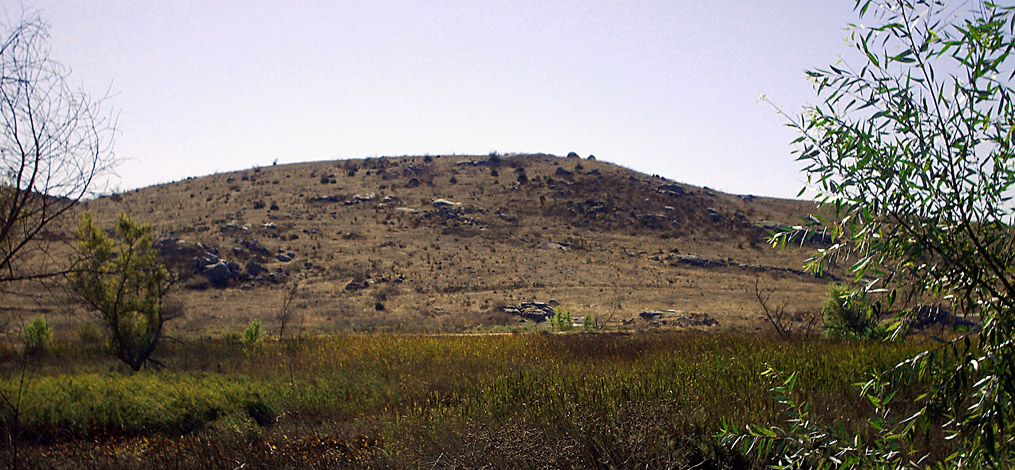
What’s in a name? A hard working farm family named Nordahl.

If you ever happen to be driving over Highway 78 and see the Nordahl Road exit and Nordahl shopping center in San Marcos, know that it was named for the Nordahl family.

Andrew Nicholas Nordahl was born in Sweden in 1835 and went to sea at the age of 18, serving on sailing ships until he decided in 1870 to settle down on land in New York. But he wasn’t through wandering. After two years he headed for Nebraska, where he married another Swedish immigrant, Anna Maria Levin. Six children were born to them in the 21 years they homesteaded there.

In 1893 the Nordahls headed for California, settling in an area of San Diego County then known as Richland. When Andrew Nicholas Nordahl died in 1899, his oldest son, Andrew William, continued running the family farming operation. A 1913 county history book described Andrew’s operation as “general farming, specializing in raising grain,” and also “dairying on a small scale.”

Andrew also played a role in getting other farmers crops produced as well by operating a steam tractor and threshing rig. Threshing machines separated the grain from its cob or husk, cleaned the grain, then gathered or stacked it. The threshing machines of the late 19th and early 20th centuries were powered by steam tractors, which were large and often too expensive for the average farmer. So owners of such tractors, in addition to using them on their own farms, rented out their services to other farmers. The archives of the San Marcos Historical Society include photos of the “Nordahl steam engine and threshing rig” at work on various area farms.

Sources for this post included the archives of the San Marcos Historical Society and the 1913 book, San Diego County, California: A Record of Settlement, Organization, Progress, and Achievement, by the S. J. Clarke Publishing Company.

Get Updates Automatically-Become A Follower of the San Diego History Seeker

You can get updates of San Diego History Seeker automatically in your email by clicking on the “Follow” button in the lower right corner of the blog page. You’ll then get an email asking you to confirm. Once you confirm you’ll be an active follower.
San Diego in 1860: A Whale of an Economy

industrial-census-1860

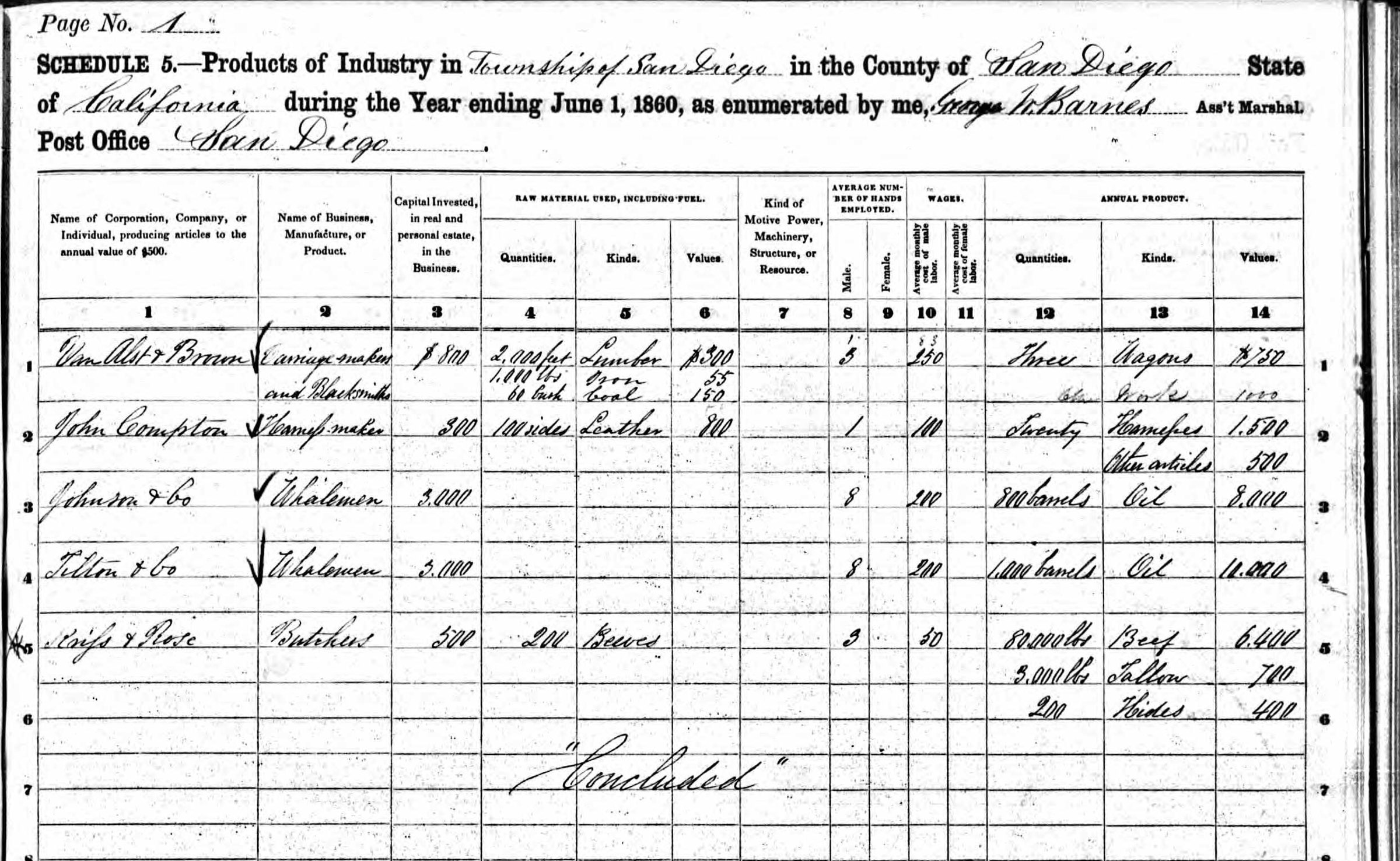
The image above is from the 1860 United States Census for San Diego Township, what we would today call downtown San Diego.

In addition to the population tallies the general public is more familiar with, decennial censuses from early times also included separate schedules for agriculture and industry. These schedules are invaluable for researchers. They also provide snapshots of local life at a certain time and place.

This “Products of Industry” schedule, which covers the one-year period from June 1, 1859 to June 1, 1860, is only one page, and lists a total of 5 businesses. Keep in mind that the city’s total population in the 1860 census was, officially, 731 people. And this industrial schedule was measuring those businesses with annual sales of $500 or more. (Note: $500 in 1860 would be roughly $14,000 today.)

Still, we can be forgiven for thinking there might have been some business owners who chose not to respond to the census takers, especially if it might involve divulging information that would make one subject to paying more taxes. But this data is still worth looking at for what it does show about this small city’s economy at that time.

For example, this enumeration sheet reveals that the most lucrative business in the city of San Diego in 1860 was the sale of whale oil. Two businesses, Johnson & Company, and Tilton & Company, whose businesses are described in column 2 as “Whalemen,” produced 1,800 barrels of oil for the year, which they sold for $18,000. That amount (roughly half a million dollars today), is 62 percent of the value of all the products listed. That says something for the value of whale oil, which was an important lighting fuel for homes and businesses in those pre-electricity days.

The next highest total for a business, $7,500, was the year’s take for Kriss & Rose, butchers who sold $6,400 worth of beef, $700 worth of tallow, and $400 worth of hides to their customers. (Note: the “Rose” in that partnership was Louis Rose, from whom Rose Canyon got its name.)

Then came John Compton, harnessmaker, who sold $2,000 worth of items, followed by Van Alst & Brown, carriage makers and blacksmiths, at $1,750.

While harnessmaker Compton was self-employed, all of the other businessnesses employed wage workers, and the sheet gives their total pay for the year as well. But that’s a story for another time.

Sources for this post included the United States Census Bureau and the United States Bureau of Labor Statistics, and the book: Louis Rose: San Diego’s First Jewish Settler and Entrepreneur, by Donald H. Harrison.

Get Updates Automatically-Become A Follower of the San Diego History Seeker

You can get updates of San Diego History Seeker automatically in your email by clicking on the “Follow” button in the lower right corner of the blog page. You’ll then get an email asking you to confirm. Once you confirm you’ll be an active follower.

A Social Issue in 1904

In California in 1904 liquor licenses were issued at the county level based on the advice and consent of the voters in a particular district. In November of that year the license of the Nuevo Saloon in Ramona was up for renewal.

Just before the election, D. N. Dodson, the editor of the Ramona Sentinel newspaper, expressed this opinion: “With license, a man gets a drink and goes home satisfied. With prohibition, he gets a jug and gets drunk. There is many a dollar that has stopped in Ramona that would have gone on, but for our saloon. Kill it and the dollar will roll out of our reach. Save the boys by voting for a license.”

The “drys,” as prohibition advocates were known then, won the election by 14 votes. In the next edition after the election, Dodson wrote an editorial in which he proposed putting his newspaper up for sale, saying he wished to “retire to a chicken ranch. We like this town and many of its people. We expect to remain here, but we don’t want to wear out trying to build up a town on the dry plan. The only two enterprises that bring in a cent of transient or foreign money to Ramona, outside the hotel, is [sic] the saloon and the Sentinel, but a majority of 14 ‘Roundheads’ show that neither are appreciated. The tyranny of majorities ‘makes the countless thousands mourn.’”

Dodson subsequently calmed down about selling the paper, although he did resign as Ramona’s justice of the peace soon after the election. Eventually the Ramona voters changed their perspective as well.

Sources for this post included the book: Ramona and Round About, by Charles LeMenager and two 1904 San Diego Union articles.

Get Updates Automatically-Become A Follower of the San Diego History Seeker

You can get updates of San Diego History Seeker automatically in your email by clicking on the “Follow” button in the lower right corner of the blog page. You’ll then get an email asking you to confirm. Once you confirm you’ll be an active follower.

How Far “Back” Was the “Back Country?”

“A Magnificent Exhibit From the Back Country” was the title of an article in The San Diego Union on October 6, 1892. The article was about an exhibit of produce mounted in the offices of the San Diego County Chamber of Commerce.

Described as “the best ever seen in the city,” the exhibit included hundreds of pounds and multiple varieties of fruits, vegetables, grain and flowers from all parts of the county, with the names and locations of the various growers who contributed to the exhibit.

There were individual pieces of produce notable for their size. W. C. Kimball of National City contributed three oranges, but as described in the article, they were whoppers: “total weight 72 ounces, the largest weighing 26 ounces and measuring 15 inches in circumference…”

T. W. Graham, of San Diego city, brought “two Hubbard squashes, 106 and 99 pounds.”

Then there were larger displays of bounty, like “400 pounds of grapes of different varieties” displayed by D. S. Sheldon of Dehesa, or the multiple boxes of apples of multiple varieties supplied by folks like D. B. Rockwood of San Pasqual, Maurice Reidy of Escondido and James Bonsall of, guess where? Bonsall!

Corn, barley, almonds, wheat, all manner of nature’s bounty was listed. What also stands out now are the names of the “back country” communities supplying this bounty. Some of them will be familiar to today’s readers, like Bonsall, Dehesa, and Julian. Others no longer exist, like Nellie, a name readers of this blog may recall from an earlier post.

Others might not strike today’s readers as being all that far back in the “back country.” Apples grapes and oranges came from Poway and Escondido, for example. Flowers and oranges were displayed from Nestor and Chollas Valley, two communities which are today neighborhoods within the San Diego city limits.

The Union article concluded that the three-day exhibit “was crowded….by admiring visitors to whom San Diego county’s ‘back country’ was a revelation.”

Get Updates Automatically-Become A Follower of the San Diego History Seeker

You can get updates of San Diego History Seeker automatically in your email by clicking on the “Follow” button in the lower right corner of the blog page. You’ll then get an email asking you to confirm. Once you confirm you’ll be an active follower.