Immigration: Does Any of This Sound Familiar?

What follows is the text of a post I originally published in June of 2015. I put it up then to provide some historical perspective on the subject of immigration. The need for historical perspective has gotten, if anything, more essential today. Spoiler alert: This is brought to you by a descendant of people who were among those referred to in the cited news article below as “low-grade aliens.”


“This country has taken a step in the right direction to preserve the strain of the pioneer stock that founded this nation and has brought it to its present standard of Americanism.”

That sentence is from an editorial that appeared in the San Diego Union on May 24, 1921. The editorial, entitled “Saving the Race,” praised the passage a few days previously of a bill restricting immigration to “three percent of the existing alien population.” This was the beginning of a quota system of immigration restriction that would be U. S. government policy for the next four decades, but at that point in time it was considered “experimental,” in the words of the editorial. And it was an experiment that the editorial writer obviously approved of.

Citing the research of one Prescott F. Hall, who was described as “a high authority on the subject of the sterilizing effect of incoming low-grade aliens,” the Union bemoaned alleged higher birthrates of “foreign” over “native-born” mothers. But it also claimed that “native-born people who migrate to regions in which the pioneer stock is still dominant show little or no lessening of their former fruitfulness. The real American strain is still paramount west of the Mississippi. It is, therefore, the policy of the West to keep its stock as free as possible from alloy of the American ‘melting pot’ now seething in the great cities along the Atlantic seaboard.”
High Tech Circa 1874

“San Diego is connected with other parts of the United States by the lines of the Western Union Telegraph Company. Length of the line from San Diego to San Francisco, six hundred and fifty miles, including the branch line to San Bernardino.”

So reads the beginning of a section on “Telegraphic Communication” in the book Information Relative to the City of San Diego, published in 1874 out of the offices of The San Diego Union on behalf of the San Diego Chamber of Commerce.

The first telegraphic message transmitted out of San Diego had taken place just a few years previously, on August 19, 1870. According to William Smythe’s 1908 History of San Diego, the coming of the telegraph was the result of Western Union representatives who came to San Diego and “raised by canvass a subscription of $8,000, the amount of the subsidy required.”

That was a lot of money in those days. Which may explain why the main contributors to that Western Union subsidy represented some of the city’s business heavyweights. The original subscribers, according to Information Relative, were “twenty three individuals and firms,” of whom “[the] largest givers were [Alonzo] Horton, [Ephraim W.] Morse, San Diego Union and J. S. Mannasse & Co.”

The book also reported that the Western Union office, located at Fifth and D Streets, “furnishes the Coast and eastern cities with daily reports of steamship movements, exports and imports; with other valuable statistics and information, amounting to thirty-six thousand words in the year 1873.”

Western Union at that point in time was in the process of merging with several major rivals to become what one study of the industry called “the first major industrial monopoly, with over 90% of the market share and dominance in every state.”

Big Data, indeed!

In addition to the aforementioned books, another source for this post was the website of the Economic History Association, https://eh.net/eha/ .

Get Updates Automatically-Become A Follower of the San Diego History Seeker

You can get weekly updates of San Diego History Seeker automatically in your email by clicking on the “Follow” button in the lower right corner of the blog page. You’ll then get an email asking you to confirm. Once you confirm you’ll be an active follower.

HAPPY AND HISTORIC HOLIDAYS TO ALL!


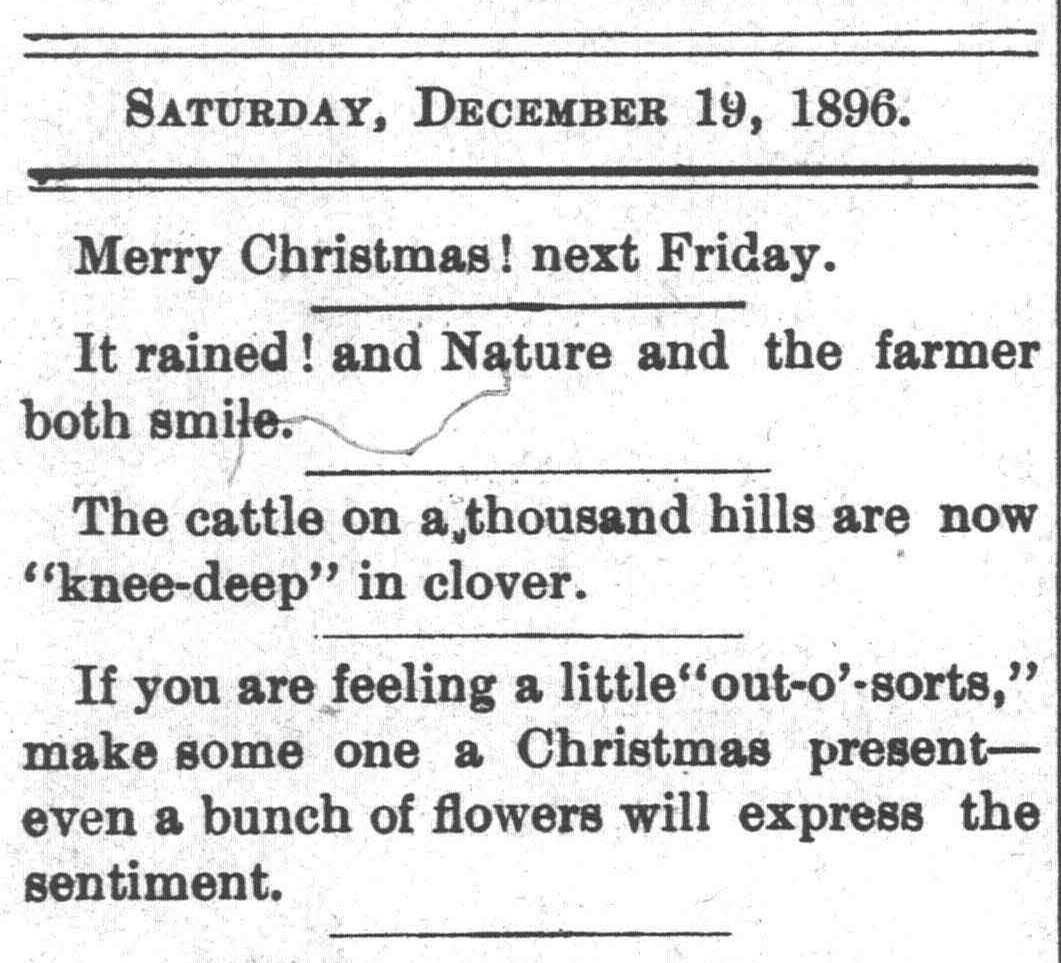
Poway Progress, December 19, 1896, p. 4.

Get Updates Automatically-Become A Follower of the San Diego History Seeker

You can get weekly updates of San Diego History Seeker automatically in your email by clicking on the “Follow” button in the lower right corner of the blog page. You’ll then get an email asking you to confirm. Once you confirm you’ll be an active follower.

Automobile Parties and Mighty Fine Fruit

“Mountain City in Midst of an Era of Prosperity,” proclaimed a headline on page 9 in the San Diego Union of June 1, 1910.

The article, datelined Julian, was about the just-completed Memorial Day weekend, noting that while there were no official observances in the town, “a number of automobile parties arrived and departed.”

“The machines were loaded down with San Diegans who came into the mountains to get a breath of fresh air the half-holiday of Saturday, followed by Sunday and Memorial day, giving them two and a half days for recreation.”

The visitors included San Diego Mayor Grant Conard and his family as well as numerous city and county officials. Comments were made on new road building projects and their potential for increasing visitors and new residents to the area.

“With better roads, which means better transportation,” stated the article, “it is hoped that a new interest will be taken in the mining industry.”

One other budding industry (excuse my pun) captured the newspaper reporter’s attention: “There is some talk here of the Julian people and nearby ranchers making the apple day of last year an annual event. The day last year was such a signal success, and resulted in such a general advertisement for this end of the county that the merchants and others were quick to see the advantage of such an event.”

While the crop yield for 1910 was expected to be smaller than the previous year, the article stated that “the quality will be far above that of last year, when the ranchers were enabled to exhibit some mighty fine fruit.”

Sources for this post included the website GenealogyBank.com .

Get Updates Automatically-Become A Follower of the San Diego History Seeker

You can get updates of San Diego History Seeker automatically in your email by clicking on the “Follow” button in the lower right corner of the blog page. You’ll then get an email asking you to confirm. Once you confirm you’ll be an active follower.

What’s in a name? The four Stowes.

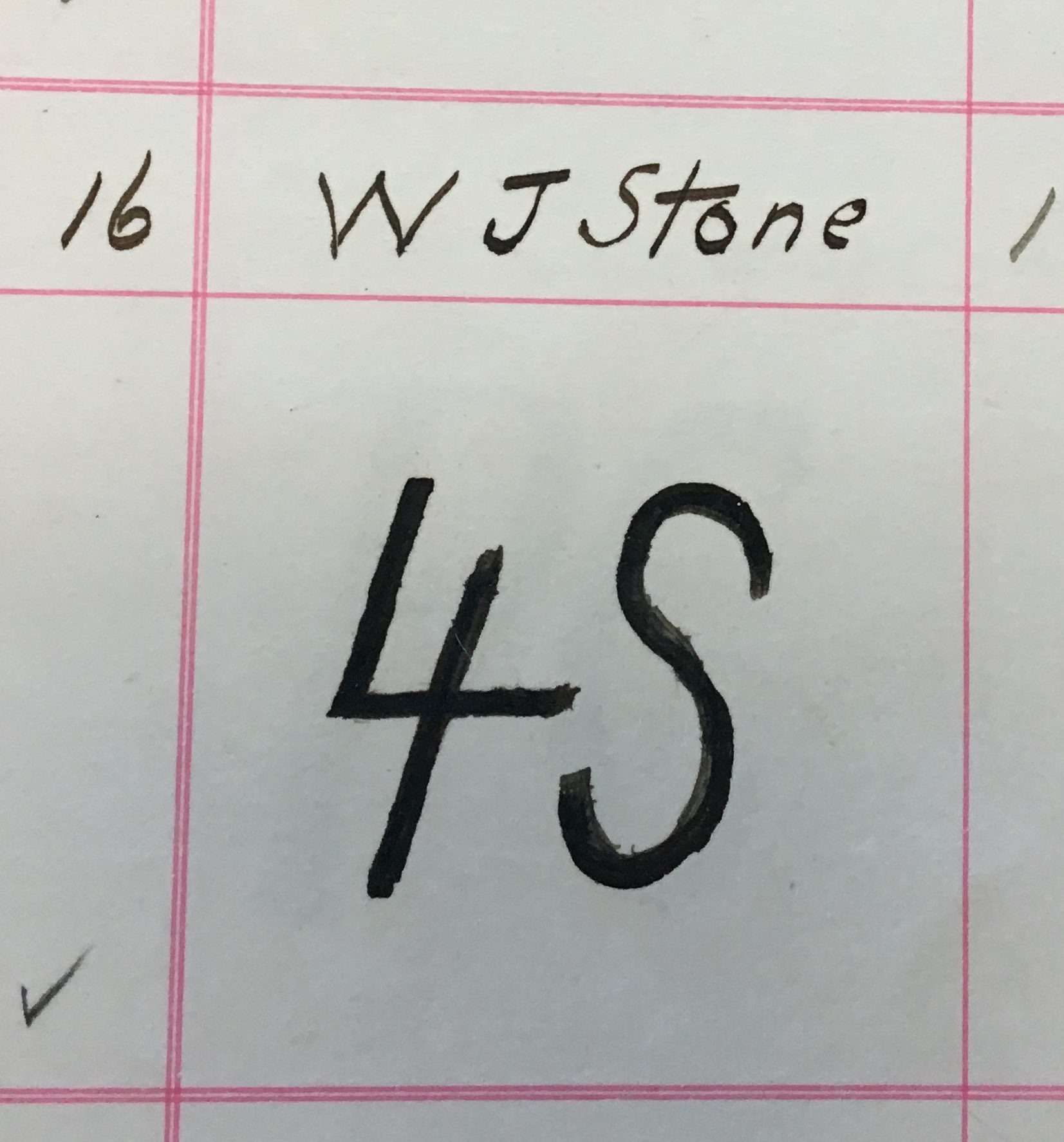
Portion of table of contents of 1918 San Diego County Brand Book showing the livestock brand registered to W. J. Stowe (misspelled Stone here). Courtesy of History Office, San Diego County Department of Parks and Recreation.

“Los Angeles man buys ranch near Bernardo,” was the headline of an article in the San Diego Union of August 3, 1918.

“W. J. Stowe of Los Angeles,” the article began, “who has bought 3,000 acres of the ranch of the Eucalyptus Culture Company, four miles southeast of Bernardo, and who has rights on 325 additional acres, has taken possession of the property and is lending his personal supervision in the making of important improvements.”

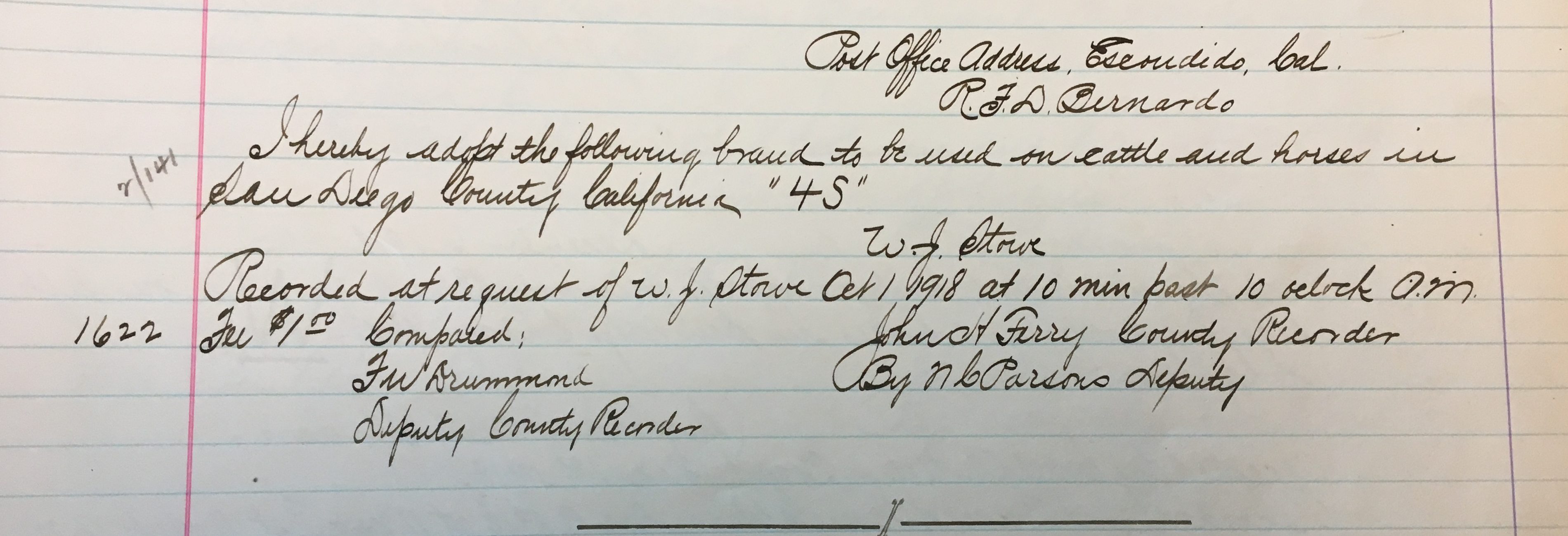
In addition to growing hay and grain, Stowe intended to keep a large herd of cattle. Livestock was big business in San Diego County at the time. Like all other livestock ranchers, Stowe had to register a brand for his livestock with the county. Below is an excerpt from the page of the county brand book for October 1, 1918 recording Stowe’s appearance:

The brand he chose represented the four Stowe family members living on the ranch and helping to run it: William J. Stowe, his wife Ada (who was listed as the official purchaser) and his sons Perry and Gardner. William’s elderly mother and mother-in-law were also in the household, but not involved in running the ranch.

The Stowe family would sell the ranch within a few years, but their “brand” remains on 4S Ranch to this day.

I’m grateful to Ellen L. Sweet and Jennifer A Grahlman, intrepid history detectives at the History Office of the San Diego County Department of Parks and Recreation. They mentioned the origin of the 4S name in their recently published book, San Diego County Parks: Over 100 Years, The 1918 brand book is happily preserved in the History Office archives.

Other sources for this post were the websites Genealogy Bank and Ancestry.com.

Get Updates Automatically-Become A Follower of the San Diego History Seeker

You can get updates of San Diego History Seeker automatically in your email by clicking on the “Follow” button in the lower right corner of the blog page. You’ll then get an email asking you to confirm. Once you confirm you’ll be an active follower.