Happy Thanksgiving to All!

“Thanksgiving night the A. O. U. W. will give a ball. Persons masked admitted free; unmasked, 10 cents. Five dollars will be given the lady having the most original and best sustained costume; also, $5 to the gentleman likewise excelling. Good music. Supper 25 cents.”

From the “Cajon Clusters” column of the Poway Progress newspaper, October 29, 1896, p. 2. A. O. U. W. stands for Ancient Order of United Workmen, a mutual aid organization established by railroad workers after the Civil War. It existed into the late 1920s.

Get Updates Automatically-Become A Follower of the San Diego History Seeker

You can get regular updates of San Diego History Seeker automatically in your email by clicking on the “Follow” button in the lower right corner of the blog page. You’ll then get an email asking you to confirm. Once you confirm you’ll be an active
 

The Road to Boulevard

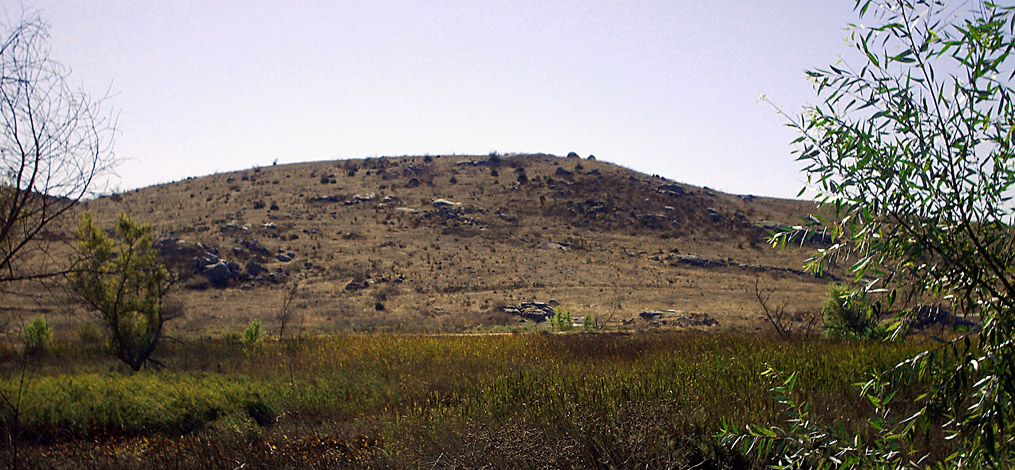
On the way back from a vacation driving trip to Arizona, as we took a little detour onto what’s now called Old Highway 80, we passed through Boulevard. And we wondered, how did this still very-rural looking place, which even today is referred to as a village, with a current population of roughly 315 residents, get to be named “Boulevard?”

Two definitive books on the origins of California place names attribute the name to the role played in the community’s development by the “boulevard” of Highway 80, linking the area with the Imperial Valley.

A check of the U. S. National Archives register of post offices shows the first Boulevard post office being designated in November 1909. The first postmaster was William H. Ruby. The Rubys were a ranching family in the area tracing back to the late 1880s. In 1913 William Ruby’s brother Don took over as postmaster, a position he would hold for almost 30 years.

You can find references to the Ruby family in newspaper accounts over the decades serving their community not just as postmasters but also election poll officials and volunteer firefighthers. Which lends credibility to the most direct story on Boulevard’s name.

In 1964, a reporter for the San Diego Union interviewed some longtime county residents about the origins of several place names. One of the places the reporter looked into was Boulevard. The person he spoke to was Vi Ruby, the widow of Don Ruby, who told him that when the U.S. Postal Department decided to create a post office in their village, they asked the Rubys if they had any suggestions.

Vi Ruby said that during that period race driver Barney Oldfield frequently came through the area on his way to racing events in San Diego and other southern California towns. Other race drivers would have been following that route as well. Which may explain why Vi’s sister-in-law, William Ruby’s wife Pearl, said, “People are making a boulevard out of it, so why don’t they call it Boulevard?”

“She entered the suggestion as a joke,” Vi Ruby told the Union, “but it was selected.”

In addition to the aforementioned U. S. National Archives register of post offices, sources for this post also included historic San Diego County newspapers and the books California Place Names: The Origin and Etymology of Current Geographical Names by Erwin G. Gudde, and San Diego County Place Names A To Z by Leland Fetzer.

Get Updates Automatically-Become A Follower of the San Diego History Seeker

You can get regular updates of San Diego History Seeker automatically in your email by clicking on the “Follow” button in the lower right corner of the blog page. You’ll then get an email asking you to confirm. Once you confirm you’ll be an active


“…a pretty watering place…”

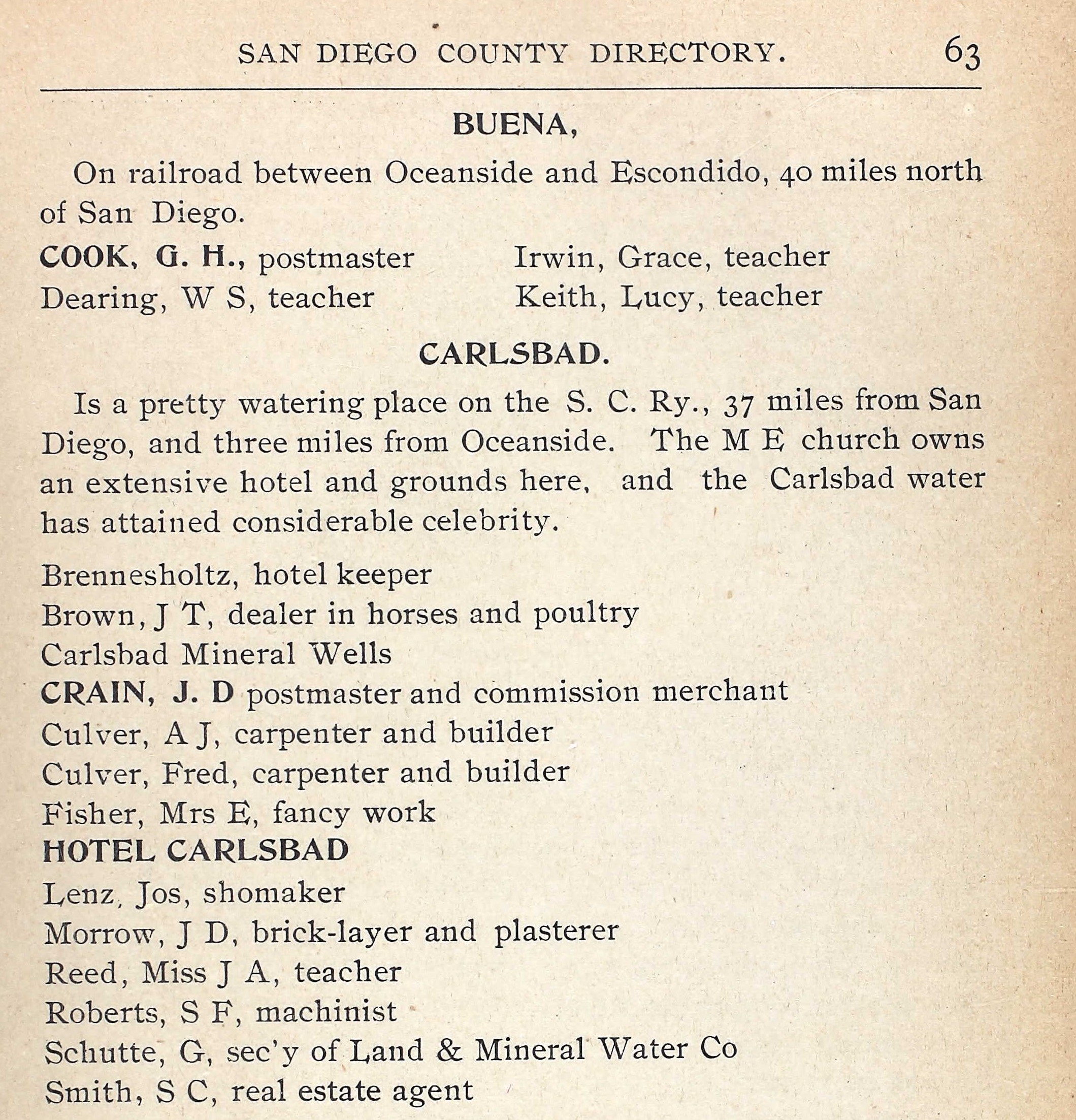
City and county directories were predecessors of telephone directories. Financed by ad sales, these privately published volumes profiled individual communities and listed the names of prominent residents and businesses. Those directories that have survived are important tools for researchers. They also provide a sort of real-time narrative peek at everyday life in a place at a given time.  Here’s a verbal snapshot of Carlsbad from an 1893 San Diego County directory:

  Get Updates Automatically-Become A Follower of the San Diego History Seeker

You can get regular updates of San Diego History Seeker automatically in your email by clicking on the “Follow” button in the lower right corner of the blog page. You’ll then get an email asking you to confirm. Once you confirm you’ll be an active
Another Kind of Mobility

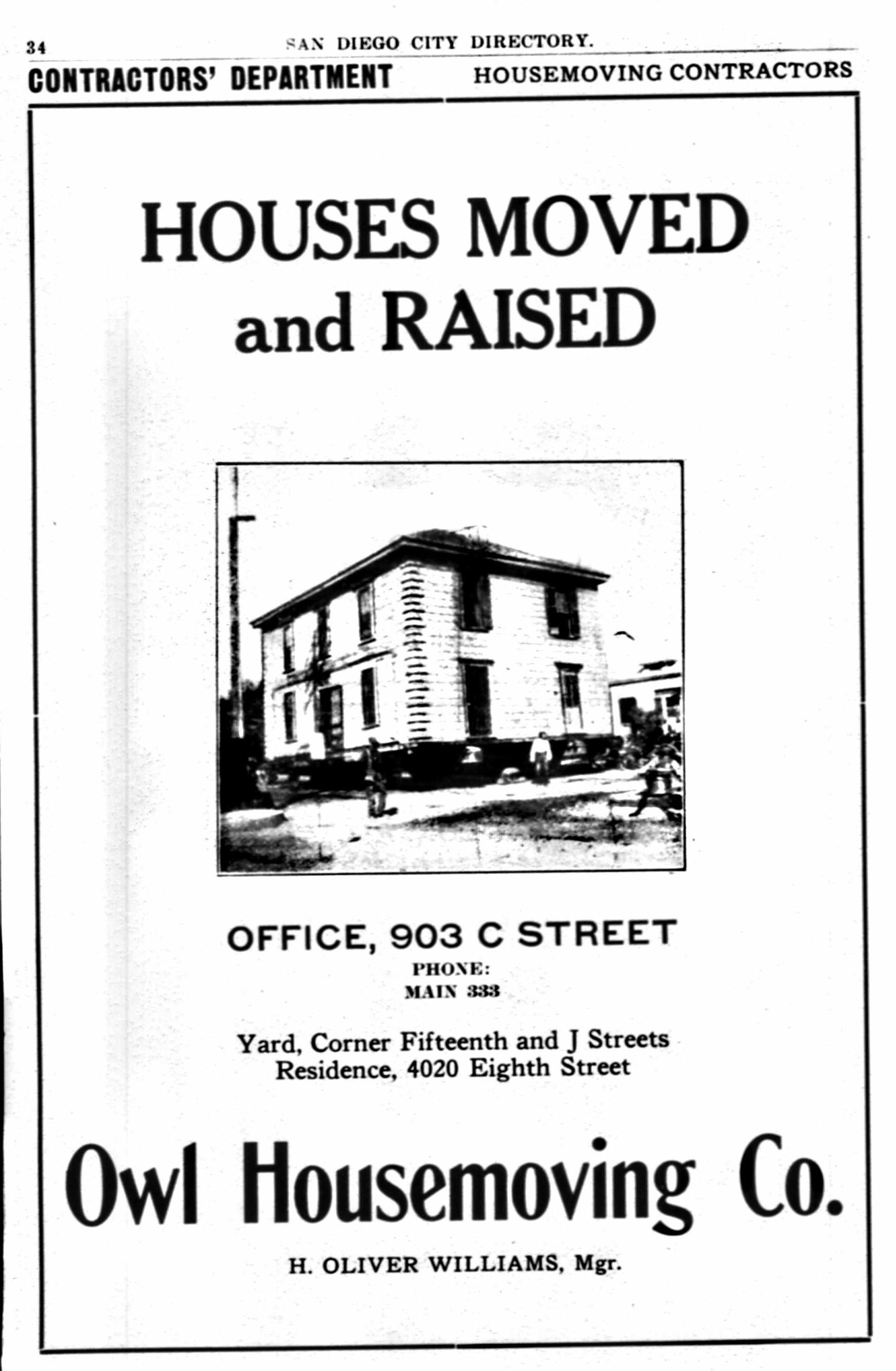
A century ago in San Diego County, mobility didn’t just mean people moving from one place to another. It often meant whole buildings moving from one place to another. Check out this ad from a 1914 San Diego City Directory:

An item in the San Diego Union of January 11, 1914 noted that “the latest evidence of things moving and times changing is had in the old Pauly residence at Eleventh and Broadway. The Owl House Moving Company is now preparing the underplaning for moving this old home from its present site to Eighteenth and G streets. The present site is to be cleared for the erection of a handsome new structure, which is to have storerooms below and offices above.”

The house was being moved “to meet the demands of more accomodations in the business district,” according to the article. “When the house now there was erected [in 1889], “San Diego was barely out of the village class….”

  Get Updates Automatically-Become A Follower of the San Diego History Seeker

You can get regular updates of San Diego History Seeker automatically in your email by clicking on the “Follow” button in the lower right corner of the blog page. You’ll then get an email asking you to confirm. Once you confirm you’ll be an active

A Job For The Times

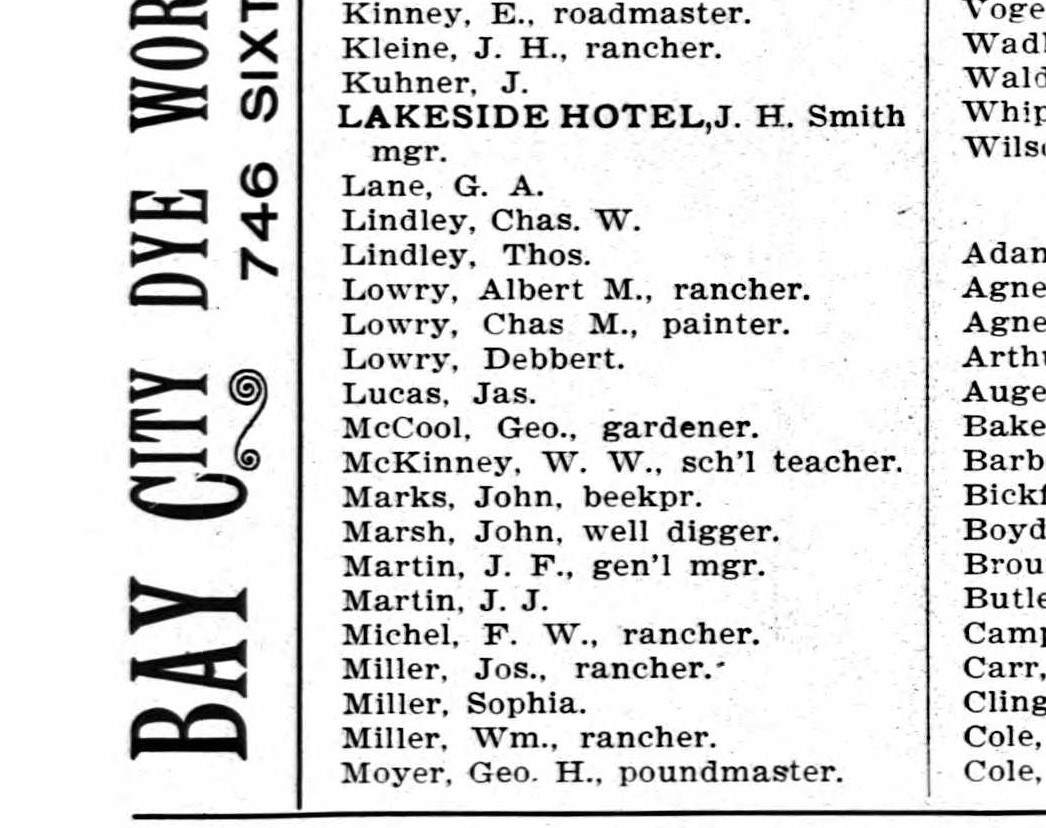
Below is part of a listing for Lakeside in a 1901 San Diego County directory:

I chose it because of the occupations listed for each resident. Most of them are jobs you’d readily expect for the time and place, like rancher, well digger, beekeeper and schoolteacher. But please note the occupation at the very bottom: poundmaster.

A pound back then was an enclosure, often by stone fencing, to house stray livestock that had been found wandering about the local area. The poundmaster or poundkeeper was charged with oversight of such animals, trying to find their owners. If no one came to claim the animals, the poundmaster was empowered to sell them at auction.

This had to be a big responsibility in San Diego County in 1901. The economy was predominantly agricultural, and the livestock population–cattle, sheep, horses, pigs, chickens–far outnumberd the humans.

Figures from the census and county surveys in 1887 showed 270,000 head of livestock compared to 30,000 people. Things hadn’t changed that much by 1901. An item in the San Diego Union on March 28 of that year began, “The farmers in the vicinity of El Cajon valley are feeling quite happy nowadays. The crops, trees and vines are all doing well, and there is plenty of pasturage for their livestock.”

This would be the predominant way of life in the county for at least another 40 years.