“We stand upon a land that carries the footsteps of millennnia of Kumeyaay people. They are a people whose traditional lifeways intertwine with a worldview of earth and sky in a community of living beings.”
These are the opening words of a resolution adopted by the Senate of San Diego State University in September 2019. That resolution acknowledged the legacy of the university’s site as Kumeyaay land. It was part of a movement throughout the nation by the descendants of America’s original residents to reassert their historical legacy and to assume agency over their history and their future.
I would also recommend checking out two other San Diego County organizations in the forefront of embracing and building on San Diego’s indigenous heritage:
This is the link to the website of the California Indian Culture and Sovereignty Center at California State University San Marcos:
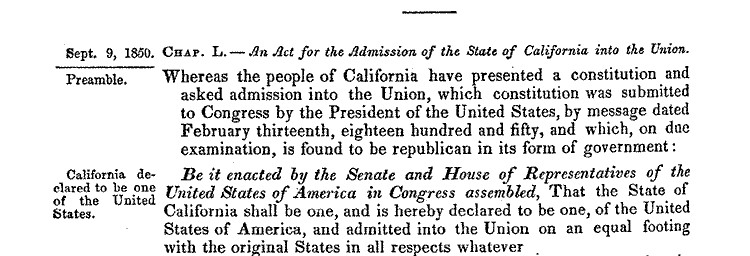
The text above is a direct copy from the proceedings of the United States Congress from 1850, courtesy of the Library of Congress. This was the act which made California the 31st state in our federal union on September 9, 1850, 171 years ago yesterday.
The Library of Congress website, loc.gov , is a gold mine of information for researchers, but it can take a little digging which along with other tasks caused me to miss getting this post out on Admission Day itself. But hey, history tells us, quite literally, that folks in San Diego and elsewhere got this news rather belatedly as well. The written notice had to be hand-carried by horsedrawn wagons to a steamship that carried it down the Atlantic to the then-canal-less isthmus of Panama. There it had to be carried overland from the Atlantic coast to the Pacific Coast, then placed back on another steamship to be carried to the coast of California. It took over a month and a half, which was why it wasn’t until October 18, 1850, that the mayor and town council of the then-small town of San Diego, according to several historical accounts, “set aside $300 for a ball in honor of the admission of California into the Union.”
Happy Belated Admission Day!
In addition to the Library of Congress, sources for this post included the 1908 book, History of San Diego: 1542-1908, by William E. Smythe, and Patt Morriison’s article, “It’s Time to Celebrate California Admission Day! Wait, what’s Admission Day? in the Los Angeles Times three days ago.
Below are excerpts from two pages of the 1850 United States Census for San Diego County:
They show the household of Antonia Snook. You can learn a lot of history from census entries, although often, especially if you go back this far in time, you learn more about what had been omitted from history. The number “63” in the far-left column indicates that this was the 63rd dwelling visited by the census takers on their rounds through that particular enumeration district. The first person enumerated at that dwelling is Antonia Snook. The two columns to the immediate right of her name list her as 35-year-old female.
The next column over is blank, which is where we get into historic omission. In this case, it’s a sexist omission, as the 1850 census only asked for the “Profession, Occupation, or Trade of each Male person over 15 years of age.” So as a woman Antonia didn’t count for having a livelihood, even though she’s listed first in her household, an indication of authority over the other occupants. That omission is made more glaring by the next column over. That column lists “Value of Real Estate owned” by Antonia, which amounts to $5,000.00, That was a considerable chunk of change in 1850. And again, please note that the only person having any financial assets in the household is Antonia.
Antonia’s full name was Maria Antonia Alvarado Snook. Born Maria Antonia Alvarado, she was the daughter of a prominent San Diego family when she married Don Jose Snook, an English sea captain who had moved to what was then the Mexican province of Alta California, in 1837. In the early 1840s Don Jose became the owner of the 17,000 acre Rancho San Bernardo 20 miles north of the then Pueblo of San Diego.
Don Jose Snook died in 1848, as his ranch and all of California were coming under U.S. control with the end of the Mexican-American War. The 1850 United States Census was the first to include California and San Diego County.
Don Jose and Maria had no children, so it’s possible the three females listed in her household, one adult, one teenager and one child, are members of her extended Alvarado family. There are also three adult males listed only by the first names, consistent with the designation ”I” in a separate column, indicating they are “Indians.” They are also listed as being “Laborers,” clearly part of the rancho workforce. The incomplete names offer another look into what history was left out of this census.
Rancho San Bernardo was then a considerable grain and cattle-raising operation. In his will Don Jose left Maria a life estate in the rancho and she actively pursued her right to use the property after her husband’s death. According to a 1997 essay by Ruth Collings in The Journal of San Diego History, Maria “added a fleur-de-lis to [Don Jose’s original cattle] brand and registered it as her own. Lured by the high prices for beef in San Francisco, she sent cattle north for several years.”
Below is an excerpt from the list of appointments of U.S. Postmasters, 1832-1971, courtesy of the U. S. National Archives and Records Administration (NARA). It shows the appointment of the first postmaster for El Cajon, Amaziah L. Knox, on June 6, 1878:
Knox, originally from Maine, had come to San Diego County in 1869, where he bought some acreage in the El Cajon Valley and began raising wheat. He also began to take lodgers in his house, which he eventually expanded into a hotel, taking advantage of his location at the half-way point between the city of San Diego and Julian, which was experiencing a boom due to the discovery of gold.
An item in the San Diego Union on of December 9, 1873 reported a visit to the paper’s offices by “Mr.Knox, of Cajon Valley” who reported that heavy rains had made the ground so wet that “they will have to wait awhile before they can go on plowing. Between 5,000 and 6,000 acres will be planted in wheat on the Cajon this season,” the article stated, of which Knox was planting some 2,000 acres.
Within a decade Knox and other valley ranchers would grow an expanding assortment of crops, including grapes, raisins and olives, of sufficient quantity and quality to appeal to markets beyond California. An 1888 book, reporting on the operation of George Cowles, an El Cajon neighbor of Knox, stated that “…today the raisins produced on the Cowles Ranch are sent all over the United States, and they are without doubt superior to any grown either in this country or Europe. ……This season there were shipped from eight to ten thousand boxes of raisins from this vineyard which is but five years old. It is situated in the center of the valley. Besides grapes, and olives, and other fruits, there are about one thousand acres in grain, while the ranch is stocked with one hundred head of fine horses, and about three hundred head of choice, graded cattle.”
While the Post Office Department chose the name El Cajon for the office over which Mr. Knox presided, his home and land were then more widely known as “Knox’s Corner.” But in 1912, just a few years before his death at the age of 84, Amaziah Knox would see the city of El Cajon formally incorporated. One of the members of the first city government would be his son, Dr. Charles Randall Knox. The original Knox house at what is now the southwest corner of Main Street and Magnolia Avenue in downtown El Cajon is today the home of the El Cajon Historical Society.
Sources for this post included the National Archives and Records Administration, historic San Diego County newspapers, the El Cajon Historical Society, and the following books: Picturesque San Diego by Douglas Gunn, published in 1887, City and County of San Diego Illustrated, and Containing Biographical Sketches of Prominent Men and Pioneers, by Leberthon and Taylor, published in 1888, and City of San Diego and San Diego County: The Birthplace of California, by Clarence Alan McGrew, published in 1922.
In honor of Major League Baseball’s All-Star Game tomorrow, the History Seeker recalls a county family that produced a trio of local baseball stars, one of whom became an All-Star in the Show, as some call the major leagues.
“The Prides of Escondido,” was the headline over a photo of three young Escondido High School baseball players in the San Diego Union on April 18, 1928.
“Escondido is proud of its Coscarart boys, and with plenty of reason,” began the article accompanying the photo, describing Joe, Steve and Pete Coscarart as “ball playing fools.”
“Joe is shortstop and cleanup hitter for the Escondido High team,” explained the article, while “Steve holds down second base and is second in the batting order. Pete, the little fellow, is lead off hitter and plays left field or wherever you want to put him.”
A few days later the Union reported the victory of the Escondido High team over ‘the Naval Training Station nine,” 3 to 1, “in a fast game featured by the bang-up playing of the Coscarart trio…” Pete, playing second base, “made a fast double-play in the fifth inning and halted a rally by the Boots. He caught a sizzling liner and threw out a runner at third base, retiring the side. Joe and Steve played right field and shortstop, respectively, and showed good form at bat and afield.”
All three brothers would star on minor league teams. An injury cut short Steve’s career. Joe and Pete would go on to the major leagues, Joe with the Boston Braves and Pete with the Brooklyn Dodgers. Pete would last in the majors the longest, playing for the Dodgers and then the Pittsburgh Pirates from 1938 to 1946. In 1939, Pete was considered the top defensive second baseman in the National League. He was considered pretty good on offense too, with a .277 batting average, 22 doubles and 10 stolen bases. The following year he made the National League All-Star team. He was later named to the Brooklyn Dodgers Hall of Fame, and is memorialized locally in Pete Coscarart Field, home of Escondido High’s baseball teams.
Sources for this post included historic San Diego and Escondido newspapers and the Society for American Baseball Research.



 San Diego History Seeker