HAPPY AND HISTORIC HOLIDAYS TO ALL!


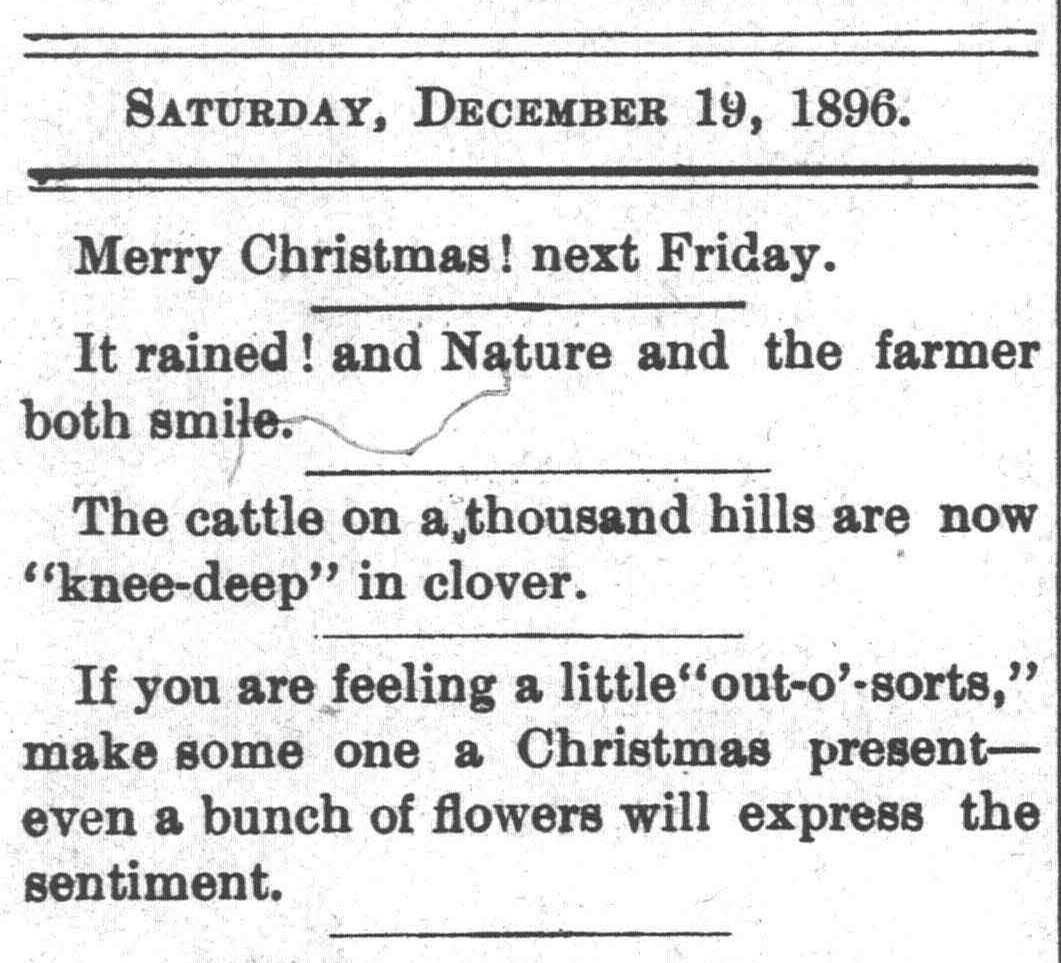
Poway Progress, December 19, 1896, p. 4.

Get Updates Automatically-Become A Follower of the San Diego History Seeker

You can get weekly updates of San Diego History Seeker automatically in your email by clicking on the “Follow” button in the lower right corner of the blog page. You’ll then get an email asking you to confirm. Once you confirm you’ll be an active follower.

Automobile Parties and Mighty Fine Fruit

“Mountain City in Midst of an Era of Prosperity,” proclaimed a headline on page 9 in the San Diego Union of June 1, 1910.

The article, datelined Julian, was about the just-completed Memorial Day weekend, noting that while there were no official observances in the town, “a number of automobile parties arrived and departed.”

“The machines were loaded down with San Diegans who came into the mountains to get a breath of fresh air the half-holiday of Saturday, followed by Sunday and Memorial day, giving them two and a half days for recreation.”

The visitors included San Diego Mayor Grant Conard and his family as well as numerous city and county officials. Comments were made on new road building projects and their potential for increasing visitors and new residents to the area.

“With better roads, which means better transportation,” stated the article, “it is hoped that a new interest will be taken in the mining industry.”

One other budding industry (excuse my pun) captured the newspaper reporter’s attention: “There is some talk here of the Julian people and nearby ranchers making the apple day of last year an annual event. The day last year was such a signal success, and resulted in such a general advertisement for this end of the county that the merchants and others were quick to see the advantage of such an event.”

While the crop yield for 1910 was expected to be smaller than the previous year, the article stated that “the quality will be far above that of last year, when the ranchers were enabled to exhibit some mighty fine fruit.”

Sources for this post included the website GenealogyBank.com .

Get Updates Automatically-Become A Follower of the San Diego History Seeker

You can get updates of San Diego History Seeker automatically in your email by clicking on the “Follow” button in the lower right corner of the blog page. You’ll then get an email asking you to confirm. Once you confirm you’ll be an active follower.

What’s in a name? The four Stowes.

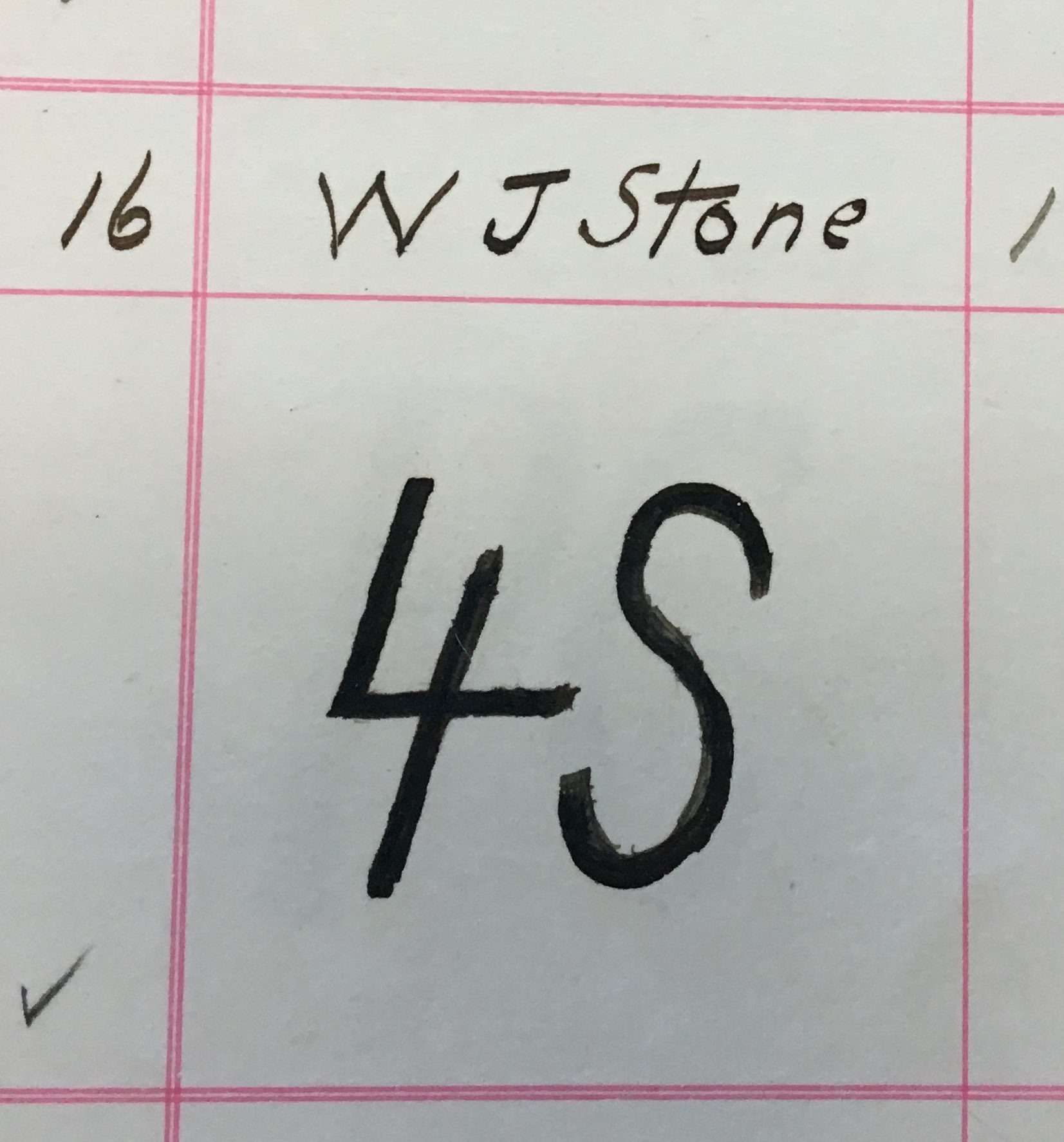
Portion of table of contents of 1918 San Diego County Brand Book showing the livestock brand registered to W. J. Stowe (misspelled Stone here). Courtesy of History Office, San Diego County Department of Parks and Recreation.

“Los Angeles man buys ranch near Bernardo,” was the headline of an article in the San Diego Union of August 3, 1918.

“W. J. Stowe of Los Angeles,” the article began, “who has bought 3,000 acres of the ranch of the Eucalyptus Culture Company, four miles southeast of Bernardo, and who has rights on 325 additional acres, has taken possession of the property and is lending his personal supervision in the making of important improvements.”

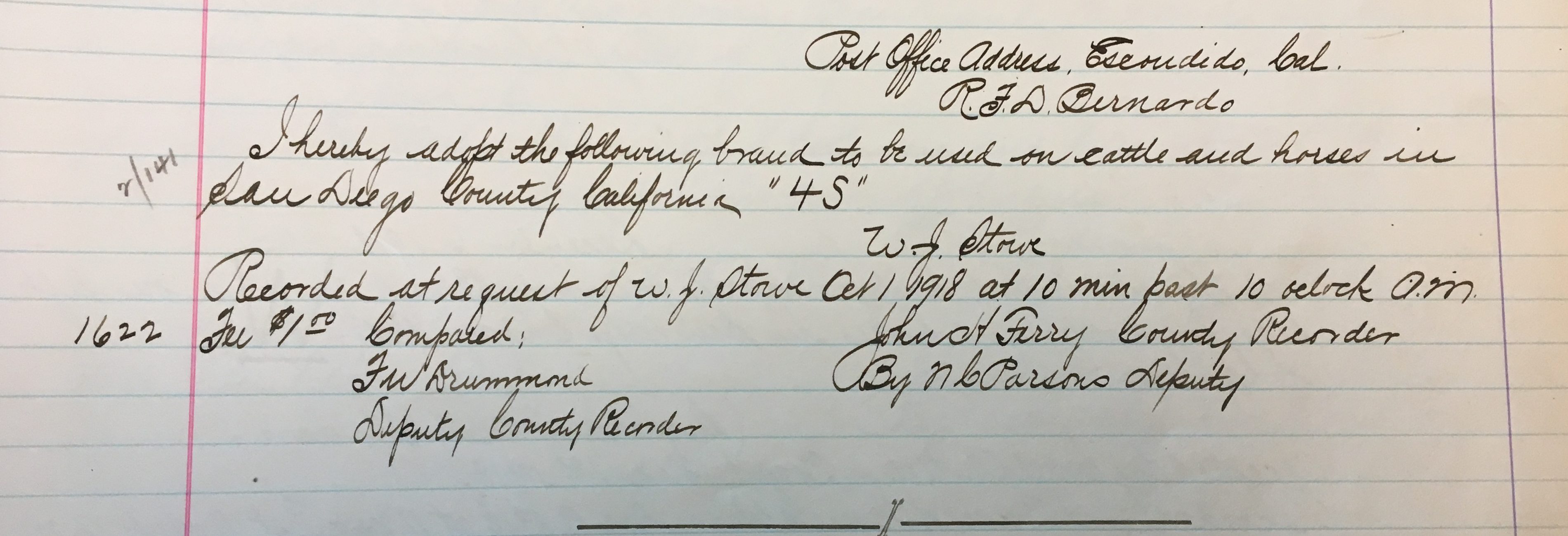
In addition to growing hay and grain, Stowe intended to keep a large herd of cattle. Livestock was big business in San Diego County at the time. Like all other livestock ranchers, Stowe had to register a brand for his livestock with the county. Below is an excerpt from the page of the county brand book for October 1, 1918 recording Stowe’s appearance:

The brand he chose represented the four Stowe family members living on the ranch and helping to run it: William J. Stowe, his wife Ada (who was listed as the official purchaser) and his sons Perry and Gardner. William’s elderly mother and mother-in-law were also in the household, but not involved in running the ranch.

The Stowe family would sell the ranch within a few years, but their “brand” remains on 4S Ranch to this day.

I’m grateful to Ellen L. Sweet and Jennifer A Grahlman, intrepid history detectives at the History Office of the San Diego County Department of Parks and Recreation. They mentioned the origin of the 4S name in their recently published book, San Diego County Parks: Over 100 Years, The 1918 brand book is happily preserved in the History Office archives.

Other sources for this post were the websites Genealogy Bank and Ancestry.com.

Get Updates Automatically-Become A Follower of the San Diego History Seeker

You can get updates of San Diego History Seeker automatically in your email by clicking on the “Follow” button in the lower right corner of the blog page. You’ll then get an email asking you to confirm. Once you confirm you’ll be an active follower.

The Farmhands Behind the Farmers, Circa 1860

One of my goals in researching and writing about history is to illuminate the lives of ordinary working people whose role in building and shaping our world can be overlooked.

So I started out looking for one of those ordinary people for a blog post subject. And I tried one of my best sources: census data. I’ve pointed out in past posts what a wealth of info you can find in census records.

In this particular case, I hit a brick wall. So far, I haven’t been able to find this particular person. But in looking for someone I thought might be a relative, but wasn’t, I stumbled across some more insights.

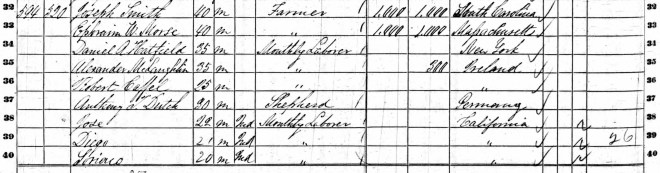
Below is a portion of a page from the 1860 United States Census for Agua Caliente Township in San Diego County. It shows the names, occupations and birthplaces of one particular farm household in Agua Caliente when the census was taken in July of 1860:

Ephraim Morse 1860 census page 1

Ephraim Morse 1860 census page 2

At the head of the list of names are two men who are obviously the proprietors of the farm, Joseph Smith and Ephraim W. Morse. Each is 40 years old and each lists his occupation as “Farmer.”

When I first saw this page, the name of Mr. Morse sounded very familiar. He turned out to be a major figure in San Diego history.

After coming west from his native Massachusetts during the Gold Rush, Morse moved from northern California to San Diego County in 1850. He made a name for himself as a retail merchant, banker, and realtor in the city of San Diego. From the 1860s to the end of his life he served at various times as a judge and a city and county treasurer. He also helped promote the coming of railroads and an early water project, the San Diego Flume Company.

A very extensive obituary in the January 26, 1906 San Diego Union focused on Morse’s business and political work in the city but also noted that in 1859 Morse “engaged in the sheep business …in partnership with Joseph Smith. They cultivated about a hundred acres of land and kept about 3,000 sheep and 100 head of cattle. In 1861 he returned to Old San Diego and resumed mercantile business….”

How do you manage 3,100 head of livestock on a hundred-acre ranch? With a lot of help, as shown by the other nine names listed below Smith and Morse on that farm household.

First comes Daniel Hatfield, 35 years old, a native of New York State.

Then there’s Alexander McLaughlin, also 35 and originally from Ireland.

Following McLauglin comes another Irishman, 25-year-old Robert Caffel.

Hatfield, McLaughlin and Caffel list their occupations as “Monthly Labor.”

Next on the list is Anthony Dutch, 30 years old and a native of Germany. His occupation is “Shepherd.”

The remaining five farmhands are listed as monthly laborers. They are listed only by their first names, and for them, unlike their other housemates, the box indicating “color” has been checked.                It’s marked “Ind” for Indian. All are born in California:

Jose is 22 years old.

Diego is 21.

Soriaco is 20.

Geronimo is 40.

Pedro is 30.

Sources for this post included the 1860 United States Census, historic San Diego County newspapers and the book, History of San Diego: 1542-1908, by William E. Smythe.

Get Updates Automatically-Become A Follower of the San Diego History Seeker

You can get updates of San Diego History Seeker automatically in your email by clicking on the “Follow” button in the lower right corner of the blog page. You’ll then get an email asking you to confirm. Once you confirm you’ll be an active follower.
Great New Book on County Park History

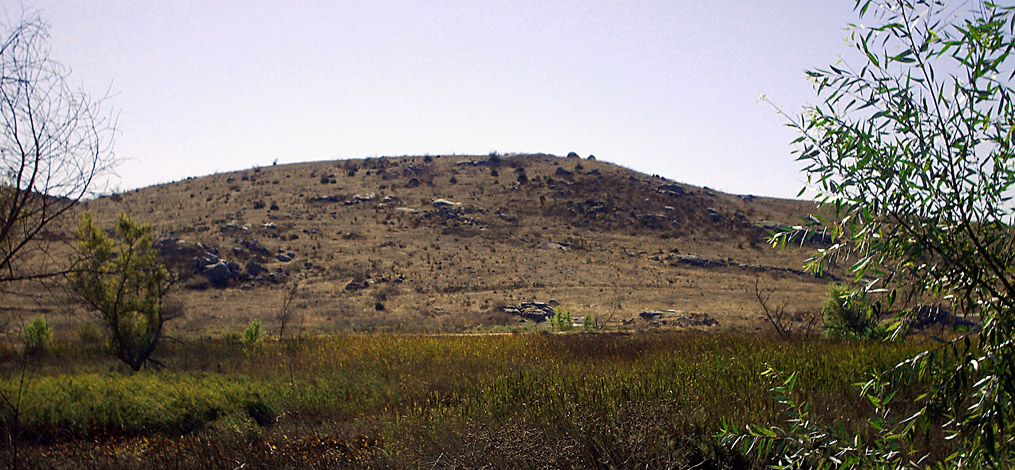
Like many of you, I’ve enjoyed hiking and camping in San Diego County’s parks. But I also enjoy them as a history seeker. There’s a lot of history to be found in the county park system, which covers 55,000 acres and more than 100 parks and preserves.

I’ve been enjoying a great new book on this history which I highly recommend: San Diego County Parks: Over 100 Years. Authors Ellen Sweet and Jennifer Grahlman are local researchers and historians who work at the San Diego County Parks History Center, part of the San Diego County Department of Parks and Recreation.

Drawing on the archives at the County Parks History Center as well as other historical archives across the county, Sweet and Grahlman have created a book that reveals newly discovered history, corrects some popular misconceptions, and offers new insights. Their passion for researching history and sharing it with others shows, and we the public are the better for it.

There are great stories about Mexican-era ranchos, an overland stage station, remnants of an early gristmill, Victorian mansions, traces of flume systems, and Depression-era construction projects among other subjects. And you’ll meet the people behind these stories, like Kate Sessions, Elisha Babcock, Felicita la Chappa, Alonza Horton and William Heise, to name just a few. And it’s loaded with historic photographs.

San Diego County Parks: Over 100 Years is available on Amazon. It’s also on sale at a number of County Parks facilities. A portion of the proceeds from sales will go to County Parks to promote ongoing park preservation efforts.

Here’s a link to the County’s website with more info, including how to order copies:

http://www.sdparks.org/content/sdparks/en/news-events/news-stories/100YearsofParkMemories.html .