July 4, 1894

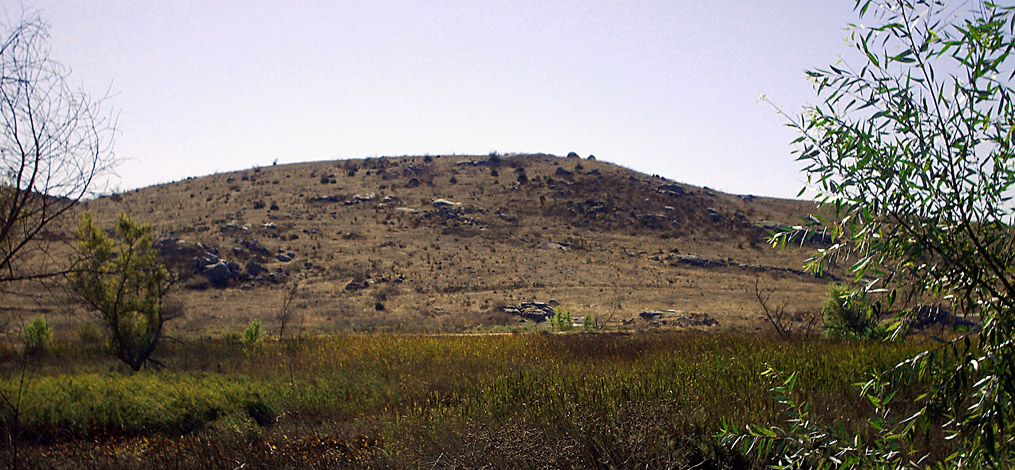
“About 1,500 people attended the Farmers’ Alliance and People’s party Fourth of July celebration and picnic at Turrentine springs, west of town, coming from many miles around,” proclaimed the Escondido Times on July 5, 1894.

The one-paragraph article gave the names of the principal speakers and said they all “made speeches from the standpoint of Populist doctrine.” The proceeds of the picnic would go to the Populist campaign fund and “the lemonade and ice cream stand did a big business.” And that was the extent of its coverage.

The Poway Progress, in its report on the picnic a week later, had a bit more to say, calling the picnic a “great success.” The dispatch, written from Bernardo on July 5, noted that “Some apologies were heard for speaking on ‘politics’ on the 4th, but the general sentiment expressed was that no better day can be chosen for the promulgation of political principles than that day, which commemorates the greatest political event of modern times-the birth of a great, free and independent nation, founded on the principle that ‘all men are created free and equal.’”

That the nation was then in an economic depression was very much on the minds of everyone there, the article reported.

“The spectacle of thousands of workmen idle and starving in the midst of plenty attests to the fact that something is wrong in our civil institutions. Our laws protect and foster gigantic trusts and monopolies while denying protection and safety to the common people. Human life is evidently of less value in the eye of the ‘law’ than money or wealth, the product of human labor.”

The correspondent expressed the hope that the people, “becoming aroused to the true condition of things,” would “man the ‘ship of state,’ and pilot her out of the shoals and quicksands where she has gradually drifted under the management of the old parties….”

“What better or more appropriate themes,” the article concluded, “could engage the attention of rational, thinking, liberty-loving men and women, or what better day could be chosen for their promulgation than the ever glorious 4th?”

Get Updates Automatically-Become A Follower of the San Diego History Seeker

You can get weekly updates of San Diego History Seeker automatically in your email by clicking on the “Follow” button in the lower right corner of the blog page. You’ll then get an email asking you to confirm. Once you confirm you’ll be an active follower.
When “General Store” Really Meant Something

A list of polling places for a county bond election in the San Diego Union in early 1923 gave the polling place for Valley Center as “Shelby’s Store.” They didn’t have to give any more address details, because everyone in Valley Center knew where it was.

For decades, the wooden building at the corner of Valley Center and Old Roads held a general store. And in those days in what was then called the “back country” of San Diego County, the phrase “general store” really meant something. It was the neighborhood grocery store, post office and gas station. For decades, in addition to gas pumps for cars and trucks, there was a separate pump for kerosene, since electricity still wasn’t widespread and a lot of residents still used kerosene lamps.

The place also served as a branch of the county library. As late as the mid-1940s, Valley Center’s only public telephone was located on the porch. A former owner’s son told a reporter in 2001 about having to drive on unpaved roads to deliver phone messages received at the store.

The store was considered, in one owner’s words, the “social hub” of Valley Center. If you’d like to learn more about it, and to see a photo of the place from the 1930s, come to my OASIS class, “San Diego North County-A Look Back,” on Wednesday, July 8 at Cypress Court in Escondido. For more details and to register, see the “About” tab on this blog site.

Sources for this post included historic San Diego newspapers and the book, Once Upon A Time in Valley Center, compiled and published in 1992 by the Valley Center Historical Society.

Get Updates Automatically-Become A Follower of the San Diego History Seeker

You can get weekly updates of San Diego History Seeker automatically in your email by clicking on the “Follow” button in the lower right corner of the blog page. You’ll then get an email asking you to confirm. Once you confirm you’ll be an active follower.

“The Major”

The San Diego Union’s “Local Brevities” column of September 19, 1883 included this item:

“Mr. W. W. Stewart laid on our table yesterday three magnificent clusters of white Muscat grapes, of the raisin variety, grown entirely without irrigation, in the vineyard of Maj. G. F. Merriam, of Apex. Maj. Merriam has one of the finest vineyards in the county. These grapes are in every respect the choices Muscats we have seen this season.”

Gustavus French Merriam served in the Union Army during the Civil War, rising to the rank of major. He would prefer to be addressed as “major” for the rest of his life. That was one of a number of interesting facts about this man. Among others: he was the first European-American settler in what we know today as the Twin Oaks Valley district in San Marcos; that valley and the range of mountains surrounding it owe their names to Merriam.

One more fact about him: he almost didn’t get to grow grapes or to lend his name to anyplace in the area, because he was almost run off his land by a local land baron.

If you’re interested in learning more about that part of the major’s story, you can learn about it by attending my upcoming OASIS talk, “San Diego North County – A Look Back,” Wednesday, July 8 at 3 p.m. at Cypress Court in Escondido. For more information and to register for the talk, visit the website http://www.oasisnet.org/San-Diego-CA/Classes and type the class name or the class number (710) in the “Search” box.

Get Updates Automatically-Become A Follower of the San Diego History Seeker

You can get weekly updates of San Diego History Seeker automatically in your email by clicking on the “Follow” button in the lower right corner of the blog page. You’ll then get an email asking you to confirm. Once you confirm you’ll be an active follower.

100 Years Ago: Real Horsepower Still In Demand

“Allied Army Seeks Horses, Mules in San Diego,” proclaimed the headline in an article on page two of the San Diego Union on Sunday morning, June 6, 1915.

“H. P. McKee, a San Diego horse dealer, received a contract from an agent of the French government to furnish 700 horses and 100 mules for the French army,” began the article, which noted that the contract “calls for good sound horses, five to nine years old, weighing 1,050 to 1,400 pounds and fifteen and a half to sixteen hands high. The horses to be used for cavalry must weigh from 1,050 to 1,200 pounds. Those to be used for artillery are required to weigh 1,200 to 1,400 pounds.”

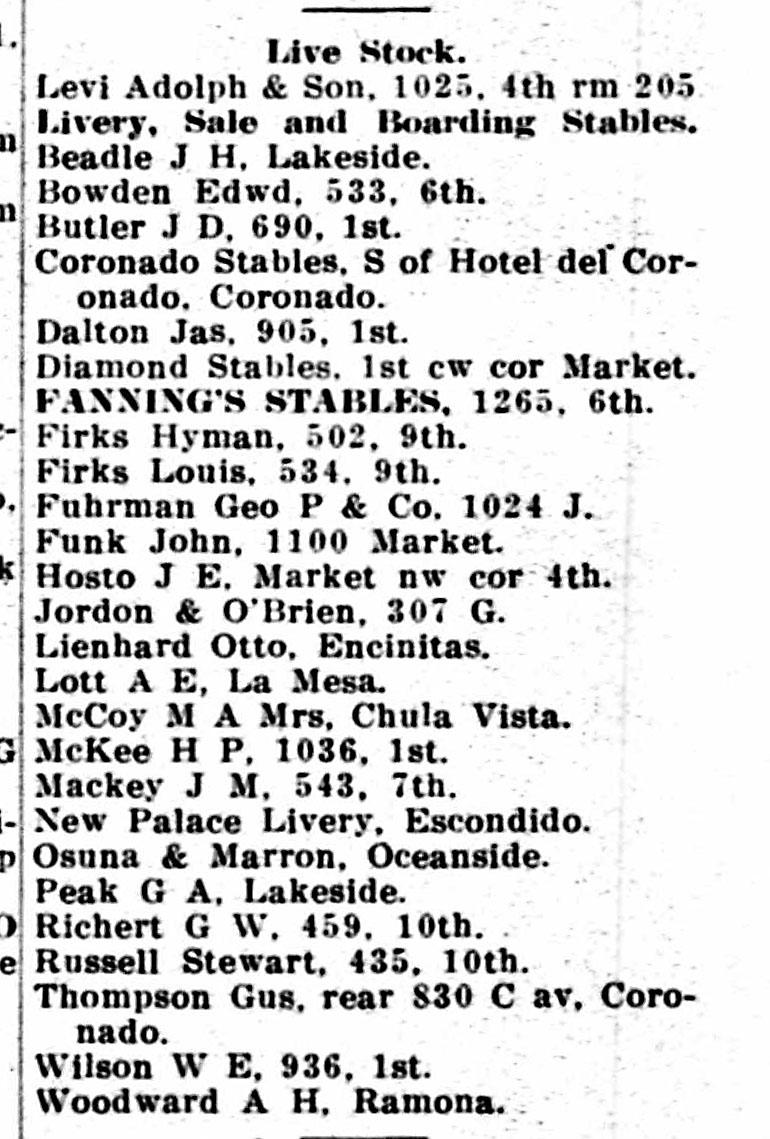
McKee would start immediately on purchasing stock, the article said, and bringing them to “McKee’s barns, 1036 First street, where they will be inspected every Saturday. They will then be sent by train to Galveston and later removed to Newport News for shipping.”

The United States at that point was still a neutral observer of the war then raging in Europe. But clearly France and Britain, who were fighting Germany, considered the US a reliable supplier of material for their military campaigns.

“This is the largest contract for horses for a foreign country ever let for a San Diego dealer,” stated the Union article, which added in closing, “There is said to be a supply of good horses in San Diego county.”

That there was a supply of good horses, or at least stables and horse dealers, in San Diego may be vouched for by this page from the 1915 San Diego City and County Directory. It shows Mr. McKee as being among 26 livery stable owners and horse sellers in the county, 16 of them within San Diego city limits:

McKee page 1915

Sources for this post included historic San Diego newspapers and the San Diego City and County Directory 1915.

Get Updates Automatically-Become A Follower of the San Diego History Seeker

You can get weekly updates of San Diego History Seeker automatically in your email by clicking on the “Follow” button in the lower right corner of the blog page. You’ll then get an email asking you to confirm. Once you confirm you’ll be an active follower.

Immigration: Then and Now?

“This country has taken a step in the right direction to preserve the strain of the pioneer stock that founded this nation and has brought it to its present standard of Americanism.”

That sentence is from an editorial that appeared in the San Diego Union on May 24, 1921. The editorial, entitled “Saving the Race,” praised the passage a few days previously of a bill restricting immigration to “three percent of the existing alien population.” This was the beginning of a quota system of immigration restriction that would be U. S. government policy for the next four decades, but at that point in time it was considered “experimental,” in the words of the editorial. And it was an experiment that the editorial writer obviously approved of.

Citing the research of one Prescott F. Hall, who was described as “a high authority on the subject of the sterilizing effect of incoming low-grade aliens,” the Union bemoaned alleged higher birthrates of “foreign” over “native-born” mothers. But it also claimed that “native-born people who migrate to regions in which the pioneer stock is still dominant show little or no lessening of their former fruitfulness. The real American strain is still paramount west of the Mississippi. It is, therefore, the policy of the West to keep its stock as free as possible from alloy of the American ‘melting pot’ now seething in the great cities along the Atlantic seaboard.”

Does any of this sound familiar? I present it in an attempt to put the question of immigration in some historical perspective. If you are curious about more of that perspective, I invite you to attend the OASIS talk I’m giving on the History of Immigration in the United States on Wednesday, June 17 at 10 a.m. at the Escondido Senior Center. To sign up or find out more visit http://www.oasisnet.org/San-Diego-CA/Classes and type “Immigration” in the “Search” box.