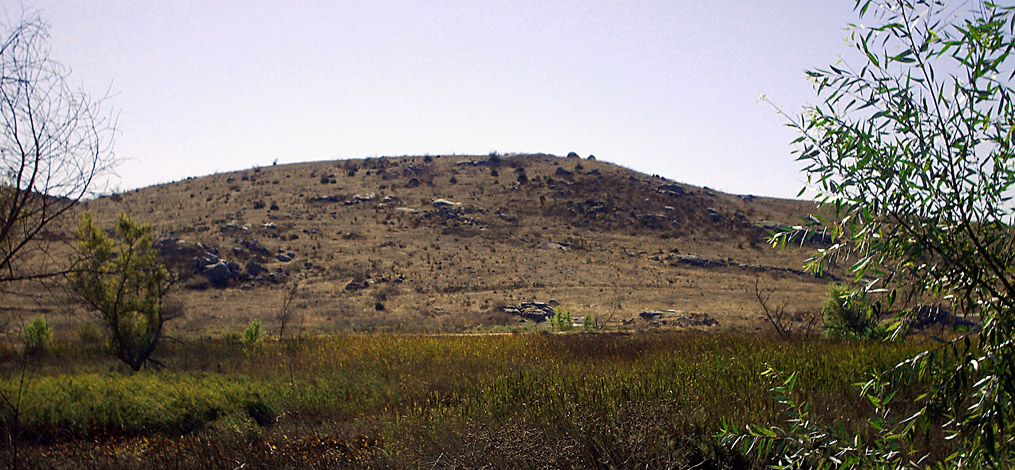
The Wide Open Spaces of Old San Diego County

It may be hard to imagine San Diego County as a sparsely populated rural district. But a good illustration can be found in the following excerpt from a report in the San Diego Union of July 25, 1872 about a meeting the previous day of the county board of supervisors.

Among the items passed by the board that day was this: “Ordered that a new school district, to be known as “Bear Valley School District,” be formed…”

Some readers may recognize “Bear Valley” as the original name of today’s Valley Center. But check out the boundary lines for the Bear Valley district laid out by the supervisors back then: “Commencing at the N. W. corner of Wolfskill’s Ranch, then East to the dividing line between Wolfskill’s and San Bernardo Ranches until the same reaches San Bernardo River, thence up said river through San Pasqual Valley to the mouth of Pama canyon, thence up the canyon to the head of Pama Valley, thence in a westerly course taking in the whole of Smith’s mountain west of said line, thence south to the place of beginning.”

Then and now, that’s a pretty big chunk of real estate. “Wolfskill’s Ranch” is today the city of Escondido, “San Bernardo” is Rancho Bernardo.” The “Pama” refers to Pamo Valley, which is today part of Ramona. And “Smith Mountain” later became Palomar Mountain.

Get Updates Automatically-Become A Follower of the San Diego History Seeker

You can get weekly updates of San Diego History Seeker automatically in your email by clicking on the “Follow” button in the lower right corner of the blog page. You’ll then get an email asking you to confirm. Once you confirm you’ll be an active follower.
 

The Evolution of “Fall Brook”

It’s become a cliché to say that so many San Diegans came from someplace else. That even goes for some of our place names. Here’s one example.

An item in the January 18, 1876 San Diego Union described the rapid growth of “Fall Brook, a beautiful little spot in the upland midway between San Luis Rey and Temecula.” Just a year before, the Union reported, “there were three families and less than twenty persons all told there. Now there are fourteen families and a total population of sixty persons. A school district has been organized and a public school has been taught for some time in a house of one of the settlers.”

By early 1879 there was a separate “Fall Brook Notes” column in the Union, which included this entry: “Mr. C. V. Reche is trying to build up a little town here, He keeps a well stocked store.”

Vital Reche, originally from Canada and later Rochester, New York, had come to California with the Gold Rush and made some money running hotels in San Francisco and San Jose. But in 1867, he and his in-laws were back east, running a coal business in a Pennsylvania town called Fall Brook, named after Fall Creek, a nearby tributary of the Tioga River.

Reche seemed destined to live out his life there when, in 1869, he was diagnosed with cancer. The diagnosis was considered terminal, but his doctor suggested a milder climate might prolong his life.

Reche came to San Diego County and after settling briefly near Pala, he fell in love with some land further to the west down the San Luis Rey River. He homesteaded 160 acres that included a stand of live oak trees and had a creek running through it. Vital chose to name the creek, and later his homestead, after the Pennsylvania creek that had fatefully linked his business and family life: Fall Brook.

His health renewed, Reche was soon growing alfalfa, fruit and honey. He also established a hotel and general store.

Vital would live another 25 years beyond his terminal cancer diagnosis, and the name Fall Brook would be adopted by a school district, post office, and, changed to a single word, the whole surrounding community.

Sources for this post included historic San Diego newspapers and the archives of the Fallbrook Historical Society.

Get Updates Automatically-Become A Follower of the San Diego History Seeker

You can get weekly updates of San Diego History Seeker automatically in your email by clicking on the “Follow” button in the lower right corner of the blog page. You’ll then get an email asking you to confirm. Once you confirm you’ll be an active follower.


The Blacksmith and the Cheese: A Day in San Pasqual Valley, 1879

Henry Fenton owned the Bandy Canyon Ranch in the San Pasqual Valley from the early 1900s until his death in 1951 at the age of 80. He left behind an unfinished memoir, which was incorporated into Henry Fenton: Typical American, a book written and privately published by his sister, Laura, in 1952 and now in the public domain.

Fenton was only eight years old and living in Iowa when his schoolteacher father’s sudden death forced his mother to send her young son to family members in California for support. He arrived in the San Pasqual Valley in 1879 and was immediately put to work as a farmhand on the San Pasqual Valley ranch owned by his uncle, William Thompson.

Young Henry would eventually own that ranch, but that’s a story in itself. For now, a brief anecdote from his memoir offers a snapshot of a day on the farm and young Henry’s interaction with the blacksmith in the nearby farm town of Bernardo.

Fenton arrived on the farm on July 18, 1879, and his first task was to help another young farmhand “bring a mule to the blacksmith for shoeing.” His companion, also a boy, “was trying to lead the mule on horseback,” recalled Fenton, “but the mule wouldn’t lead. The old man [Fenton’s uncle, William Thompson] told me to take a switch and start the mule away from the barn.” Fenton wound up walking along with the mule and rider several miles down to the blacksmith shop in Bernardo.

“We were late getting down there,” Fenton wrote, “and Billy Ober, the blacksmith, had a couple of horses to shoe, so it was noon before he could get started on our mule.”

The young farmhands hadn’t eaten since breakfast, and Fenton remembered that “about 1 p.m. I was feeling pretty empty.”

“The blacksmith gave us 20 cents—two great big dimes,” Fenton wrote, “and sent me over to the store to buy some crackers and cheese.”

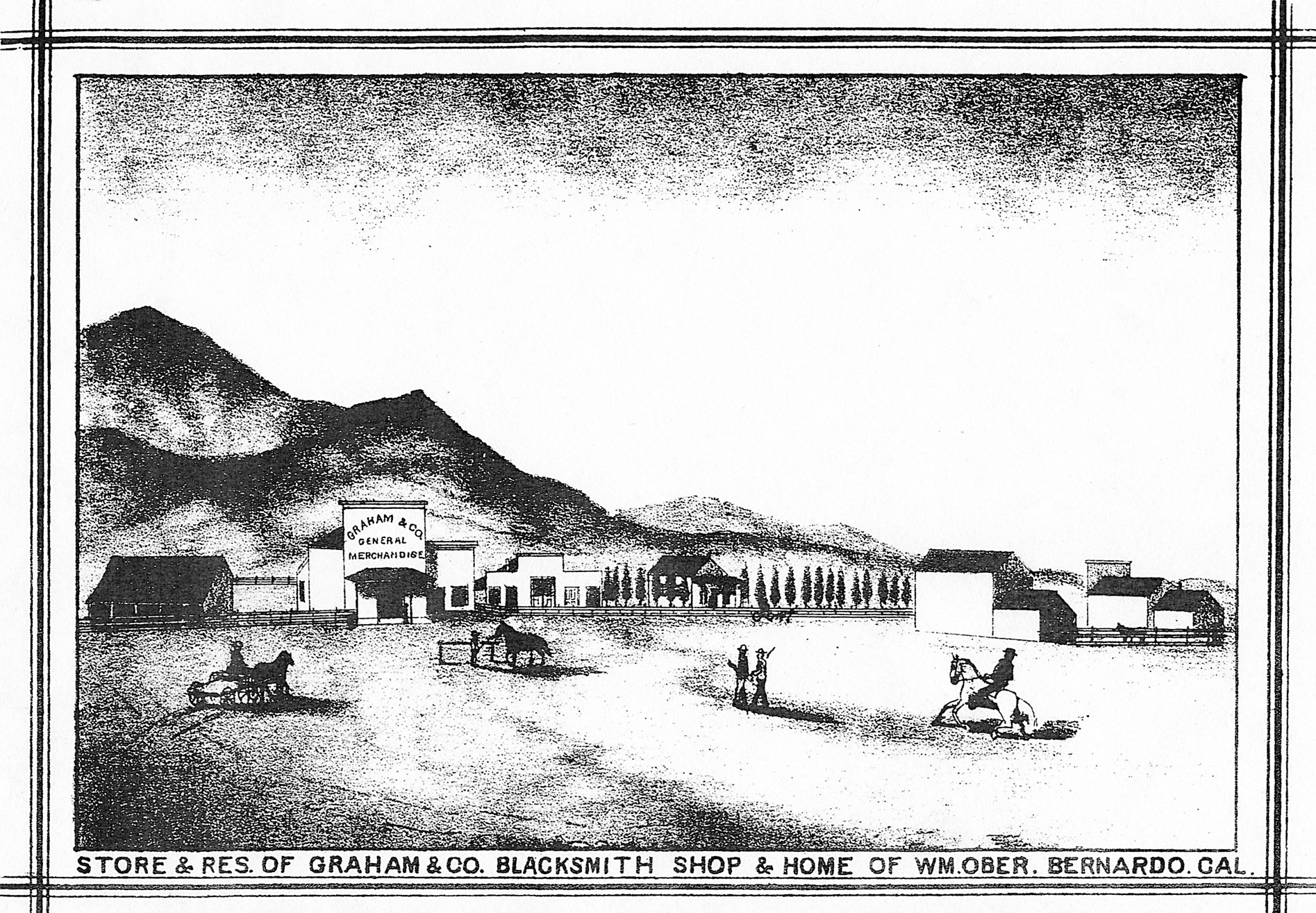
That would have been the Bernardo General Store, which was near Ober’s shop, as seen in this drawing from a late 1870s book on southern California:

Bernardo town sketch

Fenton brought the crackers back to the shop and Billy Ober gave each of the two boys four crackers. He then “laid the cheese on the anvil and took the knife he had been paring the mule shoes with and cut the cheese as near the middle as he could. I remember watching him and hoping he would give me the piece with the curve in it, as it looked larger. And sure enough he did.”

You wouldn’t think the size of his hunk of cheese would have been the first thing he was thinking of, but hey, I guess it was a different time.

Sources for this post included the Fenton book, historic San Diego newspapers, and The Grapevine, newsletter of the Escondido History Center.

Get Updates Automatically-Become A Follower of the San Diego History Seeker

You can get weekly updates of San Diego History Seeker automatically in your email by clicking on the “Follow” button in the lower right corner of the blog page. You’ll then get an email asking you to confirm. Once you confirm you’ll be an active follower.

A New Town in “the San Diego interior”

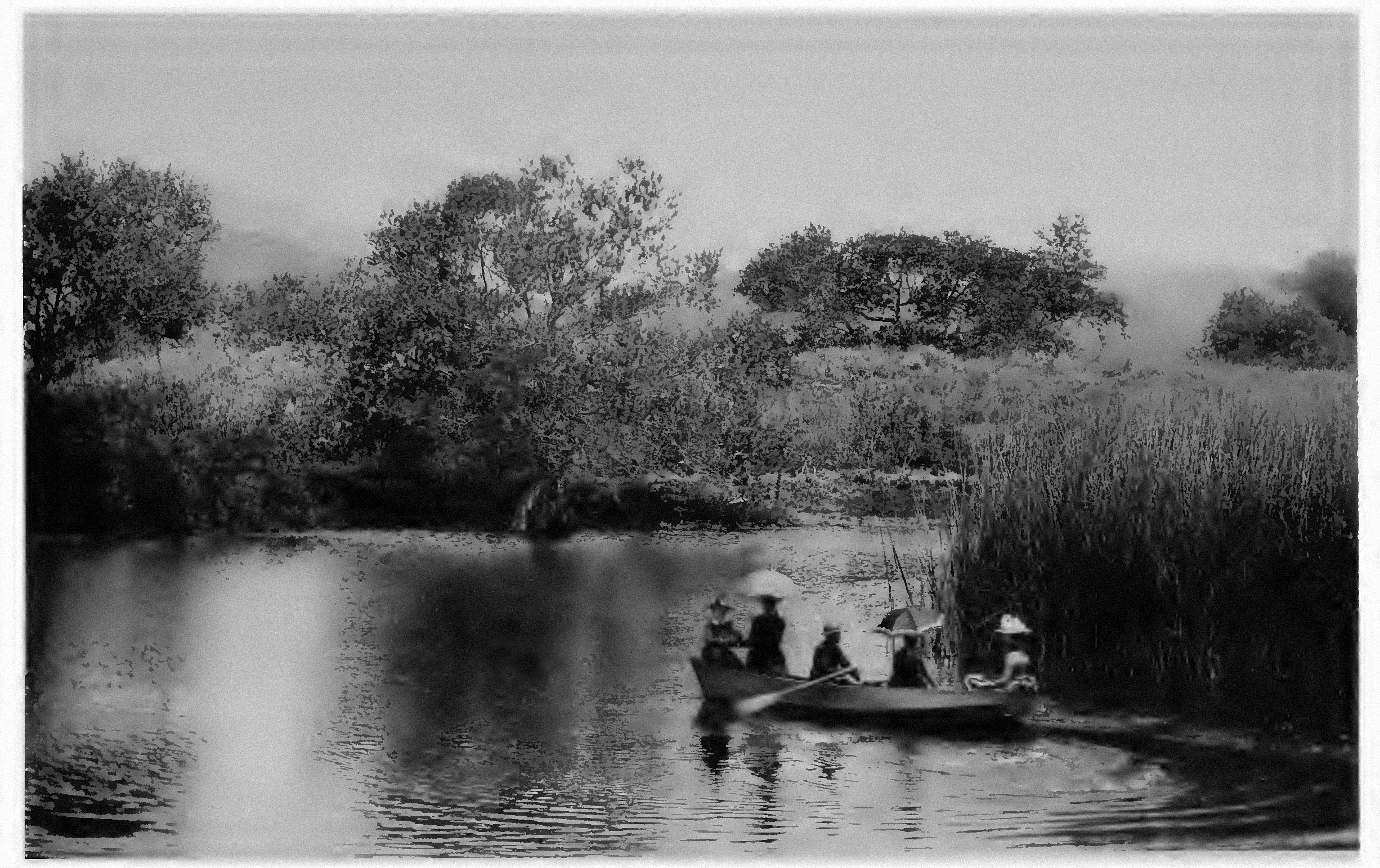
Lindo lake

View of Lindo Lake in 1887 from the book, Picturesque San Diego.

“The New Town of Lakeside” was the headline of a short item on page 3 of the San Diego Union on May 12, 1886.

“Messrs. Merrill & Dexter, managers of El Cajon Valley Company, are pushing the development of the noted Benedict Tract with commendable energy,” the story began. “The beautiful sheet of water upon the tract has been named Lindo Lake.”

The article went on to say that the new townsite “has been laid off upon the lake shore in an eligible part of which a neat hotel is nearly completed. The new mesa road to the Valley will be completed in a short time and this will bring this tract much nearer the city than by the present road.”

Maps of the new development would soon be available to prospective buyers, the article stated. It concluded by saying, “The capacities of this tract of land are second to none in the Valley or indeed in the county. Its soil is very fertile, adapted to every variety of agriculture and horticulture, and does not require irrigation. Lakeside and its environs will undoubtedly be one of the most prosperous and charming settlements in the San Diego interior.”

The “neat hotel” referred to was the Lakeside Inn. The inn and Lindo Lake would make the new town a destination for tourists as well as permanent residents.

A year after the Union article, Douglas Gunn, in his book Picturesque San Diego, saluted Lakeside and the surrounding El Cajon Valley. “It is one of the largest and richest valleys in the County,” wrote Gunn. “Population about 1,000. It is filling up rapidly with the best class of people.”

The book Illustrated History of Southern California, published in 1890, noted that the El Cajon Valley “has long been the largest wheat-producing valley in the county, owing to the exceptionally fine crops yielded in good years and its accessibility to market and export.” In addition to improved surface roads, the railroad had come through with a stop at nearby Foster.

While saluting the wheat crop, that same 1890 book hinted at the shape of things to come: “Experience has proved, however, that more profitable than wheat here is fruit and raisin growing.”

And that was just as of 1890!

Sources for this post included historic San Diego newspapers, the books Picturesque San Diego, and Illustrated History of Southern California, and the website of the Lakeside Historical Society, http://www.lakesidehistory.org/ .

Get Updates Automatically-Become A Follower of the San Diego History Seeker

You can get weekly updates of San Diego History Seeker automatically in your email by clicking on the “Follow” button in the lower right corner of the blog page. You’ll then get an email asking you to confirm. Once you confirm you’ll be an active follower.

From Avocado Fields to Flower Fields

A while back I wrote about Vista billing itself as “Avocado Capital of the World,” (see “Vista’s Rose Parade Moment,” Feb. 2, 2014) while also noting that the title got passed around a lot of San Diego County communities over the years. Here’s an example:

A report in the Dec. 13, 1923 issue of the Oceanside Blade, datelined Carlsbad, stated that “Avocado culture is now [Carlsbad’s] foremost industry and is fast placing vegetables and small fruit growing in the background…”

Earlier that year the Carlsbad Avocado Growers Club had been formed. In October, 1923 the club sponsored the first Avocado Day. Among the day’s events was, according to a local newspaper article, a “seven-course avocado dinner.”

From “Avocado Cocktail” to the desserts of cake and “Ice Cream a la Carlsbad,” all the items were “composed of avocados prepared by Carlsbad ladies, under supervision of Sam Thompson, Chef.” Thompson was one of the original cultivators of avocados in Carlsbad, planting the first groves there in 1916.

Avocado Day would become a regular October event in Carlsbad until the eve of World War II, and avocados would be a major crop in the city until the late 1940s. Then a postwar building boom made it more lucrative to sell the groves for housing rather than for their fruit. But some growers still found crops that proved commercially viable enough to keep working the land. Prominent among them was Luther Gage, a Montebello nurseryman who planted gladioli, freesias, ranunculi and anemones on five acres at Tamarack and Jefferson. This marked Carlsbad’s transition from avocado fields to flower fields.

Sources for this post included historic San Diego County newspapers and the 1994 book, Carlsbad: The Village by the Sea, written by Charles Wesley Orton for the Carlsbad Historical Society.

Get Updates Automatically-Become A Follower of the San Diego History Seeker

You can get weekly updates of San Diego History Seeker automatically in your email by clicking on the “Follow” button in the lower right corner of the blog page. You’ll then get an email asking you to confirm. Once you confirm you’ll be an active follower.